
Best Spark Plug Gapping Tool: 4 Options Compared

The PQY Universal Spark Plug Gap Gapping Tool is the best fit for most people because its adjustable fixture works with common 10mm to 16mm plugs and comes with a 32-blade feeler gauge. Choose a different tool if you need a simple coin-style checker, or only need a gauge for measuring rather than adjusting a gap.
We earn a commission if you buy through links on this page. As an Amazon Associate I earn from qualifying purchases. Products are compared on manufacturer specifications, not hands-on testing.
- Best overall: PQY Adjustable Spark Plug Gapper – An adjustable gapping fixture and 32-blade gauge cover common 10mm, 12mm, 14mm, and 16mm plugs.
- Best for quick checks: CTA Tools 3235 Coin-Style Gapper – The coin-style tool measures gaps from 0.020 to 0.100 inch.
| Product | Best for | Adjustment style | Plug fit | Gauge range | Shop |
|---|---|---|---|---|---|
| PQY Adjustable Spark Plug Gapper | Common plug threads | Adjustable fixture | 10–16mm; not 18mm | 32-blade gauge; range — | Check Price on Amazon |
| CTA Tools 3235 Coin-Style Gapper | Fast gap checks | Coin-style checker | — | 0.020–0.100 in | Check Price on Amazon |
| GEAROLL 32-Blade Adjustable Gapper | Gauge-assisted adjustment | Adjustable fixture | 10–16mm; not 18mm | 32-blade gauge; range — | Check Price on Amazon |
| Toolwiz 32-Blade Adjustable Gapper | Reducing plug gaps | Adjustable fixture | 10–16mm; not 18mm | Tapered gauge; range — | Check Price on Amazon |
Spark plug gapping tools
Match the tool to your plug’s thread and whether you need to adjust the electrode or only measure the gap.
PQY Adjustable Spark Plug Gapper
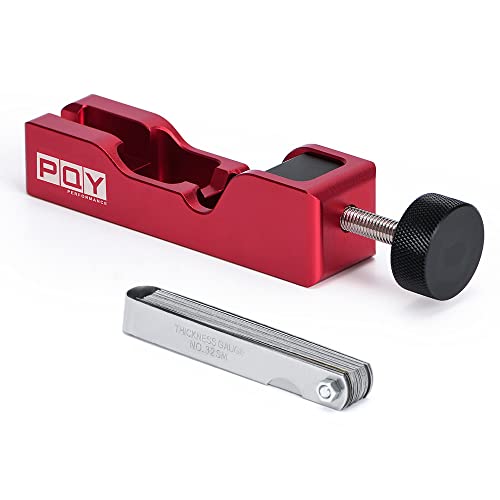
The PQY pairs an adjustable spark plug fixture with a 32-blade feeler gauge, making it a practical choice when you need both to set and check a gap. It fits most standard 10mm, 12mm, 14mm, and 16mm plugs, but not 18mm plugs. The aluminum body uses a knob to move the electrode against the chosen gauge blade. Its adjustment tip accounts for electrode spring-back. The limitation is that the fit claim does not cover long- or short-reach plugs, so verify the plug style as well as thread size.
Bottom line: Choose this if your plug is a common thread size and you want an adjustable fixture with a gauge.
CTA Tools 3235 Coin-Style Gapper

The CTA Tools 3235 is a coin-style gapper, distinct from the fixture-based adjusters in this group. Its 0.020- to 0.100-inch range makes it useful for checking a gap against a quick reference scale. The steel tool is plated, and its flexible construction is intended to be resilient. Unlike a gapping fixture supplied with a feeler gauge, the 3235 does not specify a plug-thread fit or a separate gauge set. Choose it when a compact measurement tool is the priority; buyers wanting controlled electrode adjustment should select an adjustable fixture instead.
Bottom line: Pick this for simple coin-style gap measurement within its range.
GEAROLL 32-Blade Adjustable Gapper
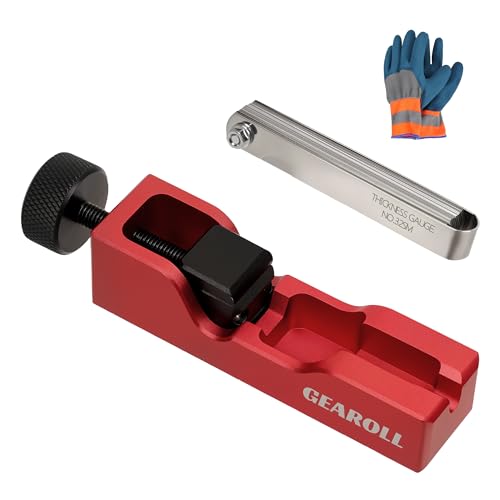
The GEAROLL combines a knob-adjusted fixture with a 32-blade steel feeler gauge and adds a release step: turn the knob slightly backward before removing the plug, then recheck the gap. Its fit covers most standard 10mm, 12mm, 14mm, and 16mm non-preset plugs, excluding 18mm and long- or short-reach plugs. That makes plug style an important fit check.
Bottom line: Choose this if you want an adjustable fixture and a steel gauge for common thread sizes.
Toolwiz 32-Blade Adjustable Gapper
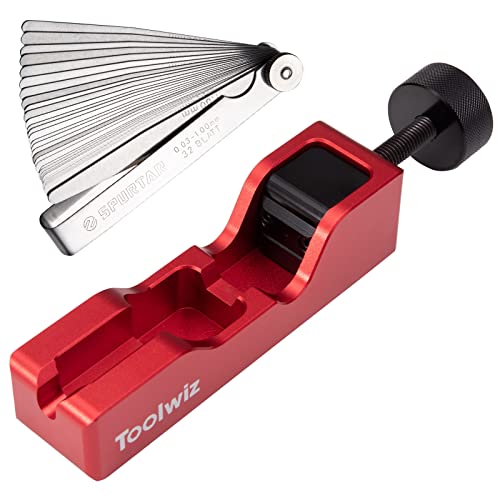
The Toolwiz differs from the other adjustable fixtures by explicitly limiting its adjustment to reducing a gap; it cannot enlarge one. It fits most standard 10mm, 12mm, 14mm, and 16mm plugs, but excludes 18mm and long- or short-reach types. A 32-blade steel feeler gauge is included, and the product also identifies it as a tapered gauge. The maker notes that iridium and platinum plugs usually do not need adjustment. If your plug gap is too small and needs to be opened, choose a different method rather than relying on this tool.
Bottom line: Pick this only when your plug fits and the gap needs to be reduced.
How to choose a spark plug gapping tool
Choose a tool by deciding whether you need to measure a gap, adjust an electrode, or do both. A feeler gauge measures clearance by sliding a blade between the center and ground electrodes; a fixture-style gapper holds the plug while a knob moves the ground electrode. Coin-style tools are quick checkers, while multi-blade gauges offer more measurement choices. Spark plug gaps are commonly specified in thousandths of an inch or hundredths of a millimeter, so use the unit and target in the engine maker’s specification. A measurable rule: if the required gap is outside a tool’s published range, do not use that tool to judge the setting.
| Need | Tool type | Check before choosing |
|---|---|---|
| Measure only | Feeler gauge or coin tool | Range includes target |
| Adjust and measure | Fixture-style gapper with gauge | Plug thread and reach fit |
| Measure angled access | Angled feeler gauge | Blade profile suits access |
Check spark plug thread and reach
Thread diameter alone does not establish plug fit: reach, the distance from the seat to the end of the threaded shell, also matters. Common passenger-car spark plug thread diameters include 10mm, 12mm, 14mm, and 18mm, and reach varies by engine and plug design. A fixture sized for common 10mm to 16mm threads can still be unsuitable for a long- or short-reach plug. Match the exact plug specification before clamping it. If your plug is 18mm or has an unusual reach, do not assume that a tool described as universal will fit; verify the required fit before ordering.
Set the gap without damaging the electrode
Use the gap specified for the engine, not a generic target: many modern plugs are preset for their application, and fine-wire iridium or platinum electrodes can be damaged by careless bending. Measure with a clean blade that slides with light drag; a blade that forces the electrodes apart gives a misleading check. For adjustable tools, turn the knob slowly and remeasure after releasing pressure because some electrodes spring back. Never lever against the center electrode or porcelain insulator. If the plug manufacturer says the gap is preset or not adjustable, avoid changing it unless the application’s service guidance calls for adjustment.
When to use a feeler gauge or coin tool
A feeler gauge is the more useful choice when you need a specific measurement in thousandths of an inch or millimeters; a coin tool is convenient for a quick visual check over its marked range. Tapered coin tools can wedge between electrodes, so avoid forcing them through a narrow gap. Straight or angled feeler blades can reach differently depending on plug orientation and surrounding access. Verify that a gauge’s range includes the target, and use a blade profile that meets the gap without bending the electrode. If the only task is measurement, a separate adjustable fixture adds no necessary function.
Frequently Asked Questions
What gap should I set on a spark plug?
Set the gap specified for your exact engine and plug application; there is no single correct gap for every vehicle. Specifications are often given in thousandths of an inch, so preserve the unit when comparing the target with a gauge.
Can I use a coin tool to adjust a plug gap?
A coin-style tool is primarily a quick measurement tool, and forcing its tapered edge through a gap can bend an electrode. Use a fixture designed for adjustment when a controlled change is needed.
Do iridium spark plugs need gapping?
Many iridium plugs are preset for their application and usually do not need adjustment. Fine-wire electrodes can be damaged by bending, so only change the gap when the plug or engine guidance calls for it.
How do I know whether a gap is too wide?
Compare the measured clearance with the exact engine specification; a blade that passes freely beyond the target indicates a larger gap. Check with light drag and avoid forcing a gauge between electrodes.
Can I gap a spark plug with an 18mm thread?
Some fixture-style tools exclude 18mm plugs even when they fit common smaller threads. Confirm the tool supports both the plug’s thread size and its reach before using it.