
Best Portion Control Plates: 4 Divided Plates Compared

For most people, the Health Beet portion control plate is the clearest pick because its 10-inch surface divides a meal into 50% vegetables, 25% carbohydrates, and 25% protein. Choose VIYNRAN 4-Piece Plate and Bowl Set instead if you want a plate-and-bowl set with measuring lines, or WAYGYMBBD 9-Inch Wheat Straw Plates or Soptalles 2-Pack 9-Inch Plates for multiple 9-inch plates.
We earn a commission if you buy through links on this page. As an Amazon Associate I earn from qualifying purchases. Products are compared on manufacturer specifications, not hands-on testing.
- Best overall: Health Beet 10-Inch Portion Control Plate – Its 10-inch plate labels a half portion for vegetables and quarter portions for carbs and protein.
- Best for plate-and-bowl sets: VIYNRAN 4-Piece Plate and Bowl Set – The set includes four pieces and a 1.5-cup bowl, plus measuring lines.
- Best for wheat-straw material: WAYGYMBBD 9-Inch Wheat Straw Plates – The five 9-inch plates are made from wheat straw material and are microwave- and dishwasher-safe.
- Best for two-color sets: Soptalles 2-Pack 9-Inch Plates – The two 9-inch plates come in blue and green and are microwave- and dishwasher-safe.
| Product | Best for | Diameter | Pieces | Material | Shop |
|---|---|---|---|---|---|
| Health Beet 10-Inch Portion Control Plate | Visual meal portions | 10 in | 1 | — | Check Price on Amazon |
| VIYNRAN 4-Piece Plate and Bowl Set | Measured plate-and-bowl | 9 in | 4 | — | Check Price on Amazon |
| WAYGYMBBD 9-Inch Wheat Straw Plates | Multi-plate wheat straw | 9 in | 5 | Wheat straw | Check Price on Amazon |
| Soptalles 2-Pack 9-Inch Plates | Two-color pair | 9 in | 2 | Food-grade PP | Check Price on Amazon |
Portion Control Plates Compared
Compare the plate sizes, set contents, and materials to choose a divided dish that suits your meals and cleanup routine.
Health Beet 10-Inch Portion Control Plate

The Health Beet plate stands apart with its 50/25/25 layout: half for vegetables, one quarter for carbohydrates, and one quarter for protein. Its 10-inch diameter gives the meal sections a little more room than the 9-inch options here. The single white plate is designed for adults, teens, and kids, and is microwave- and dishwasher-safe. Choose it if a visual split is more useful than measuring lines or multiple plates. The tradeoff is that it is sold as a single plate, so it may not suit a household that wants matching portions for several diners.
Bottom line: Pick this if you want one plate with a clearly labeled half-and-quarter meal layout.
VIYNRAN 4-Piece Plate and Bowl Set

The VIYNRAN set is the only option here that pairs divided plates with bowls and measuring lines. It includes four pieces, with 9-inch plates and a 1.5-cup bowl; the product also gives the bowl dimensions as 5.3 by 2.5 inches. Three plate sections separate protein, carbohydrates, and fruits or vegetables. That combination suits someone who wants to portion both plated foods and bowl servings rather than buy plates alone.
Bottom line: Choose this if you want measuring lines and a bowl as well as divided plates.
WAYGYMBBD 9-Inch Wheat Straw Plates

The WAYGYMBBD set provides five 9-inch divided plates, more plates than the two-piece set here. Each round plate has three compartments, and the material is wheat straw. The plates are described as BPA-free and microwave- and dishwasher-safe, making this a fit for buyers who want several reusable plates with those care features. The maker also gives a plate height of 0.78 inch. These are plates only, not a plate-and-bowl set; choose another option if you want bowl portions or printed measuring lines alongside the divisions.
Bottom line: Pick this for five 9-inch plates made from wheat straw material.
Soptalles 2-Pack 9-Inch Plates
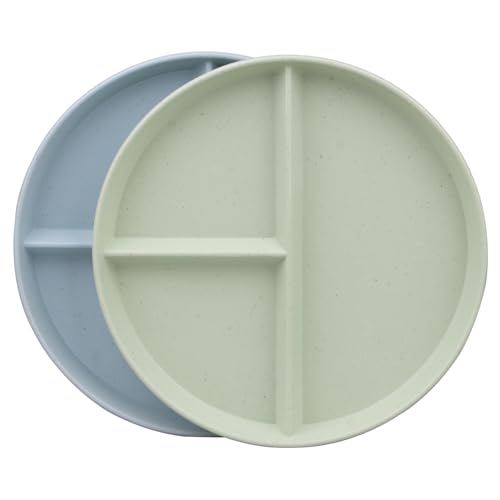
The Soptalles option is a two-plate set in blue and green, a simple fit for someone who wants a pair rather than a larger pack. Each 9-inch plate has three compartments and is made of food-grade polypropylene (PP). The plates are reusable and described as microwave- and dishwasher-safe, with resistance to breakage and chipping. Their 0.7-inch height is slightly lower than the 9-inch WAYGYMBBD plates. This set has fewer pieces than the other multi-plate choices, so it is less suited to households that need several place settings at once.
Bottom line: Choose this if a blue-and-green pair of reusable PP plates meets your needs.
How to Choose a Portion Control Plate
Start with the meal pattern you want the plate to make easy: divided plates separate food groups, while measuring lines add visual serving cues. A common balanced-plate approach fills about half the plate with nonstarchy vegetables, then gives roughly one quarter each to protein and grain or another carbohydrate. A three-section shape does not guarantee those proportions; check the relative compartment sizes if the half-vegetable layout matters to you. For matching that pattern, favor a plate that explicitly marks a half section, such as Health Beet 10-Inch Portion Control Plate. If you mainly need a reminder to separate foods, a three-compartment plate may be enough. For precise servings, use a measuring cup or kitchen scale; plate divisions are visual guides, not weight measurements.
Choosing a Plate Diameter
Plate diameter changes how much food fits, but it does not set a serving size by itself. These choices range from 9 to 10 inches; the 10-inch option provides more surface area, while the 9-inch options are more compact. Measure a familiar dinner plate before choosing: if you want the new dish to take up less table or cabinet space, select a 9-inch model. Keep in mind that a smaller plate still needs appropriately sized food portions. Compartment shape also matters: a wide vegetable section is easier to fill with bulky produce than a narrow one. Bowl capacity is a separate measurement, so check the cup capacity when selecting a set that includes bowls.
Divided Plates and Portion Containers
Divided plates and portion containers solve different meal-planning problems. A plate separates foods at serving time, while a pre-measured container system assigns foods to separate containers for portioning or packing. Three compartments are useful when a meal naturally includes several food groups; measuring lines are more helpful when you want additional visual cues on the plate or bowl. The practical choice is to match the tool to the meal: use a divided plate for a plated dinner, and choose containers when separately packing foods is the priority. Materials and care features also differ among plates, so compare those before settling on a set. A divided plate cannot measure the weight or calorie content of the food placed in each section.
| Need | Useful format | What to compare |
|---|---|---|
| Separate foods on a meal plate | Three-compartment plate | Diameter and section proportions |
| Visual serving cues | Plate with measuring lines or labeled sections | Which foods each section represents |
| Pack foods separately | Portion containers | Container capacities and food plan |
Using and Caring for Portion Plates
Use the compartments as a serving guide, then adjust for the meal and your own dietary needs rather than treating the dividers as a measurement. Plate-method guidance commonly gives nonstarchy vegetables about half the plate, with protein and carbohydrate foods taking roughly one quarter each. Starchy vegetables count differently from nonstarchy vegetables in many meal plans, so a potato does not automatically belong in the vegetable half. For heat and cleanup, rely on the product’s microwave and dishwasher compatibility; the options differ, and not every product includes the same care claims. Avoid assuming that a plate is oven-safe or safe for unusually high heat based only on microwave compatibility. Follow safe food handling separately: keep raw meat and its juices away from ready-to-eat foods.
Frequently Asked Questions
Do portion control plates measure food accurately?
No; plate sections are visual guides, not scales or volume measures. Use a measuring cup or kitchen scale when a recipe or nutrition plan calls for a precise amount.
What foods go in each plate section?
A common layout puts nonstarchy vegetables in about half the plate, with protein and carbohydrate foods in roughly one quarter each. A potato or other starchy vegetable is generally counted with carbohydrate foods in this approach.
Does a smaller plate reduce serving size automatically?
No; a 9-inch plate holds less surface area than a 10-inch plate, but portion size depends on how much food is served. Use the compartments and serving guidance that fit the meal.
Can portion control plates go in the microwave?
Some plates are described as microwave-safe, but that claim does not establish oven safety or a specific maximum heating time. Check the product’s care directions before heating food.
Are divided plates suitable for children?
Several divided plates are marketed for adults and children, but a plate does not determine a child’s nutritional needs or serving size. Keep hot food and heated dishes out of reach until safe to handle.