
Pond Leak Detection Dye: 4 Tracers Compared

Green Tracing Dye, 1 Gallon is a practical starting point for pond leak tracing because its maker says one gallon treats up to 12,000 gallons and identifies it as fluorescent green dye. Choose a different option if you want a smaller 64-ounce bottle, explicit UV visibility, or red tracer dye.
Water tracing dye is a colored tracer added near a suspected leak to see whether water carries it toward the leak path.
We earn a commission if you buy through links on this page. As an Amazon Associate I earn from qualifying purchases. Products are compared on manufacturer specifications, not hands-on testing.
- Best overall: Green Tracing Dye, 1 Gallon – Its maker says the fluorescent concentrate treats up to 12,000 gallons of water.
- Best for UV tracing: Green Gobbler Water Tracing Dye, 1 Gallon – The maker says the green dye can be traced more accurately under ultraviolet light.
- Best for smaller volume: Green Water Tracing Dye, 64 oz – The 64-ounce bottle is rated to treat more than 6,000 gallons.
| Product | Best for | Bottle size | Coverage claim | Color | Shop |
|---|---|---|---|---|---|
| Green Tracing Dye, 1 Gallon | Large water volumes | 1 gallon | Up to 12,000 gallons | Green fluorescent | Check Price on Amazon |
| Green Gobbler Water Tracing Dye, 1 Gallon | UV visibility | 1 gallon | — | Green | Check Price on Amazon |
| Concentrated Red Tracer Dye, 1 Gallon | Red tracer option | 1 gallon | Up to 12,000 gallons | — | Check Price on Amazon |
| Green Water Tracing Dye, 64 oz | Smaller bottle | 64 ounces | 6,000+ gallons | Neon green | Check Price on Amazon |
Pond Leak Detection Dye Options
Compare the dye color, bottle size and stated treatment coverage before selecting a tracer for your pond.
Green Tracing Dye, 1 Gallon

Green Tracing Dye, 1 Gallon is distinguished by its capacity to treat up to 12,000 gallons in one gallon of fluorescent green concentrate. The maker describes it for water tracing and leak detection, as well as septic analysis, flow mapping, pollution studies and plumbing tracing. That broad use makes it a sensible option when a pond is part of a larger water tracing job. The product weighs 9 pounds.
Bottom line: Choose this if you need a fluorescent green tracer for a large water volume.
Green Gobbler Water Tracing Dye, 1 Gallon
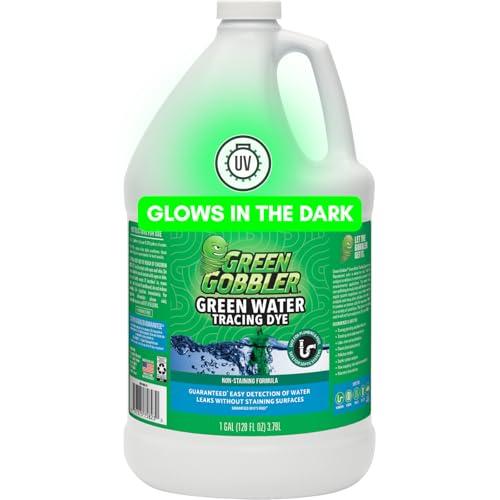
Green Gobbler Water Tracing Dye, 1 Gallon stands out for its explicit ultraviolet tracing option: the maker says its bright green dye can be traced more accurately under UV light or measured with a fluorometer. The gallon-size concentrate is also intended for leak tracing, overflow analysis, discharge testing and flow studies. Its non-staining claim may matter around hard pond edges and clothing, though the maker qualifies that the dye washes from virtually any surface or fabric. The bottle dimensions are 11.42 by 8.82 by 5.98 inches. Unlike other choices here, no treatment volume is given, so it is harder to estimate coverage in advance.
Bottom line: Choose this when UV tracing or fluorometer measurement is part of your plan.
Concentrated Red Tracer Dye, 1 Gallon

Concentrated Red Tracer Dye, 1 Gallon is the red-tracer option among these concentrates, and its maker says the high concentration produces a sharp color and treats up to 12,000 gallons of water. It is also described for flow mapping, septic analysis, pollution studies and plumbing tracing, so the product is not limited to ponds. A one-gallon container gives it the same treatment volume as another option here, while the contrasting tracer color may be useful where green is difficult to distinguish from the surroundings. The color field conflicts with the red product name, so verify the dye color before ordering if hue is essential.
Bottom line: Choose this if a red tracer is preferable and you confirm the color first.
Green Water Tracing Dye, 64 oz

Green Water Tracing Dye, 64 oz is the smaller-bottle choice: its 64-ounce concentrate is rated for more than 6,000 gallons, with a dose of 1 ounce per 100 gallons. Its neon green formula is described as visible in daylight and glowing under UV light, and the maker identifies pond-related pool leak detection alongside household plumbing, drains and septic use. The 1-ounce rate gives a concrete starting point for calculating a measured water treatment, unlike the other products here. The limitation is scale: the treatment volume is lower than the up-to-12,000-gallon claims on two gallon-size concentrates.
Bottom line: Choose this if a 64-ounce bottle and stated dosing rate suit your job.
How to Choose Pond Leak Detection Dye
Choose a dye you can distinguish against the pond water and its bottom; green fluorescence is offered by three options here, while one is named as a red tracer. UV visibility can help when daylight is limited, but the UV claim applies only to the products that expressly identify that feature. Match the container and treatment claim to the water volume you intend to trace: the coverage spans 6,000+ to 12,000 gallons, while one gallon-size option gives no coverage figure. For a pond under 6,000 gallons, the 64-ounce product’s rate of 1 ounce per 100 gallons provides a measurable starting point; do not transfer that dose to a different concentrate.
How to Trace a Suspected Pond Leak
Apply tracer near the suspected leak path and watch whether the colored plume moves toward a specific point; a dye trail is most useful in relatively still water. Wind, circulation equipment and inflow can move dye away from the suspected path, so pause artificial circulation and observe the water before drawing a conclusion. A separate bucket comparison can help distinguish leakage from evaporation: place a marked bucket of pond water beside the pond, record both levels, and compare after 24 hours. If both levels fall similarly, evaporation may explain much of the loss; a larger pond drop points toward leakage or another water-loss route. Never use a treatment rate from one concentrate as a universal pond dose.
Coverage and Dye Visibility
Coverage figures are not interchangeable: two gallon-size concentrates claim up to 12,000 gallons, the 64-ounce green concentrate claims 6,000+ gallons, and the remaining gallon product gives no treatment volume. One US gallon contains 128 fluid ounces, so the smaller bottle is half a gallon; at the 1-ounce-per-100-gallon rate, 64 ounces corresponds to 6,400 gallons. Green fluorescence is explicitly offered by several options, and two products identify UV visibility. Keep the dye dose controlled and observe the color near the suspected route, because a large dose can color a much wider area and make a narrow trail harder to interpret.
| Tracing need | Useful product attribute | Decision |
|---|---|---|
| Measured dose for a smaller pond | 1 oz per 100 gallons; 64 oz bottle | Use the product with that stated rate |
| Low-light tracing | UV visibility claim | Select an option that expressly supports UV tracing |
| Large treatment volume | Up to 12,000 gallons claimed | Compare the two gallon-size coverage claims |
Common Pond Dye Testing Mistakes
A dye test can mislead when water movement is ignored: pumps, inflows and wind-driven surface movement can carry a plume away from a leak. Test in a calm period, note the suspected location first, and watch the dye close to that route rather than judging only the pond’s overall color. Another mistake is treating a coverage claim as a guaranteed dose for every pond; the 1-ounce-per-100-gallon rate belongs only to the product that states it. Avoid adding concentrate near animals or sensitive plants without checking compatibility, and keep concentrated dye away from eyes and out of reach of children. If the dye color matters against a dark or vegetated pond bottom, confirm that hue before use.
Frequently Asked Questions
How much pond tracing dye should I use?
The green 64-ounce product specifies 1 ounce per 100 gallons, which equals 6,400 gallons at the full bottle.
Can pond leak dye work in daylight?
Yes, the green dye products include high-visibility or daylight visibility claims. Sunlight, water color and bottom vegetation affect how clearly a narrow plume stands out, so look near the suspected route rather than across the whole pond.
Does UV light help find pond leaks?
UV illumination can improve tracing for products whose makers specify UV visibility. Two options here identify UV tracing, while a fluorometer is also mentioned for one green concentrate; neither tool changes the need to observe water movement.
How can I tell a pond leak from evaporation?
Compare pond-level change with a marked bucket of pond water placed beside it over 24 hours. A pond drop greater than the bucket’s drop suggests an additional loss such as leakage, though inflow or overflow can also affect the result.
Will fluorescent dye stain a pond edge?
One green product is described by its maker as non-staining and washable from virtually any surface or fabric, and another calls itself non-staining when diluted. Test a small inconspicuous area first if the edge material is important.