
Best Container to Store Milk in Fridge: 3 Picks

DHSBTLS 32 oz Glass Milk Bottles suits most households because its four 32-ounce glass bottles let you divide milk into smaller containers. Choose Ritayedet 64 oz Glass Milk Bottles instead if you want fewer, larger jugs with handles; a milk container is a sealed vessel for storing milk, while a storage bin only organizes bags or bottles.
Keep milk at 40°F or below, preferably toward the back of the refrigerator rather than in the warmer door.
We earn a commission if you buy through links on this page. As an Amazon Associate I earn from qualifying purchases. Products are compared on manufacturer specifications, not hands-on testing.
- Best overall: DHSBTLS 32 oz Glass Milk Bottles – Four 32-ounce glass bottles divide milk into manageable portions.
- Best for larger batches: Ritayedet 64 oz Glass Milk Bottles – Two 64-ounce jugs have carry handles and measurement scales.
- Best for one bottle: Stock Your Home 32 oz Glass Milk Bottle – A single 32-ounce glass bottle has a dishwasher-safe body.
| Product | Best for | Capacity per bottle | Bottle count | Shop |
|---|---|---|---|---|
| DHSBTLS 32 oz Glass Milk Bottles | Portioning milk | 32 oz | 4 | Check Price on Amazon |
| Ritayedet 64 oz Glass Milk Bottles | Large batches | 64 oz | 2 | Check Price on Amazon |
| Stock Your Home 32 oz Glass Milk Bottle | Single bottle | 32 oz | 1 | Check Price on Amazon |
Milk containers for the fridge
Compare bottle capacity and pack size, then choose a container that fits your shelf and pouring routine.
DHSBTLS 32 oz Glass Milk Bottles
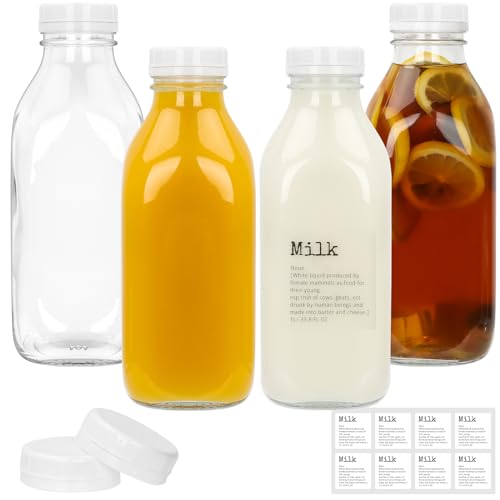
Four separate 32-ounce bottles make this set the practical choice when you want to divide a larger amount of milk across containers. The clear glass bottles have screw-seal lids and safety rings, and the set includes six lids and stickers. The wide mouths make filling and pouring easier, and the bottles can also hold other beverages.
Choose this set if multiple smaller bottles fit your refrigerator routine better than a pair of large jugs. The bottles are glass, so handle them carefully and leave room around them to avoid knocks; the specifications do not give a bottle-by-bottle footprint.
Bottom line: Choose this set if you prefer several smaller bottles over one large jug.
Ritayedet 64 oz Glass Milk Bottles

Two 64-ounce jugs offer the largest capacity per bottle among the milk containers here. Each has a carry handle, a silicone-gasket screw cap, a silicone spout, and scales marked in quarts and fluid ounces. The maker describes the cap as airtight and watertight.
This pair suits households that want to transfer larger amounts into fewer vessels and appreciate measuring marks.
Bottom line: Pick these if large-capacity jugs and built-in measurement marks matter most.
Stock Your Home 32 oz Glass Milk Bottle

A single 32-ounce bottle is the simplest option for replacing one small milk container rather than buying a multi-bottle set. Its clear glass body is dishwasher-safe and resistant to stains and odors, according to the maker; the three included white caps are not dishwasher-safe. The bottle also works for other liquids.
Choose this bottle if you want one reusable vessel and are comfortable washing the caps separately. Its compact capacity may mean more refills than the 64-ounce jugs, so it is less suited to storing a large batch in one container.
Bottom line: Choose this bottle for a single reusable 32-ounce container.
How to choose a fridge milk container
Choose a container by capacity, opening style, and how much refrigerator space you can spare. A quart is 32 fluid ounces, so a 32-ounce bottle holds one quart and a 64-ounce jug holds two quarts. Smaller containers can be easier to handle and leave less milk in a partly used vessel; larger ones mean fewer containers to fill and wash.
Glass does not retain odors as readily as some plastics, but it is heavier and can break if dropped. A screw cap with a gasket can help contain spills, while a handle or spout can make pouring more controlled. For most refrigerators, measure shelf height and depth before choosing a jug; if a bottle is taller than the available clearance, it will not fit upright.
Safe refrigerator storage for milk
Keep milk at 40°F or colder, because bacteria can grow more quickly above that temperature. The back of a refrigerator is generally colder and steadier than the door, where repeated opening exposes containers to warmer air. A refrigerator thermometer helps verify the actual temperature rather than relying only on the dial.
Return milk to refrigeration promptly after pouring, and avoid leaving it at room temperature for more than two hours—or one hour when the room is above 90°F. Wash reusable bottles and lids between refills, and use clean hands and utensils when transferring milk. A bottle’s seal helps limit spills and odors, but it does not make milk safe if it has been held too warm.
Milk bottle sizes and storage fit
Use bottle capacity to plan both portions and shelf space: 32 ounces equals one quart, while 64 ounces equals two quarts. A tall bottle can use less shelf width but needs sufficient vertical clearance; a wide or handled jug may need more room side to side. Measure the refrigerator shelf before choosing, especially when the bottle will sit upright.
For a compact refrigerator, compare the container’s height and width with the clear shelf area, not the exterior dimensions alone. Leave enough room to grip and remove the bottle without striking nearby glass. The table gives a simple capacity-to-use guide; it does not replace checking your refrigerator’s measurements.
| Capacity | Useful when |
|---|---|
| 32 oz (1 quart) | You want a smaller bottle or separate portions |
| 64 oz (2 quarts) | You prefer fewer, larger containers |
Cleaning reusable milk bottles
Wash a reusable milk bottle after each emptying before filling it again. Milk residue can remain around threads, gaskets, and spouts, so disassemble removable parts when the design allows and clean each surface with warm water and dish soap. Rinse thoroughly and let parts dry completely before reassembly.
Dishwasher compatibility can differ between a bottle and its lid: check each component’s care directions rather than assuming the entire set is dishwasher-safe. Glass handles heat better than many plastics, but it can chip or crack after impact or sudden temperature changes. Do not pour very hot liquid into a cold glass bottle, and discard a bottle with a crack or chipped rim.
Frequently Asked Questions
What temperature should a refrigerator be for milk?
Keep the refrigerator at 40°F or colder. A separate refrigerator thermometer can confirm the temperature, especially if the appliance setting is unclear.
Is the refrigerator door a good place for milk?
The back of a refrigerator is generally a steadier, colder place than the door. Frequent door opening exposes milk to warmer air, so store it on an interior shelf when possible.
How long can milk sit out after pouring?
Refrigerate milk within two hours at typical room temperatures. If the room is above 90°F, the limit is one hour.
Can glass milk bottles go in the dishwasher?
Some glass bottles are dishwasher-safe, but caps, gaskets, and spouts may have different care requirements. Check each component’s directions, and avoid sudden temperature changes that can crack glass.