
Diesel Compression Test Kits: 4 Tool Sets Compared

The Wzyblixo kit suits buyers who want both compression and cylinder leak-down testing in one set, with adapters for diesel and gasoline engines. Choose a compression-only kit instead if you do not need leak-rate readings or the extra diagnostic hardware.
We earn a commission if you buy through links on this page. As an Amazon Associate I earn from qualifying purchases. Products are compared on manufacturer specifications, not hands-on testing.
- Best overall: Wzyblixo 46-Piece Compression & Leak Test Kit – Combines diesel compression measurement with a dual-head leak detector and adapters for several engine types.
- Best for broad pressure range: Bicos Diesel Compression Tester Kit – Includes a 0–1,000 psi gauge, flexible hose, release valve, and 13 glow-plug and injector adapters.
- Best for combined diagnostics: OMT 51-Piece Compression & Leakage Tester – Adds dual-gauge leak-down readings and lists compression measurement up to 700 psi.
- Best for specified adapters: DAYUAN 17-Piece Diesel Compression Tester – Provides four injector adapters with thread and length specifications, plus nine glow-plug adapters.
| Product | Best for | Pressure range | Adapter count | Leak-down testing | Shop |
|---|---|---|---|---|---|
| Wzyblixo 46-Piece Compression & Leak Test Kit | Combined testing | — | 46 pieces | Yes | Check Price on Amazon |
| Bicos Diesel Compression Tester Kit | Cars and trucks | 0–1,000 psi | 13 adapters | No | Check Price on Amazon |
| OMT 51-Piece Compression & Leakage Tester | Leak diagnosis | Up to 700 psi | 51 pieces | Yes | Check Price on Amazon |
| DAYUAN 17-Piece Diesel Compression Tester | Adapter specifics | 0–1,000 psi | 13 adapters | No | Check Price on Amazon |
Diesel Compression Test Kits Compared
Compare the pressure range, adapter coverage, and diagnostic functions before choosing a kit.
Wzyblixo 46-Piece Compression & Leak Test Kit

The Wzyblixo set stands out by combining compression measurement with cylinder leak-down testing, unlike the compression-only options here. It includes a diesel pressure gauge, dual-head leak detector, and assorted glow-plug, injector, and spark-plug adapters. The maker says it supports diesel and gasoline engines, including HDi, TDCi, and PD types, as well as cars, trucks, buses, agricultural machinery, and marine engines. This kit suits someone who wants both diagnostic methods in one set. The product name gives a 46-piece count, but the maker does not give a pressure range, so buyers who need a particular maximum reading should confirm that before ordering.
Bottom line: Choose this if you want compression and leak-down testing in one kit.
Bicos Diesel Compression Tester Kit

The Bicos kit is a diesel-focused compression tester with a clearly given 0–1,000 psi gauge range; unlike the combined kits, its features center on compression readings rather than leak-down diagnosis. Its gauge has a release valve and flexible hose, and the set includes nine glow-plug adapters and four injector adapters. The maker says it is intended for varied diesel vehicles, including cars, trucks, and tractors. That adapter selection suits buyers who need several common connection options.
Bottom line: Pick this for a diesel compression tester with a 1,000 psi range.
OMT 51-Piece Compression & Leakage Tester

The OMT set is distinguished by simultaneous dual-gauge leak-down readings: its gauges show compression from 0–100 psi and leakage from 0–100%, while the maker gives a separate compression measurement capacity of up to 700 psi. It includes adapters, hoses, and quick couplers, and the maker says it fits modern HDi, TDCi, and PD engines. The dual readings can help a mechanic distinguish compression testing from leak-rate diagnosis in one kit. This is a fit for buyers who prioritize leak-down troubleshooting alongside compression measurement. Its maximum is lower than the 1,000 psi ranges given for two other kits, which matters if the engine procedure calls for readings above 700 psi.
Bottom line: Choose this when dual-gauge leak-down readings are a priority.
DAYUAN 17-Piece Diesel Compression Tester
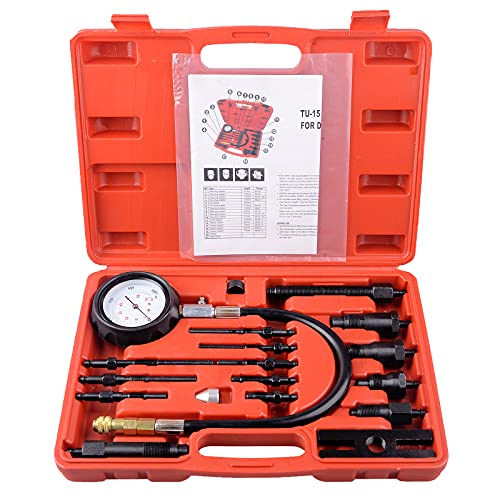
The DAYUAN set differentiates itself with four injector-adapter thread and length specifications, useful when matching a tester to a known port. It has a 0–1,000 psi gauge, a 14-inch tube, nine glow-plug adapters, and four injector adapters; the maker says it can identify worn valves and piston rings in most diesel cars, trucks, and tractors. This compression-only set suits buyers who want the adapter dimensions called out before selecting a connection. It does not include the leak-down function offered by the combined kits, so choose another type if checking leakage percentages is part of the job.
Bottom line: Pick this when the injector-adapter dimensions match your engine.
How to Choose a Diesel Compression Tester
Choose a tester by matching its pressure range and adapter connections to the engine’s service procedure. Diesel compression readings are substantially higher than gasoline-engine readings, so use a diesel-rated gauge and do not assume a gasoline-only tester is suitable. Adapter fit is equally important: glow-plug and injector ports use different threads and lengths, and the wrong adapter can damage threads or fail to seal. A useful decision rule is to select a kit whose maximum gauge range exceeds the engine’s specified test pressure, while remaining within the adapter type required by the procedure. Compression-only kits measure cylinder pressure; leak-down kits add regulated air and a leakage reading to help locate where pressure escapes.
How to Compare Cylinder Readings
Compare cylinders under the same test conditions rather than treating one universal pressure number as correct for every diesel engine. Engine design, temperature, cranking speed, altitude, and gauge setup affect readings, so use the manufacturer’s service limit for the specific engine. As a screening rule of thumb, a spread greater than about 10 percent between cylinders deserves investigation, but that is not a replacement for the engine maker’s limit. Keep the battery charged and use consistent cranking time and throttle or fuel-shutoff settings as specified for the engine. Record each cylinder’s result in order; a low cylinder can then be retested after checking the adapter seal and cranking conditions.
| Test type | What it measures | Useful when |
|---|---|---|
| Compression test | Pressure made while cranking | Comparing cylinder pressure |
| Leak-down test | Air leakage from a pressurized cylinder | Tracing where pressure escapes |
Use Diesel Test Adapters Safely
Use the correct glow-plug or injector adapter and keep the engine from starting during a compression test. Follow the engine-specific procedure for disabling fuel delivery, removing components, and cranking; diesel fuel systems can operate at extreme pressure, and a running high-pressure fuel line can inject fuel through skin. Never search for a leak with a hand near a pressurized line. Keep loose clothing and tools away from belts and fans while cranking, and let hot components cool enough for safe access. For leak-down testing, secure the engine against rotation before applying air: compressed air can turn a piston and move engine components suddenly. Work in a ventilated area and keep the test setup stable.
Compression Tester Adapter Fit and Care
Check thread type, diameter, and adapter length before using a tester, because a connection that starts crooked can damage the engine port. Clean carbon and debris around the glow-plug or injector opening before removal so material does not fall into the cylinder. Inspect hose fittings and seals for cracks or wear, and release trapped pressure before disconnecting a gauge or adapter. Store adapters by type and keep their threads protected; a missing seal or damaged thread can produce a false low reading. If a test result seems inconsistent, confirm the connection is sealed and repeat the measurement with the same cranking procedure before drawing conclusions.
Frequently Asked Questions
What does a diesel compression test measure?
A diesel compression test measures the pressure each cylinder builds while the engine is cranked. Comparing cylinders under the same conditions can reveal an outlier, but the engine-specific service limit determines whether a reading is acceptable.
How much difference between cylinders is concerning?
A spread above roughly 10 percent is a common screening flag, not a universal pass-or-fail limit. Engine makers may specify a different maximum variation, so compare readings with the service limit for that engine.
Should I test the engine warm or cold?
Use the temperature condition specified by the engine maker because temperature changes compression readings. If no procedure is available, do not compare a warm-cylinder result with a cold-cylinder result as though the conditions were equal.
Can I use a gasoline compression tester on a diesel?
Only use a tester rated for the diesel engine’s pressure range and equipped with the correct adapter. A gasoline-only gauge or mismatched connection can be unsuitable for diesel compression pressure.
What is the difference between compression and leak-down testing?
A compression test records pressure generated while cranking, while a leak-down test pressurizes a cylinder with air and measures leakage. Leak-down testing can help identify whether air is escaping through a valve, rings, or another path.
What safety steps matter during diesel testing?
Disable starting and fuel delivery as the engine procedure directs, and keep hands away from high-pressure fuel lines. Diesel fuel escaping from a running high-pressure system can penetrate skin and requires urgent medical care.