
Rocketfish Bluetooth Audio Receiver: 5 Options Compared

The Rocketfish Bluetooth Audio Receiver is the direct match for adding wireless audio to a home sound system, with optical and analog stereo outputs and memory for eight devices. Choose an alternative if you need coaxial output, a longer claimed range, or a different codec mix.
A Bluetooth receiver takes audio from a paired phone, tablet, or computer and sends it to a wired sound system; it does not send audio from the sound system to Bluetooth headphones.
We earn a commission if you buy through links on this page. As an Amazon Associate I earn from qualifying purchases. Products are compared on manufacturer specifications, not hands-on testing.
- Best overall: Rocketfish Bluetooth Audio Receiver – The Rocketfish combines optical and analog stereo outputs with eight-device memory.
- Best for long range: 1Mii B06Pro Long Range Receiver – The maker claims up to 197 feet line-of-sight and 60–100 feet indoors without obstacles.
- Best for simple pairing: Esinkin Bluetooth Audio Adapter – A single button pairs or disconnects a device, and the adapter can reconnect automatically.
| Product | Best for | Bluetooth version | Audio outputs | Claimed range | Shop |
|---|---|---|---|---|---|
| Rocketfish Bluetooth Audio Receiver | Optical stereo setups | 5.0 | Optical, analog stereo | Up to 100 ft | Check Price on Amazon |
| Esinkin Bluetooth Audio Adapter | Simple pairing | — | 3.5 mm, RCA | 30–40 ft indoors | Check Price on Amazon |
| 1Mii B06+ Bluetooth Receiver | Codec flexibility | 5.3 | — | — | Check Price on Amazon |
| 1Mii B06Pro Long Range Receiver | Longer connections | 5.3 | AUX, RCA, optical, coaxial | 197 ft line-of-sight | Check Price on Amazon |
| 1Mii B06Pro+ Receiver | LDAC support | 5.3 | AUX, RCA, optical, coaxial | — | Check Price on Amazon |
Rocketfish Bluetooth Audio Receiver and Alternatives
Compare output connections, codec support, and range claims to find a receiver that fits your stereo.
Rocketfish Bluetooth Audio Receiver

The Rocketfish receiver is the only direct Rocketfish match here, pairing an eight-device memory with both optical and analog stereo outputs. Brand says Bluetooth 5.0 provides a connection up to 100 feet and that aptX HD support enables 24-bit audio. That combination suits a home system with either digital optical input or analog stereo input, while the device memory can help households that switch among several sources. The tradeoff is that the maker does not identify a coaxial output or aptX Adaptive support, so buyers needing either should choose an alternative that names it.
Bottom line: Choose this if you want Rocketfish branding, optical or analog stereo connection, and memory for multiple paired devices.
Esinkin Bluetooth Audio Adapter
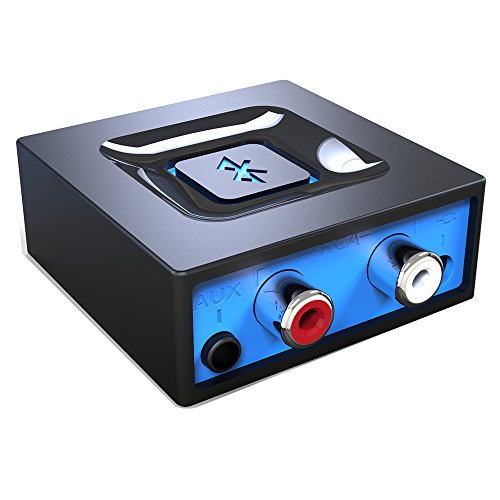
The Esinkin adapter stands out for straightforward button-based pairing rather than a broad codec or output list. It connects to speakers or a home stereo through a 3.5 mm or RCA cable, and the maker says it can reconnect automatically to the previously paired device. The indoor range is 30–40 feet without obstacles, making it a reasonable fit when the phone and stereo are in the same room or nearby.
Bottom line: Choose this for a nearby stereo with 3.5 mm or RCA input and button-based reconnection.
1Mii B06+ Bluetooth Receiver

The 1Mii B06+ separates itself with Bluetooth 5.3 and support for aptX HD, aptX Adaptive, and switchable 3D audio. The maker describes it as a receiver only, intended to add wireless music streaming to an existing stereo, amplifier, or powered speakers; it is not a transmitter. That makes it a fit for listeners whose source device and sound system work with its receiver role and codec options.
Bottom line: Choose this if aptX Adaptive or switchable 3D audio matters and you need a receiver, not a transmitter.
1Mii B06Pro Long Range Receiver

The 1Mii B06Pro is the clear option for a stereo that needs multiple connection types, including AUX, RCA, optical, or coaxial. It uses Bluetooth 5.3 and supports aptX Low Latency, aptX HD, and switchable 3D audio. Brand claims a range of up to 197 feet in open-air line-of-sight conditions and 60–100 feet indoors without obstacles; walls and nearby wireless equipment can reduce that reach. Its larger output selection and range claims distinguish it from Rocketfish, but the maximum distance should not be treated as a guaranteed indoor range.
Bottom line: Choose this for coaxial connectivity or when a longer claimed wireless range is useful.
1Mii B06Pro+ Receiver

The 1Mii B06Pro+ adds LDAC support to a feature set that also names aptX HD, aptX Low Latency, aptX, and AAC. It is a Bluetooth 5.3 receiver for adding wireless streaming to an existing home stereo, with AUX, RCA, optical, and coaxial connections identified in its name. That makes it a strong fit for someone choosing by codec support and connector flexibility.
Bottom line: Choose this if LDAC support and several output connection types are priorities.
How to choose a Bluetooth audio receiver
Choose by the stereo’s available input first, then check codec compatibility with the device sending audio. Analog RCA and 3.5 mm inputs are common on home systems; optical and coaxial inputs are digital alternatives, but the receiver must provide a matching output. Bluetooth codecs such as aptX HD, aptX Adaptive, AAC, and LDAC only provide their format-specific benefit when the sending device also supports the same codec. A useful rule is to buy for the input you will actually connect, not merely the largest codec list. A receiver also differs from a transmitter: receivers send Bluetooth-source audio into a wired system, while transmitters send audio out to Bluetooth headphones or speakers.
Bluetooth receiver range and placement
Bluetooth range claims are best treated as maximum conditions, not a guaranteed distance through a house. For example, the 1Mii B06Pro maker claims up to 197 feet in open-air line-of-sight and 60–100 feet indoors without obstacles; walls, floors, and nearby Wi-Fi equipment can shorten the usable connection. Put the receiver in the same room as the source when reliability matters, and avoid hiding it inside a metal cabinet. If the phone must stay more than 30 feet away indoors, prioritize a receiver with a longer indoor range claim, then test placement before fixing cables permanently. Codec choice does not replace adequate signal strength.
Bluetooth codecs and audio quality
Codec names describe how Bluetooth audio is encoded, but they do not guarantee a particular listening result. AptX HD, aptX Adaptive, LDAC, and AAC are useful selection criteria only when both the phone or computer and receiver support a compatible codec; otherwise the connection uses another mutually supported format. Low-latency support is most relevant when audio must stay synchronized with video, and support on only one side is not enough. A receiver’s output connection matters too: optical and coaxial carry digital audio, while RCA and 3.5 mm carry analog audio. Match the receiver output to the stereo input and select the correct input on the stereo.
Receiver setup mistakes to avoid
The most common setup mistake is buying a receiver when the goal is to send television or stereo audio to Bluetooth headphones. A receiver handles audio arriving from a Bluetooth source; that headphone setup generally calls for a Bluetooth transmitter. Another mistake is assuming all Bluetooth receivers have the same connectors: analog RCA does not plug directly into an optical-only input, and coaxial is a separate digital connection from optical. Before setup, confirm the stereo input type and place the receiver where its wireless signal is not blocked by cabinets or walls. For a crowded home with multiple paired phones, device memory can also matter; the Rocketfish model’s feature set specifies eight-device memory.
Frequently Asked Questions
Can a Bluetooth audio receiver connect to Bluetooth headphones?
No, a receiver normally takes audio from a Bluetooth phone or computer and sends it to a wired stereo. To send stereo or television audio to Bluetooth headphones, use a Bluetooth transmitter instead.
Do both devices need to support aptX HD?
Yes, the sending device and receiver need a compatible codec for aptX HD to be used. If either side lacks it, the Bluetooth connection uses another mutually supported format.
How far can Bluetooth audio work indoors?
Indoor range depends on obstructions and interference, so a maximum open-air figure is not an indoor guarantee. The 1Mii B06Pro maker claims 60–100 feet indoors without obstacles; walls and floors can reduce that distance.
Should I use optical or RCA to connect my receiver?
Use the output that matches an available input on the stereo: optical connects to optical, while RCA connects to analog RCA inputs. If your stereo only has one type of input, choose a receiver with the matching output.
Will a Bluetooth receiver work with any phone?
A Bluetooth-enabled phone can generally pair with a receiver, but advanced codec support requires the same codec on both devices. Check the phone’s supported codecs when aptX HD, aptX Adaptive, AAC, or LDAC is a deciding factor.