
All Perspectives Induction Headlamp: 3 Models Compared

WopkDupk Rechargeable Headlamp suits most people seeking an induction headlamp because its 230-degree flood beam and separate side spotlight cover both nearby and distant viewing. Choose another model if a lumen figure or a two-pack is the deciding factor.
Here, “induction” refers to motion-sensor control: a hand wave switches the light on or off when sensor mode is active.
We earn a commission if you buy through links on this page. As an Amazon Associate I earn from qualifying purchases. Products are compared on manufacturer specifications, not hands-on testing.
- Best overall: WopkDupk Rechargeable Headlamp – Combines a 230-degree COB flood beam with a side spotlight and five modes.
- Best for stated brightness: Avlxt 350-Lumen Headlamp, 2-Pack – Its maker gives a 350-lumen figure alongside a 230-degree beam.
- Best for six modes: Rechargeable 230° Headlamp, 2-Pack – Includes six modes, including motion sensing, and comes as a two-pack.
| Product | Best for | Pack size | Light modes | Shop |
|---|---|---|---|---|
| WopkDupk Rechargeable Headlamp | Beam flexibility | 3 | 5 | Check Price on Amazon |
| Rechargeable 230° Headlamp, 2-Pack | Mode selection | 2 | 6 | Check Price on Amazon |
| Avlxt 350-Lumen Headlamp, 2-Pack | Stated lumen rating | 2 | 5 | Check Price on Amazon |
Induction Headlamps Compared
Compare beam coverage, controls, and included headlamp count before choosing a motion-sensor model.
WopkDupk Rechargeable Headlamp

WopkDupk Rechargeable Headlamp stands out for pairing a wide COB floodlight with a separate side spotlight, rather than relying on the wide beam alone. The 230-degree floodlight illuminates a broad viewing area, and the maker says the spotlight reaches nearly 300 feet. Five modes cover high and low settings for each light plus strobe; motion-sensor switching is also included. This three-pack may suit households or work crews that need multiple headlamps. The maker gives no lumen figure, so buyers choosing by measured brightness should compare a model with a lumen rating instead.
Bottom line: Pick this when you want both broad close-up coverage and a separate spot beam.
Rechargeable 230° Headlamp, 2-Pack

Rechargeable 230° Headlamp, 2-Pack distinguishes itself with six listed modes, counting motion sensing as a mode alongside high and low COB and XPE settings and strobe. Its 230-degree beam provides broad coverage, while a separate spotlight can focus on a specific area. The two-pack is a practical fit when two people need lights at the same time. The sensor is described as working with a hand wave within 10 centimeters, including while wearing gloves. The specifications do not give a lumen figure, so it is a less informative choice for anyone comparing headlamps by a quantified brightness claim.
Bottom line: Choose this if six listed modes and a two-headlamp pack fit your needs.
Avlxt 350-Lumen Headlamp, 2-Pack
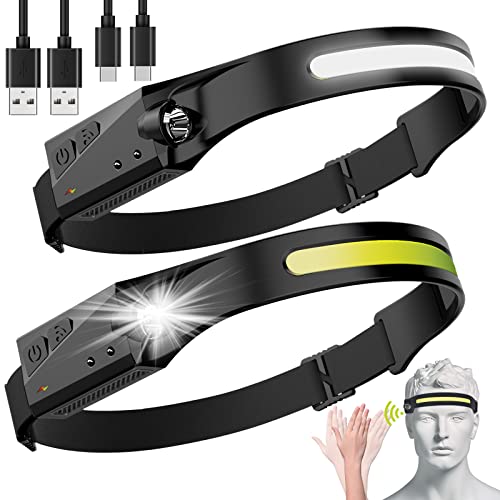
Avlxt 350-Lumen Headlamp, 2-Pack is the only option here with a brightness figure: its maker claims 350 lumens. It combines that 230-degree beam with a side spot light, five settings, motion sensing, and an adjustable design. The two-pack suits buyers who want matching lights for a pair of users or a spare. Its modes include high and low settings for both the COB beam and XPE light, plus strobe.
Bottom line: Pick this when a maker-stated 350-lumen rating matters most.
How to Choose an Induction Headlamp
Choose by beam shape first: a wide COB flood beam helps illuminate a broad work area, while a spot beam concentrates light farther ahead. For close repairs within arm’s reach, prioritize wide coverage; for a trail or distant object, use a focused spot. Motion sensing is convenient when your hands are dirty or gloved, but it requires a deliberate sensor-mode setting on models that separate it from ordinary button controls. Compare claimed lumens only when the figure is provided, and remember that beam shape affects usefulness as much as brightness. If a lumen number is your deciding factor, favor a model that provides one rather than assuming similar-looking lights have equal output.
Wide-Beam and Spotlight Uses
A wide beam spreads illumination across the nearby viewing area, reducing the need to turn your head during close work. A spot beam narrows illumination toward a specific target and is generally more useful for looking farther ahead. A 230-degree figure describes beam angle, not distance or brightness; it cannot be compared directly with a lumen rating. Many headlamps combine flood and spot LEDs, but switching between them may require a separate mode. For a stationary repair with a work surface nearby, a flood beam is usually the better match; for walking where you need to see ahead, a spot option can add useful reach. The maker’s claimed distance or lumen figures are not interchangeable measures.
Motion-Sensor Controls and Modes
Motion-sensor control lets a hand wave switch a lamp on or off, which can help when gloves make small buttons awkward. Sensor operation is distinct from light modes such as high, low, and strobe; check the control sequence so you know how to disable sensing when a wave could trigger the lamp. Headlamps commonly use rechargeable lithium-ion cells, and charge life depends on brightness setting, battery capacity, and temperature. Avoid charging a wet headlamp, and use the charging cable and power source specified by its manufacturer. A sensor is a convenience feature, not a substitute for checking that the light is off before putting it away.
Brightness Claims and Headlamp Safety
Lumens measure total light output, while beam distance describes how far useful light reaches; a wide beam can feel bright nearby without throwing as far as a focused beam. ANSI/PLATO FL 1 is a voluntary performance standard used for flashlight measures such as beam distance and runtime, so a lumen number without a test method gives less basis for comparison. Never aim a powerful headlamp directly into another person’s eyes, especially at close range. For outdoor use, preserve a low setting for nearby tasks and use brighter modes only when needed. Before relying on a rechargeable headlamp for a long outing, verify runtime at the mode you plan to use and carry a backup light.
Frequently Asked Questions
What does induction mean on a headlamp?
On these products, induction refers to motion-sensor control that switches the lamp on or off with a hand wave. The sensor must be enabled, and mode controls may be separate.
Is a 230-degree beam brighter than a spotlight?
No, beam angle describes spread rather than brightness. A wide beam covers more nearby area, while a focused spot concentrates light farther ahead.
What does a headlamp lumen rating tell me?
Lumens measure total light output, not how far the beam reaches. Compare lumen figures alongside beam shape and distance claims, and check whether the maker identifies a test method.
Can I use motion sensing with gloves on?
A hand-wave sensor can work with gloves, and one of these models specifies operation within 10 centimeters. Keep the sensor mode active and wave within its detection range.
How should I charge a rechargeable headlamp safely?
Charge the headlamp while it is dry and use the charging equipment specified by its maker. Do not leave a charging battery in a hot vehicle or near combustible material.