
Catnip Tea for Babies: 5 Options Compared by Fit

For a baby-labeled catnip blend, Secrets of Tea Baby Catnip is the closest match, but its suggested servings do not establish that tea is appropriate for your infant; ask your pediatrician before offering any. Choose a different option only if you want a different herbal blend or tea for an adult, since most other picks are not baby-specific.
Catnip tea is an herbal infusion made by steeping catnip leaves or blossoms in hot water; it is not a substitute for breast milk or formula.
We earn a commission if you buy through links on this page. As an Amazon Associate I earn from qualifying purchases. Products are compared on manufacturer specifications, not hands-on testing.
- Best overall: Secrets of Tea Baby Catnip – It is the only option explicitly labeled as baby catnip tea and combines catnip with fennel, cumin, and chamomile.
- Best for plain catnip: Celebration Herbals Catnip Leaf and Blossom – It names catnip leaf and blossom as the tea ingredients.
- Best for bottle preparation: Secrets of Tea Babies’ Magic Tea – Its stringless bag directions describe cooling the infusion and mixing it with formula or breast milk.
| Product | Best for | Herbs named | Tea bags | Baby-specific | Shop |
|---|---|---|---|---|---|
| Secrets of Tea Baby Catnip | Baby-labeled blend | Catnip, fennel, cumin, chamomile | 20 | Yes | Check Price on Amazon |
| Celebration Herbals Catnip Leaf and Blossom | Plain catnip | Catnip leaf and blossom | 24 | No | Check Price on Amazon |
| Positively Botanicals Organic Catnip Tea | Organic catnip | Catnip | 20 | No | Check Price on Amazon |
| Secrets of Tea Babies’ Magic Tea | Bottle preparation | Fennel, chamomile, cumin | 20 | Yes | Check Price on Amazon |
| Secrets of Tea Fennel and Chamomile | Two-herb blend | Fennel, chamomile | 20 | No | Check Price on Amazon |
Catnip tea for babies and related herbal teas
Compare the named herbs and intended use, then consult your pediatrician before giving any herbal tea to an infant.
Secrets of Tea Baby Catnip
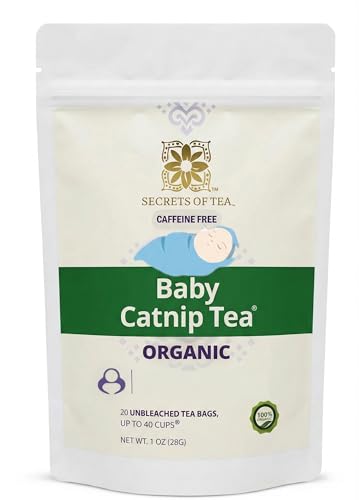
Unlike the plain catnip teas here, this blend is explicitly labeled for babies and combines catnip with fennel, cumin, and chamomile. The maker describes it as organic and caffeine-free, with no added sugar or artificial flavors, and gives a steeping time of 3 to 5 minutes. Its serving guide says 1 to 5 ounces per serving, 3 to 4 times daily; that is not a pediatric recommendation, so ask your child’s clinician before using it. The blend suits shoppers looking specifically for a baby-labeled catnip product, but it is not a plain catnip infusion.
Bottom line: Choose it only if you want a baby-labeled mixed-herb tea and your pediatrician approves.
Celebration Herbals Catnip Leaf and Blossom

Catnip leaf and blossom are the only herbs named for this tea, distinguishing it from the mixed-herb baby blend. The package contains 24 tea bags, and the maker identifies the tea as caffeine-free. Do not infer infant suitability from the herb name or caffeine-free claim; check with your pediatrician before offering herbal tea.
Bottom line: Choose it for a plain catnip infusion for an adult, not as an infant recommendation.
Positively Botanicals Organic Catnip Tea

This is the other plain catnip option, with USDA Organic, non-GMO, and kosher claims, rather than the leaf-and-blossom wording used by Celebration Herbals Catnip Leaf and Blossom. It comes as 20 tea bags and is identified as caffeine-free. Organic status and lack of caffeine do not make herbal tea appropriate for an infant. Ask the child’s clinician before using this or any other herb as a baby drink.
Bottom line: Choose it for organic catnip tea when the drinker is an adult.
Secrets of Tea Babies’ Magic Tea

Unlike the catnip blends, this baby-oriented tea contains fennel seed, chamomile flower, and cumin seed, with no catnip named. Its stringless bags are designed for the bottle: the maker’s directions say to steep one bag for 2 minutes, cool it, then mix it 50/50 with formula or breast milk. The maker also says to consult the baby’s doctor before offering herbal tea. This is the clearest bottle-preparation option among these products, but it does not meet a request for catnip tea and should not be treated as routine infant feeding.
Bottom line: Choose it only if you want a non-catnip blend and the baby’s doctor approves.
Secrets of Tea Fennel and Chamomile

This two-herb blend contains fennel and chamomile, unlike the catnip teas and the cumin-containing blends. The maker describes it as caffeine-free with no added sugar, and recommends one bag per 8-ounce cup steeped for about 5 minutes. It also contains no catnip. For a baby, ask a pediatrician before offering any herbal infusion.
Bottom line: Choose it for a fennel-and-chamomile tea for an adult, not for catnip.
Whether babies should drink catnip tea
Babies generally should not be given catnip tea unless their pediatrician specifically advises it. For most healthy infants, breast milk or iron-fortified infant formula is the main nutrition through the first 6 months; around 6 months, complementary foods begin, while breast milk or formula remains important. Herbal tea is not a substitute for either. Caffeine-free and organic describe product attributes, not proof of infant safety. The practical decision rule is simple: if your baby is under 12 months, do not introduce an herbal drink without the child’s clinician’s guidance. If a clinician recommends a product, ask about the appropriate age, amount, preparation, and whether it should replace or accompany a feed.
How to compare catnip tea ingredients
Read the herb list first: a plain catnip tea and a baby-labeled mixed-herb blend are different products. Catnip teas may use leaves, blossoms, or both, while blended teas can add herbs such as fennel, cumin, or chamomile. Those ingredients can change taste and preparation, but the specifications here do not establish a baby-safe dose. Use the table to separate ingredient type from baby-specific labeling; neither label alone answers whether your child should drink it.
| Product type | What to look for | Decision point |
|---|---|---|
| Plain catnip | Catnip leaf or blossom | Adult tea, not baby-specific |
| Mixed-herb baby-labeled tea | Catnip plus other herbs, or a different blend | Ask clinician before infant use |
| Other herbal blend | Fennel, chamomile, or cumin without catnip | Does not match a catnip request |
Choose by the actual herbs named, not by the word “baby” or by a caffeine-free claim.
Preparing herbal tea safely
For an adult cup, tea bags are generally steeped in freshly boiled water, then removed; follow the product’s own time and water amount. For infants, however, preparation instructions are not a safety clearance. Avoid giving hot liquid to a baby, and never use tea to dilute formula or replace a feed unless a clinician explicitly directs it. The baby-labeled products here include different preparation approaches: one describes cooled tea mixed with formula or breast milk, while another suggests small servings. Those directions should not override an infant-feeding plan. If a clinician approves tea, confirm the exact preparation and serving amount before making it.
Common mistakes when choosing baby herbal tea
A common mistake is treating “caffeine-free,” “organic,” or “baby” on a package as enough evidence that a tea is suitable for an infant. Those terms do not establish a safe age or dose. Another mistake is confusing catnip tea with a different herbal blend: fennel and chamomile products without catnip do not meet a request for catnip. A measured choice rule helps: if the ingredient list does not name catnip, it is not catnip tea; if the intended drinker is an infant, get pediatric guidance before use regardless of the ingredient list. Keep any hot water and freshly brewed tea away from children to prevent scalds.
Frequently Asked Questions
Can a newborn have catnip tea?
Newborns should receive breast milk or infant formula, and even small amounts of other liquids can interfere with feeding.
Is caffeine-free tea safe for infants?
Caffeine-free does not by itself make a tea safe for an infant. Herbal ingredients and serving amounts matter, so ask the pediatrician before offering tea at any age under 12 months.
Can I mix herbal tea with baby formula?
Do not use tea to dilute or prepare formula; prepare formula according to its label and safe-water guidance. Ask the pediatrician before adding any tea to a baby’s feed.
When do babies usually start drinking water?
Small amounts of water are generally introduced around 6 months when complementary foods begin, while breast milk or formula remains the main drink through 12 months. Tea is not a substitute for water, milk, or formula.
How long should catnip tea steep?
Steeping times depend on the product: the baby-labeled catnip blend gives 3 to 5 minutes, while a separate fennel-and-chamomile tea gives about 5 minutes. For an infant, follow clinician advice rather than using steep time to determine a serving.