
Light Up Runners Vest: 3 Options Compared

For a light up runners vest with the clearest runtime figure, choose noxgear Tracer2 Medium-Large: its maker says it runs up to 20 hours and offers 360-degree illumination. Choose another option if you want a front light for seeing the path, or need a vest with an explicitly stated waist range.
We earn a commission if you buy through links on this page. As an Amazon Associate I earn from qualifying purchases. Products are compared on manufacturer specifications, not hands-on testing.
- Best overall: noxgear Tracer2 Medium-Large – Its maker specifies up to 20 hours of runtime, plus 8 solid colors and 8 flashing modes.
- Best for path lighting: Zacro Vest with 500LM Chest Light – It adds a front chest light with three brightness levels.
- Best for waist adjustment: Zacro 5-Color LED Reflective Vest – Its size L specifies an adjustable 26–49-inch waist.
| Product | Best for | Light modes | Fit | Shop |
|---|---|---|---|---|
| noxgear Tracer2 Medium-Large | Longer outings | 8 colors, 8 flash modes | Medium-Large | Check Price on Amazon |
| Zacro Vest with 500LM Chest Light | Seeing the path | 5 colors, 3 modes | Adjustable; 26–49 in. | Check Price on Amazon |
| Zacro 5-Color LED Reflective Vest | Waist adjustability | 5 colors, 3 modes | Size L; 26–49 in. | Check Price on Amazon |
Light Up Runners Vests
Compare the lighting approach, runtime and fit details to match a vest to your route and clothing.
noxgear Tracer2 Medium-Large
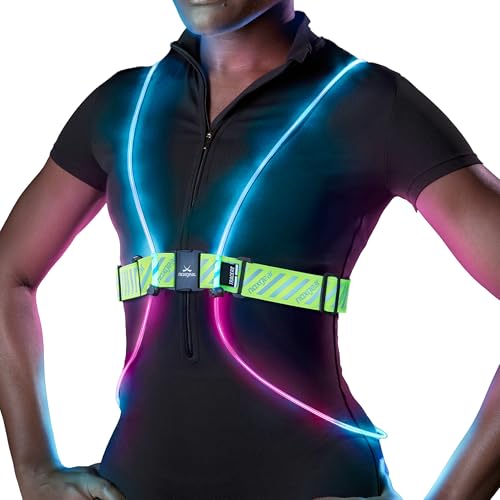
noxgear Tracer2 Medium-Large stands apart with its runtime of up to 20 hours and a choice of 8 solid colors or 8 multicolor flashing modes. The maker describes its setup as 360-degree illumination, with fiber-optic cables, 3M reflector chest belts and a bounce-free design. USB-C charging is also part of the package. This option suits runners who prioritize longer runtime and multiple visibility modes over a separate path-facing beam.
Bottom line: Choose it for the longest runtime and broadest mode selection.
Zacro Vest with 500LM Chest Light

Zacro Vest with 500LM Chest Light is the chest light choice, combining a white front beam rated at 500 lumens with three brightness levels and five selectable light colors. The maker says the vest has 360-degree lighting and an IPX4 rating; the latter is a splash-resistance rating, not a promise of submersion protection. Its adjustable waist range is 26–49 inches. This setup suits runners who want a forward beam as well as visibility to others. Runtime is not among the specifications, so people planning long outings should verify battery endurance before relying on it.
Bottom line: Pick it when a forward-facing beam matters alongside visibility.
Zacro 5-Color LED Reflective Vest

Zacro 5-Color LED Reflective Vest gives runners five light colors and three modes: steady, single-color flashing or a cycling multicolor flash. Its size L lists a waist adjustment from 26 to 49 inches, making that measurable fit range its clearest distinction. The vest weighs 0.35 pounds. It does not have a front chest light called out in the features, so runners who need a beam to illuminate uneven pavement should consider a chest light model instead. This is a straightforward pick for someone who wants color choices and an adjustable waist without making a front beam the deciding feature.
Bottom line: Choose it if the 26–49-inch waist range fits and color modes are enough.
How to choose a light up runners vest
Choose based on whether you need to be seen, see the path, or both. Reflective material returns light from an external source such as headlights; powered LEDs produce their own light, while a forward-facing lamp can illuminate the ground. For routes with traffic, favor visibility from multiple directions, and use a separate path light if the vest does not include a forward beam. A useful decision rule is to choose a model with a dedicated front light when you routinely run on unlit pavement or trails; colored LEDs alone are not a substitute for a ground-facing beam. Compare runtime against your longest outing, leaving reserve for delays rather than planning to use the full stated maximum.
Vest fit and visibility coverage
A running vest should stay close enough to avoid swinging but leave room for the layers worn on the route. Check waist and shoulder adjustment with your usual outer layer on; a measurement range is more useful than relying on a broad size label alone. For night running, aim for visibility from the front, sides and back, since traffic can approach from different angles. Reflective strips work only when light reaches them, so reflective gear is not a replacement for active lighting on a dark route. Avoid covering LED panels or reflective sections with a jacket, hydration pack or loose clothing, which can reduce their visibility.
LED colors, flashing modes and front lights
Color modes mainly change how the wearer appears; a white forward beam serves a different purpose by lighting the surface ahead. Steady modes provide continuous light, while flashing modes vary the signal and can attract attention, but a flashing light does not reveal potholes or debris. A tilting lamp can be aimed down toward the route, while brightness settings let runners reduce output when a high beam is unnecessary. If a vest has both LEDs and reflective trim, treat them as complementary: LEDs remain visible without headlights, and reflective areas can return light from vehicles or streetlamps.
| Need | Look for | Tradeoff |
|---|---|---|
| Be seen from several directions | 360-degree illumination and reflective areas | May not light the ground ahead |
| See uneven pavement | A white front beam with adjustable brightness | Battery runtime becomes important |
| Extend time between charging | A clearly stated runtime | Actual duration can vary with mode and brightness |
Charging and safe night-running use
Rechargeable lights need a charge plan that accounts for the selected mode and brightness; maximum runtime claims should not be treated as guaranteed duration in every setting. Charge before an outing and inspect the cable port and light units for damage or moisture. An IPX4 marking indicates protection against splashing water, not protection for immersion. Wear the vest where its lights and reflective elements remain unobstructed, and use a separate headlamp or chest light if the route is dark enough that footing is hard to see. Add a small reserve of battery time for route changes or delays rather than setting out with a nearly depleted light.
Frequently Asked Questions
Do light up running vests replace a headlamp?
No, not unless the vest includes a forward beam bright and well-aimed enough for the route. Colored visibility lights help others spot you, while a headlamp or chest light helps reveal pavement and obstacles.
How bright should a running vest chest light be?
A 500-lumen beam is a clearly stated output on one option here, but the useful brightness depends on route lighting and beam direction. Choose an aimable beam for dark or uneven paths, and lower the setting when full output is unnecessary.
Can I wear a reflective vest over a jacket?
Yes, if the vest fits securely over the jacket and its lights and reflective areas remain uncovered. Try the fit with the thickest layer you expect to wear, since added clothing can tighten shoulder and waist adjustments.
Does IPX4 mean a running vest is waterproof?
No. IPX4 means protection against water splashing from any direction, not immersion or sustained exposure to heavy water; dry the equipment after a wet run.
How often should I recharge an LED running vest?
Recharge it before a run if the remaining battery time is uncertain, and use the maker’s maximum runtime only as a planning reference. Higher brightness or different lighting modes can affect how long a charge lasts.