
Best Paint Thickness Gauge: 4 Car Meters Compared

For most used-car inspections, CM-224 Auto Paint Thickness Gauge is the best paint thickness gauge because it is designed for car checks and measures up to 1,500 μm with 0.1 μm resolution. Choose Blue Fe/NFe Car Coating Meter for its accuracy specification, or POROMETISTO 0–2,000 μm Car Gauge if you want data storage and export; these gauges read metal panels, not plastic or fiberglass.
We earn a commission if you buy through links on this page. As an Amazon Associate I earn from qualifying purchases. Products are compared on manufacturer specifications, not hands-on testing.
- Best overall: CM-224 Auto Paint Thickness Gauge – Its 0–1,500 μm range and 0.1 μm resolution suit automotive panel checks.
- Best for accuracy specs: Blue Fe/NFe Car Coating Meter – It gives an accuracy of ±(3% + 2 μm) and reads in μm or mils.
- Best for data export: POROMETISTO 0–2,000 μm Car Gauge – It offers storage and export, plus a 0–2,000 μm range.
| Product | Best for | Measurement range | Resolution | Substrate detection | Shop |
|---|---|---|---|---|---|
| CM-224 Auto Paint Thickness Gauge | Routine car checks | 0–1,500 μm | 0.1 μm | Fe / NFe / Fe+Zn | Check Price on Amazon |
| Blue Fe/NFe Car Coating Meter | Accuracy specification | 0–1,300 μm | 0.1 μm | Fe / NFe | Check Price on Amazon |
| POROMETISTO 0–2,000 μm Car Gauge | Saved measurements | 0–2,000 μm | 0.1 μm to 99.9 μm; 1 μm above | Fe / NFe | Check Price on Amazon |
| Auto-Detection Car Coating Meter | Basic metal checks | — | — | Steel / aluminum | Check Price on Amazon |
Best paint thickness gauges for cars
Match the gauge’s metal compatibility and measurement range to the panels you plan to inspect.
CM-224 Auto Paint Thickness Gauge

For straightforward automotive inspections, this model combines a 0–1,500 μm range with 0.1 μm resolution and a backlit LCD. It detects steel, aluminum and Fe+Zn substrates automatically. The maker says it is factory calibrated for car body checks and can be used without setup after battery installation. That makes it a practical choice for first-time buyers comparing metal body panels. Its range is narrower than the 0–2,000 μm option, so buyers checking especially thick coatings may prefer that wider range.
Bottom line: Choose this for a car-focused gauge with a backlit display and automatic substrate detection.
Blue Fe/NFe Car Coating Meter

The blue meter distinguishes itself with an accuracy of ±(3% + 2 μm), alongside 0.1 μm resolution and a 0–1,300 μm range. Its two-in-one probe identifies ferrous and non-ferrous metal, and the maker says the V-shaped groove supports measurements on concave, rough and convex surfaces. It reads in μm and mils, which helps when comparing readings from sources using either unit. The range is the shortest among the car-focused gauges here, so it may not suit inspections where unusually thick coatings are a concern.
Bottom line: Choose this if an accuracy specification and readings in two units matter most.
POROMETISTO 0–2,000 μm Car Gauge

For buyers who want to retain inspection readings, this gauge adds data storage and export to a 0–2,000 μm measurement range. It detects steel, iron, aluminum and copper, with 0.1 μm resolution through 99.9 μm and 1 μm resolution above that. The maker gives an accuracy specification of ≤±(3% of reading + 2 μm) and says the gauge has two measure and calibrate modes. It is limited to metal: it will not read plastic, fiberglass, carbon fiber, wood or drywall, so it cannot assess every exterior panel or trim piece.
Bottom line: Choose this if saved readings and a wider stated range are useful for your inspection.
Auto-Detection Car Coating Meter
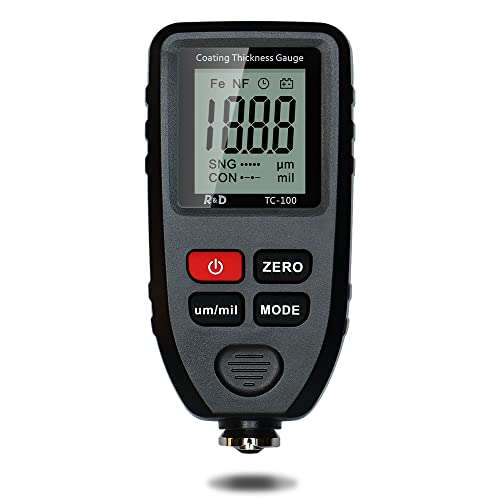
This meter focuses on automatic recognition of steel and aluminum rather than providing a numeric range in its features. The maker says it is intended for automotive paint inspection and other metal-surface coating checks. Because the gauge is designed for metallic surfaces, it can help compare readings across compatible car panels but cannot assess plastic or composite bodywork. Buyers who need to compare readings against a specific measurement range or accuracy target should choose a model with those figures provided, such as Blue Fe/NFe Car Coating Meter or POROMETISTO 0–2,000 μm Car Gauge.
Bottom line: Choose this for basic coating comparisons on steel and aluminum panels.
How to choose a paint thickness gauge
For car checks, choose a gauge that detects both ferrous steel and non-ferrous aluminum, since many vehicles use both metals. Automotive paint readings are commonly around 100–180 μm, but factory finishes vary by maker, model and panel; use repeated comparisons across the same vehicle rather than treating one reading as a universal pass/fail threshold. A large jump from neighboring panels can be a reason to investigate further, not proof of a repair. Look at resolution and stated accuracy separately: resolution is the smallest displayed increment, while accuracy describes the possible measurement error. If a gauge does not provide a range or accuracy figure and those numbers matter to your decision, choose one that does.
Where paint thickness gauges work
Most handheld automotive coating gauges work on metal substrates, using magnetic induction on ferrous steel and eddy-current methods on non-ferrous aluminum. A gauge that detects both types automatically reduces the need to switch modes, but neither method measures paint over plastic, fiberglass or carbon fiber. Check whether the panel is steel or aluminum before interpreting a reading; a metal-detection feature does not make a gauge suitable for every exterior part. For mixed-material vehicles, use the meter only on compatible metal panels and assess plastic bumpers separately. Keep the probe square against the surface and take several readings across each panel, since one spot cannot represent an entire panel.
How to interpret car paint readings
Use a pattern of measurements rather than a single number: compare multiple points on each panel with nearby panels made from the same substrate. Original factory coatings often fall near 100–180 μm, while repainting can produce higher or more uneven readings, but those ranges overlap and are not conclusive on their own. A panel-to-panel difference is more informative when the substrate and measurement method are consistent. Before relying on a gauge, check its zero or calibration procedure on an appropriate reference surface, then keep the probe clean and still during each reading. Do not use paint thickness alone to judge structural condition or accident history; it measures coating over a compatible metal surface.
Common paint thickness gauge mistakes
The most common mistake is trying to read a nonmetal panel with a gauge built for steel and aluminum; plastic, fiberglass and carbon fiber are outside the operating principle of these meters. Another is comparing readings in different units or confusing resolution with accuracy. One micrometer (μm) equals 0.001 millimeter, and one mil equals 25.4 μm, so confirm the display unit before comparing figures. Dirt, a tilted probe and curved or rough surfaces can also make readings less consistent. Take several measurements on a clean, flat area when possible, and treat unusual readings as a prompt for closer inspection rather than as a standalone diagnosis.
Frequently Asked Questions
What paint thickness is normal on a car?
Factory automotive paint is commonly around 100–180 μm, but the actual range varies by vehicle and panel. Compare several locations on the same metal panel and use neighboring panels as context rather than relying on one cutoff.
Can a paint thickness gauge read plastic bumpers?
No, magnetic-induction and eddy-current gauges require a compatible metal substrate beneath the coating. These methods do not measure paint over plastic, fiberglass or carbon fiber.
How many readings should I take on each panel?
Take several readings spread across each panel so a single spot does not drive the conclusion. Keep the probe square and compare like materials, since steel and aluminum may use different measurement methods.
What is the difference between microns and mils?
A mil is 25.4 μm, while 1 μm is one-thousandth of a millimeter. Check the displayed unit before comparing results, especially when one gauge reports microns and another reports mils.
Does a high paint thickness reading prove a car was repaired?
No, a high reading alone cannot prove a repair because original coatings vary and readings can differ by panel. Treat a large, repeated difference from comparable neighboring panels as a reason to inspect further.