
Seattle’s Best Coffee Portside Blend: 4 Formats Compared

Seattle’s Best Portside Ground, 12 oz suits most people who want Portside Blend for everyday brewing because its single 12-ounce bag of medium-roast ground coffee is ready to measure and brew.
Choose Seattle’s Best Portside Whole Bean, 6 × 12 oz if you prefer to grind whole beans fresh, or Seattle’s Best Portside K-Cup Pods, 96 count if you use a Keurig brewer and want single-cup pods; Seattle’s Best Portside Ground, 6 × 12 oz is the larger ground-coffee multipack.
We earn a commission if you buy through links on this page. As an Amazon Associate I earn from qualifying purchases. Products are compared on manufacturer specifications, not hands-on testing.
- Best overall: Seattle’s Best Portside Ground, 12 oz – A single 12-ounce bag of medium-roast Portside ground coffee suits straightforward home brewing.
- Best for grinding fresh: Seattle’s Best Portside Whole Bean, 6 × 12 oz – Six 12-ounce bags contain whole beans that you can grind to match your brewer.
- Best for Keurig brewers: Seattle’s Best Portside K-Cup Pods, 96 count – The pack contains 96 Portside K-Cup pods and recommends the 8-ounce setting.
- Best for ground-coffee stockup: Seattle’s Best Portside Ground, 6 × 12 oz – The multipack provides six 12-ounce bags of Portside ground coffee.
| Product | Best for | Format | Pack quantity | Brew guidance | Shop |
|---|---|---|---|---|---|
| Seattle’s Best Portside Ground, 12 oz | Everyday ground coffee | Ground | 1 × 12 oz bag | — | Check Price on Amazon |
| Seattle’s Best Portside Whole Bean, 6 × 12 oz | Fresh-ground coffee | Whole bean | 6 × 12 oz bags | 2 tbsp per 6 fl oz water | Check Price on Amazon |
| Seattle’s Best Portside K-Cup Pods, 96 count | Keurig single cups | K-Cup pods | 96 pods | 8-ounce Keurig setting | Check Price on Amazon |
| Seattle’s Best Portside Ground, 6 × 12 oz | Ground coffee stockup | Ground | 6 × 12 oz bags | 1 tbsp recommended | Check Price on Amazon |
Seattle’s Best Coffee Portside Blend Formats
Compare the ground, whole bean and pod options by package size and the brew routine each supports.
Seattle’s Best Portside Ground, 12 oz

Seattle’s Best Portside Ground, 12 oz is the simplest match for a regular ground-coffee routine: it comes as one 12-ounce bag of medium-roast Portside Blend, so you can brew it with a drip machine or another brewer suited to ground coffee. The maker describes the blend as smooth-roasted Arabica with a hearty, well-rounded flavor. The specifications give no dose recommendation, so start with your brewer’s guidance and adjust to taste. A single bag is a less substantial stock-up than the multi-bag options, which matters if you want to replenish less often.
Bottom line: Pick this if you want one bag of Portside ground coffee for routine brewing.
Seattle’s Best Portside Whole Bean, 6 × 12 oz
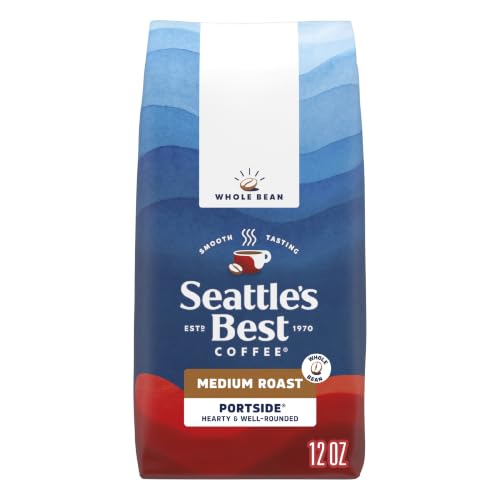
Seattle’s Best Portside Whole Bean, 6 × 12 oz is the only whole bean option here, giving you control over grind size just before brewing. The pack contains six 12-ounce bags, and the maker recommends 2 tablespoons of beans for every 6 fluid ounces of water. The maker also identifies the coffee as 100% Arabica sourced in Latin America and describes its medium roast as deep, smooth and well-rounded. Whole beans require a grinder, so this format is a poor fit if you want coffee ready to scoop without extra equipment.
Bottom line: Choose this if you have a grinder and want to grind each brew to suit your method.
Seattle’s Best Portside K-Cup Pods, 96 count

Seattle’s Best Portside K-Cup Pods, 96 count is the single-cup format for Keurig brewers, with 96 Portside medium-roast pods in four boxes. The maker recommends the 8-ounce setting for a smooth cup. Unlike the bagged options, each pod is portioned for a single brew, which can simplify making one cup at a time. This is the wrong format for a standard drip basket or a grinder-based pour-over, so choose it only if your brewer accepts K-Cup pods. Consider your usual cup size before settling on the recommended setting.
Bottom line: Pick this for a Keurig-compatible routine centered on individual cups.
Seattle’s Best Portside Ground, 6 × 12 oz

Seattle’s Best Portside Ground, 6 × 12 oz shares the ready-to-brew ground format with Seattle’s Best Portside Ground, 12 oz but comes as six 12-ounce bags, making it the larger multipack choice. The maker describes Portside as a hearty, well-rounded medium roast and recommends 1 tablespoon of ground coffee for its smoothest brew. That tablespoon guidance is a starting point, not a universal strength setting: water volume, grind and personal taste all change the result. A six-bag pack is less suitable if you want to try only one bag or prefer whole beans you can grind yourself.
Bottom line: Choose this if you want Portside ground coffee in a six-bag pack.
How to choose a Portside coffee format
Choose by brewer and how much control you want over each cup: ground coffee works with brewers that take loose grounds, whole beans need a grinder, and K-Cup pods need a compatible brewer. Drip machines generally use a flat-bottom or cone filter; check the brewer’s filter shape and size because those are not interchangeable in every machine. For a repeatable starting point, a common coffee-to-water range is about 1:16 to 1:18 by weight, or roughly 1 ounce of coffee to 16–18 ounces of water. The ground and whole bean makers give different spoon-based recommendations, so use the guidance for the format you choose rather than assuming the measures are interchangeable.
How to measure coffee and water
Weighing coffee and water is more repeatable than measuring grounds by spoon because grind size changes how much coffee fits in a spoon. A practical starting range is 1 gram of coffee for every 16–18 grams of water; for a 12-fluid-ounce mug, that is roughly 20–23 grams of coffee. Adjust within that range for stronger or lighter results, then keep the ratio consistent as you change grind or brew method. A finer grind extracts faster than a coarse grind, so avoid changing grind and dose at the same time when dialing in flavor. Seattle’s Best Portside Whole Bean, 6 × 12 oz provides a maker-recommended spoon measure, while the ground options have their own differing guidance.
Keep coffee fresh after opening
Store coffee in an airtight container in a cool, dry cupboard and use it within about 1–2 weeks of opening for best flavor; heat, air, light and moisture speed flavor loss. Whole beans generally retain aroma longer than ground coffee because less surface area is exposed to air, so grind only what you plan to brew when freshness is a priority. Avoid storing coffee in the refrigerator, where condensation and food odors can affect it. For a multi-bag pack, keep unopened bags sealed and open one at a time; transfer opened coffee to an airtight container rather than leaving the bag unsealed on the counter.
Compare Portside formats by routine
Match the package to your brewer first, then consider quantity. Pods are convenient for individual Keurig cups, while ground coffee suits brewers with a grounds basket; whole beans suit people who already have a grinder.
| Routine | Choose | Key condition |
|---|---|---|
| Single mug in a Keurig | Seattle’s Best Portside K-Cup Pods, 96 count | Use a K-Cup-compatible brewer |
| Ground coffee, one bag | Seattle’s Best Portside Ground, 12 oz | Use a brewer that accepts grounds |
| Ground coffee, multiple bags | Seattle’s Best Portside Ground, 6 × 12 oz | Allow sealed storage for extra bags |
| Grind at home | Seattle’s Best Portside Whole Bean, 6 × 12 oz | Have a coffee grinder |
Frequently Asked Questions
How much Portside coffee should I use per cup?
For Seattle’s Best Portside Whole Bean, 6 × 12 oz, the maker suggests 2 tablespoons of whole bean coffee for every 6 fluid ounces of water; for Seattle’s Best Portside Ground, 6 × 12 oz, the maker recommends 1 tablespoon of ground coffee. Spoon measures vary with grind and packing, so weighing coffee at about a 1:16 to 1:18 coffee-to-water ratio gives a more repeatable starting point.
Can Portside ground coffee go in a French press?
Ground coffee can be used in a French press, but a coarse grind is usually preferred to limit sediment and over-extraction during a typical 4-minute steep. The specifications do not specify the grind size, so check the grind before choosing it for that method.
What does the 8-ounce setting do for K-Cup coffee?
The 8-ounce setting controls how much water the Keurig brewer runs through a pod, and Seattle’s Best Portside K-Cup Pods, 96 count’s maker recommends that setting. Larger settings make a more diluted cup from the same pod, so use a smaller volume if you prefer stronger coffee.
How should I store an opened bag of coffee?
Keep opened coffee in an airtight container in a cool, dry cupboard, away from heat, light and moisture. For best flavor, aim to use it within about 1–2 weeks after opening; refrigeration can expose coffee to condensation and odors.