
350 Watt Solar Panels: Portable and Rigid Options Compared

For a portable 350 watt solar panel, ZOUPW 350W Portable N-Type 16BB pairs a 50.2V open-circuit rating with a 4-in-1 cable, while BLUETTI 350W Portable Solar Panel uses an MC4 connector and weighs 30.6 pounds. Choose a different option for a fixed installation or a different wattage: the remaining panels are rigid or rated 300W, 425W, or 640W total.
A solar panel’s wattage is its rated output under standard test conditions, not a guarantee of the power it will deliver in every setting.
We earn a commission if you buy through links on this page. As an Amazon Associate I earn from qualifying purchases. Products are compared on manufacturer specifications, not hands-on testing.
- Best overall: ZOUPW 350W Portable N-Type 16BB – A portable 350W panel with a 50.2V open-circuit rating and four connector types in its cable.
- Best for MC4 connections: BLUETTI 350W Portable Solar Panel – A portable 350W panel with an MC4 connector and adjustable kickstand.
- Best for bifacial output: JJN 425W Bifacial Rigid Panel – A rigid 425W bifacial panel intended for on- or off-grid systems.
| Product | Best for | Rated power | Weight | Type | Shop |
|---|---|---|---|---|---|
| ZOUPW 350W Portable N-Type 16BB | Portable power stations | 350W | 22.2 lb | Foldable portable | Check Price on Amazon |
| BLUETTI 350W Portable Solar Panel | MC4-equipped systems | 350W | 30.6 lb | Foldable portable | Check Price on Amazon |
| Renogy 640W N-Type 18BB Pair | Rooftop installations | 640W total | 90.5 lb | Two rigid panels | Check Price on Amazon |
| JJN 425W Bifacial Rigid Panel | Bifacial installations | 425W | 51.6 lb | Rigid bifacial | Check Price on Amazon |
| 300W Bifacial 18BB Panel | Smaller off-grid arrays | 300W | 19.18 lb | Rigid bifacial | Check Price on Amazon |
350 Watt Solar Panels
Compare exact 350W portable panels with nearby-wattage options for fixed systems and other uses.
ZOUPW 350W Portable N-Type 16BB
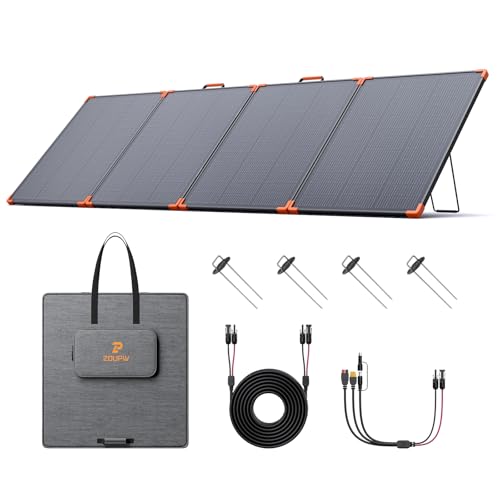
ZOUPW 350W Portable N-Type 16BB is the lighter of the two exact 350W portable options here, at 22.2 pounds, and its cable includes XT60, Anderson, DC7909, and DC8020 connectors. The maker gives an open-circuit voltage of 50.2V and a cell-efficiency figure of 25%. That combination may suit a buyer comparing input compatibility and carrying weight for a power station. The panel measures 94.13 by 33.15 inches and is 0.85 inches high, so check the space needed when deployed. Confirm the power station’s maximum solar input voltage and connector compatibility before ordering.
Bottom line: Choose this if lower panel weight and the included connector variety matter.
BLUETTI 350W Portable Solar Panel

BLUETTI 350W Portable Solar Panel distinguishes itself with an MC4 connector and an adjustable kickstand, making it a practical match to systems designed for that connection. Its monocrystalline cells have a maker-stated efficiency of up to 23.4%, and the panel weighs 30.6 pounds. The folded footprint is 35.6 by 24.1 inches, useful when storage dimensions matter more than minimizing carry weight. The maker names compatibility with several BLUETTI power stations as well as other solar generators. Check the generator’s maximum solar input voltage and current, since a matching connector alone does not establish electrical compatibility.
Bottom line: Pick this when MC4 connection and the named BLUETTI compatibility are the deciding factors.
Renogy 640W N-Type 18BB Pair

Renogy 640W N-Type 18BB Pair is a two-panel rigid set rated at 640W total, rather than a single 350W panel. Each panel is rated at 320W, so this set suits buyers planning a larger rooftop, farm, shed, or off-grid array. The maker cites N-type cells, 18 busbars, IP68 protection, and up to 25% cell efficiency. At 90.5 pounds for the pair, it is a fixed-installation choice rather than a lightweight camping panel. Its panel dimensions are 64.37 by 34.65 by 1.38 inches; plan mounting space and support for both panels.
Bottom line: Choose this for a fixed system needing two panels and 640W combined.
JJN 425W Bifacial Rigid Panel

JJN 425W Bifacial Rigid Panel is the only 425W option here and the other bifacial panel; it is a rigid, single-panel design for rooftop, home, farm, storage, or charging-station systems. The maker says its dual-glass construction can capture light from the rear as well as the front, with up to 30% more energy yield under suitable conditions. The panel is 67.8 by 44.6 by 1.2 inches and weighs 51.6 pounds. Its UL61730 certification and 25% efficiency figure are maker-provided claims. Rear-side output depends on reflected light and installation clearance, so it is not a like-for-like 350W portable substitute.
Bottom line: Select this for a rigid 425W setup where rear-side light can reach the panel.
300W Bifacial 18BB Panel
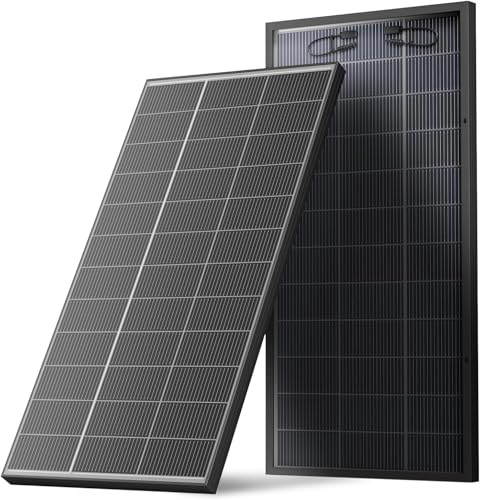
300W Bifacial 18BB Panel is the lowest-rated panel in this group at 300W, and its 19.18-pound weight makes it lighter than the rigid options rated 425W or 640W total. It is a 12V/24V-system panel with N-type 18BB cells and bifacial construction, intended for home, RV, roof, boat, camping, and other off-grid applications. The maker gives a maximum efficiency of 25.3% and says rear-side light can increase energy output in suitable placements. Its dimensions are 52.76 by 26.38 by 1.18 inches. Choose it only if 300W output fits your plan; it does not meet a strict 350W requirement.
Bottom line: Pick this for a smaller 300W bifacial setup rather than an exact 350W replacement.
How to choose a 350 watt solar panel
Start with the power station’s electrical input limits, then compare connector type, panel voltage, and portability. A panel’s rated watts describe output under standard test conditions: 1,000 watts per square meter of irradiance, 25°C cell temperature, and an air-mass spectrum of 1.5. Real output changes with sunlight angle, shade, temperature, and soiling, so a 350W rating is not a promise of 350W at every moment. Check the power station’s maximum solar input voltage and current before ordering; open-circuit voltage is not the same as operating voltage. For a portable setup, also compare weight and folded or deployed dimensions with the available storage and setup area.
Portable versus rigid solar panels
Portable foldable panels prioritize transport and temporary positioning, while rigid panels are intended for fixed mounting or installation in an array. A rigid panel typically uses a frame and glass cover; a foldable panel uses hinged sections and a carrying arrangement, so the two formats have different storage and mounting needs. Use the product’s dimensions to check clearance and mounting area rather than assuming that a wattage rating predicts size. For example, confirm that a foldable panel can be positioned without shade across its sections, and that a rigid panel’s mounting surface supports its footprint. Do not place panels where people can trip over cables or where wind can dislodge an unsecured panel.
What panel wattage means in real sunlight
Rated wattage is measured under standard test conditions, but sun intensity and panel temperature change through the day. A panel pointed toward the sun with little shading generally has better access to direct light than one lying flat or partly shaded; even a small shadow across cells can reduce output. Bifacial panels can collect light at the rear, but the gain depends on reflective ground or surfaces and enough clearance behind the panel. Treat a maker’s potential gain as conditional, not guaranteed. For planning, use the power station’s input limits and expected daily energy needs rather than multiplying the panel’s nameplate watts by every daylight hour.
Connectors and electrical compatibility
Connector fit is only one part of compatibility: a power station must also accept the panel’s voltage and current. Open-circuit voltage (Voc) is measured with no load and may rise in colder conditions; keep the panel’s Voc below the power station’s maximum allowed input. Operating voltage and current affect how a connected panel works under load, so compare those values when the manufacturer supplies them. For series-connected panels, voltages add; for parallel-connected panels, currents add. Never exceed the controller’s limits, and use connectors and cables rated for the system. Keep connections dry and avoid joining incompatible plugs by force.
| Need | Panel choice | Key trade-off |
|---|---|---|
| Portable 350W setup | Foldable 350W panel | Compare weight, storage footprint, and connector |
| Fixed larger array | Rigid multi-panel set | Plan mounting area and combined electrical limits |
| Rear-side light access | Bifacial rigid panel | Output gain depends on reflective surroundings |
Frequently Asked Questions
Does a 350 watt panel always make 350 watts?
No; 350W is a rated output under standard test conditions of 1,000 W/m² irradiance and 25°C cell temperature. Shade, sun angle, and cell heat can reduce real output.
How much space does a foldable solar panel need?
Allow at least the panel’s full deployed footprint plus room to angle it toward the sun and keep cables clear. Compare the maker’s dimensions with your setup area, since folded dimensions do not describe the deployed space.
Can I connect two solar panels in series?
Only if the power station or charge controller allows the combined voltage. Series wiring adds panel voltages, and the array’s open-circuit voltage must stay below the controller’s maximum, including the voltage rise that can occur in cold weather.
Do bifacial panels need special placement?
Bifacial panels need light to reach the rear face for rear-side generation. Reflective ground and clearance below the panel can help; a close, dark mounting surface limits that contribution.