
Full 3-Inch Speaker Frequency and Driver Comparison

For a 108 Hz to 20 kHz frequency range, choose Shutao 3-Inch 8-Ohm 10W; that range is the clearest published frequency figure among these full 3-inch speakers. Choose Dayton Audio PC83-8 instead if you want its poly-cone driver design, or Gikfun 3-Inch 4-Ohm 20W if your build needs a 4-ohm, 20-watt driver.
A 3-inch full-range driver is designed to cover multiple audio bands from one driver, but its usable response depends on the enclosure and installation. Check your amplifier’s impedance compatibility before choosing.
We earn a commission if you buy through links on this page. As an Amazon Associate I earn from qualifying purchases. Products are compared on manufacturer specifications, not hands-on testing.
- Best overall: Shutao 3-Inch 8-Ohm 10W – Its 108 Hz to 20 kHz frequency range gives a concrete response figure for comparison.
- Best for poly cone: Dayton Audio PC83-8 – The poly-damped woven glass-fiber cone is designed to control cone breakup and provide a smooth roll-off.
- Best for 4-ohm builds: Gikfun 3-Inch 4-Ohm 20W – It combines a 4-ohm rating with 20 watts of rated power.
| Product | Best for | Rated power | Impedance | Shop |
|---|---|---|---|---|
| Shutao 3-Inch 8-Ohm 10W | Published response range | 10 W | 8 ohms | Check Price on Amazon |
| Eboxer-1 3-Inch 5W | Compact 5-watt builds | 5 W | — | Check Price on Amazon |
| Gikfun 3-Inch 4-Ohm 20W | 4-ohm DIY projects | 20 W | 4 ohms | Check Price on Amazon |
| Dayton Audio PC83-8 | Poly-cone driver design | — | — | Check Price on Amazon |
Full 3-Inch Speakers
Compare each driver’s power, impedance and frequency information against your build requirements.
Shutao 3-Inch 8-Ohm 10W
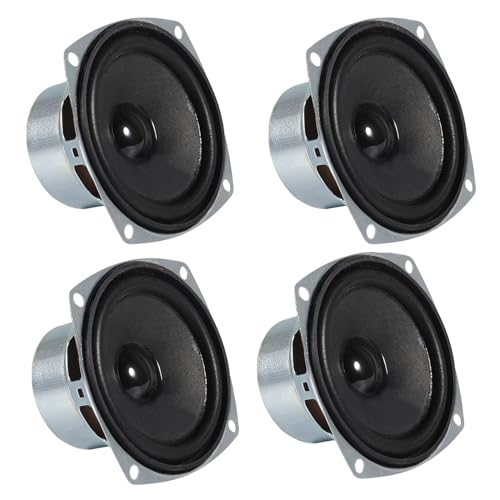
Shutao 3-Inch 8-Ohm 10W is the only driver here with a frequency range, making it the clearest choice when response figures are central to your comparison. It is an 8-ohm, 10-watt speaker with a 78 mm outer diameter, 52 mm height and 71 mm mounting-hole diameter. The maker gives a sensitivity rating of 90 dB. Its range is a useful starting point, but it does not guarantee the same response in every enclosure. Choose another driver if your project requires a 4-ohm load or more than 10 watts.
Bottom line: Pick it when a frequency range and an 8-ohm, 10-watt rating fit your design.
Eboxer-1 3-Inch 5W

That makes it a fit for a small DIY sound box when the power is the main known constraint, rather than a build that must reach a particular frequency. The maker describes its sound as clear and its installation as easy. Treat those as maker claims, not measured comparisons.
Bottom line: Choose it for a 5-watt compact project after confirming amplifier compatibility.
Gikfun 3-Inch 4-Ohm 20W

Gikfun 3-Inch 4-Ohm 20W stands apart with a 4-ohm impedance and 20-watt rated power, plus a 77 mm diameter and 36 mm height. Those dimensions help when checking whether a driver can fit a compact baffle; allow for mounting clearance beyond the cone diameter. The maker positions it for home audio-visual use and DIY projects, including Arduino builds. Match its impedance and power rating to the amplifier and enclosure design.
Bottom line: Pick it for a DIY build designed around a 4-ohm, 20-watt driver.
Dayton Audio PC83-8

Dayton Audio PC83-8 distinguishes itself through its poly-damped woven glass-fiber cone and copper cap, rather than a numeric response range or power rating. The maker says the cone controls breakup and provides a smooth roll-off, while the copper cap keeps inductance under control and extends high-frequency response. The maker also names MTM bookshelf speakers, car audio and line arrays as possible applications. Choose this driver when those design features matter to your project. If your amplifier, power handling or target response requires a numeric specification, this product’s specifications do not establish that match.
Bottom line: Choose it when the cone and inductance-control design features suit your project.
How to compare 3-inch speaker frequency ranges
A frequency range is useful only when you know how it was measured and under what conditions. A driver’s response changes with the enclosure, mounting, listening position and any crossover or equalization; a bare driver’s published range should not be treated as guaranteed in-room output. For a meaningful comparison, look for a response curve and note the tolerance, such as ±3 dB, rather than comparing endpoint numbers alone. A small driver may cover a broad range on paper while producing less bass than a larger driver. If the build needs strong low frequencies, plan for a subwoofer or larger woofer instead of relying on the word “full-range.”
Match a 3-inch speaker to its enclosure
Enclosure volume and construction affect bass response, efficiency and unwanted resonance. A sealed enclosure is typically simpler to design, while a vented enclosure can extend bass near its tuning frequency when properly calculated. A 3-inch driver’s outer diameter is not the same as the cutout size; measure the basket and mounting pattern before cutting a baffle. Use the manufacturer’s driver parameters, such as Fs, Vas and Qts, in an enclosure calculator when available. Without those parameters, treat an enclosure design as an approximation rather than assuming any small box will deliver the same low end. Leave room for the frame and wiring behind the driver.
Choose speaker impedance and amplifier power
Impedance determines the electrical load the speaker presents to an amplifier, and a lower-ohm load can make an amplifier work harder. Check the amplifier’s minimum supported impedance before connecting a 4-ohm or 8-ohm driver; do not assume the two ratings are interchangeable. Speaker power ratings and amplifier output ratings also need careful interpretation, because music is dynamic and clipping can damage a driver even when an amplifier’s nominal wattage seems modest. Keep the signal clean and avoid sustained distortion. When combining multiple drivers, series and parallel wiring change the total load, so calculate the resulting impedance before wiring the system.
Which full-range driver fits your build
Choose by the specification your project cannot compromise: frequency range for a target bandwidth, impedance for amplifier compatibility, power for intended use, or physical dimensions for a tight enclosure. The table separates the known figures from missing ones without treating a missing number as a performance weakness. A dash means the specifications do not provide that value. Before ordering a driver for a fixed baffle, measure both the opening and available mounting depth; a nominal 3-inch label does not establish the cutout diameter. For a multi-driver array, also plan crossover points and wiring before assembly.
| Build requirement | Relevant figure | Decision |
|---|---|---|
| Specified bandwidth | 108 Hz–20 kHz | Choose Shutao 3-Inch 8-Ohm 10W when that stated range is the deciding criterion. |
| 4-ohm load, 20 W | 4 ohms; 20 W | Choose Gikfun 3-Inch 4-Ohm 20W if the amplifier and build support those ratings. |
| Poly-cone design | Poly-damped woven glass fiber | Choose Dayton Audio PC83-8 when the described cone design is the priority. |
| 5-watt driver | 5 W | Consider Eboxer-1 3-Inch 5W after confirming its impedance suits the amplifier. |
Frequently Asked Questions
Does a 3-inch full-range speaker play deep bass?
A 3-inch driver generally has limited deep-bass output compared with a larger woofer, and enclosure design affects the result. For strong low bass, use a subwoofer or larger woofer rather than relying on a full-range label.
What does a speaker frequency range tell me?
A frequency range gives the frequencies a maker says a speaker can reproduce, but it does not show how evenly or loudly it plays them. Look for a response curve and its tolerance to compare performance more meaningfully.
Can I connect a 4-ohm speaker to an 8-ohm amplifier?
Only if the amplifier is rated to support a 4-ohm speaker load. Check its minimum impedance rating first, because a lower load can increase current demand and cause overheating or shutdown.
How much power does a 3-inch speaker need?
The required amplifier output depends on the speaker’s power rating, sensitivity, room and listening level. Stay within the driver’s rated power and avoid sustained clipping, which can damage a speaker even when the nominal wattage seems suitable.
How do I size a cutout for a 3-inch speaker?
Measure the speaker frame and mounting-hole pattern rather than using the nominal 3-inch diameter as the cutout size. Also check mounting depth and leave clearance behind the driver for wiring and movement.