
Intelligent Dual Focus Reading Glasses: 3 Compared

Intelligent Dual Focus Glasses is the closest match for intelligent dual focus reading glasses because its maker describes focus that adjusts with viewing distance. Choose another option if you want a two-pair set or a frame size instead.
These glasses are marketed as changing focus for different viewing distances; its maker does not establish a prescription or a specific vision correction.
We earn a commission if you buy through links on this page. As an Amazon Associate I earn from qualifying purchases. Products are compared on manufacturer specifications, not hands-on testing.
- Best overall: Intelligent Dual Focus Glasses – Its maker describes automatic focus adjustment based on the distance of the viewed object.
- Best for a two-pair set: AQOYNQ Automatic Zoom Glasses – The package includes two pairs, two pouches and two lens cloths.
- Best for a white color option: Nuaiute Presbyopia Glasses – The product is offered in white and the name specifies a two-piece set.
| Product | Best for | Color | Size | Package | Shop |
|---|---|---|---|---|---|
| Intelligent Dual Focus Glasses | Distance-based focus | Clear | One Size | — | Check Price on Amazon |
| AQOYNQ Automatic Zoom Glasses | Two-pair package | Gradient blue | 5.71 inches | 2 pairs, 2 pouches, 2 cloths | Check Price on Amazon |
| Nuaiute Presbyopia Glasses | White two-piece set | White | — | 2 pairs | Check Price on Amazon |
Intelligent Dual Focus Reading Glasses Compared
Compare the focus claims, stated size and package contents before choosing a pair.
Intelligent Dual Focus Glasses

Intelligent Dual Focus Glasses is the clear-lens option, and its maker says the focus adjusts based on the distance of the object being viewed. The product also describes high light transmission and blue-light protection for indoor and outdoor use. Its one-size designation may suit shoppers who do not need a frame measurement, but it does not help buyers compare fit dimensions. Treat the focus and protection language as maker claims, not as a prescription specification; anyone who needs a particular correction should confirm the lens prescription and fit before choosing.
Bottom line: Choose this if a clear finish and maker-described distance-based focus are your priorities.
AQOYNQ Automatic Zoom Glasses

AQOYNQ Automatic Zoom Glasses stands apart with a 5.71-inch size and a package containing two pairs, two pouches and two lens cloths. Its maker says the autofocus changes with the line of sight and describes the glasses for reading, computer use and television viewing. The lenses are PC, while the frame combines TR and metal; the maker also identifies a gradient blue color. The size does not explain which frame dimension it measures, so buyers who need a precise fit should verify the measurement before ordering.
Bottom line: Pick this if you want two pairs and the gradient blue color.
Nuaiute Presbyopia Glasses
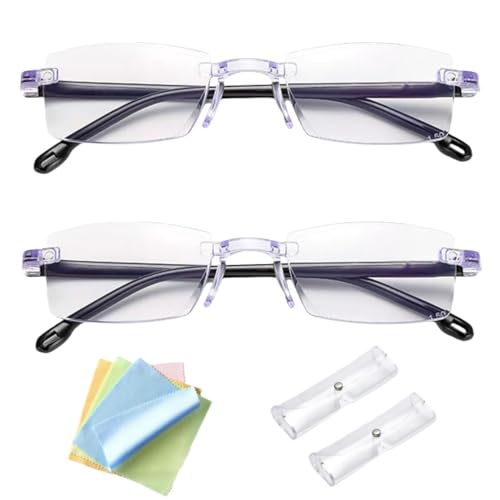
Nuaiute Presbyopia Glasses is the white two-piece set, with maker-described autofocus for reading fine print, screens and distant objects. That makes this option a match for shoppers drawn to the claimed multi-distance use and white color, not for someone selecting glasses by a known lens power or measured frame size. Confirm that the set’s fit and lens correction meet your needs before relying on it for a specific task.
Bottom line: Choose this if a white two-pair set is the deciding preference.
How to choose intelligent dual focus reading glasses
Start with the vision correction you need, then consider whether the glasses provide it. Reading glasses are commonly sold in lens powers from +0.75 to +4.00 diopters, often in 0.25-diopter steps; that range is a general retail convention, not a measure of the options here. Auto-focus wording alone does not identify a lens power, prescription, or mechanism. If you already use prescription lenses, compare the required correction and any astigmatism prescription before selecting nonprescription glasses. For these three options, the practical distinctions are the color, size and package contents rather than a confirmed prescription range.
| Need | What to compare |
|---|---|
| Known vision correction | Lens prescription and power |
| Frame fit | Frame width, bridge and temple length |
| More than one pair | Pair count and included accessories |
Lens types and focus claims
Single-vision readers use one lens power across the lens, while bifocals typically place a near-vision segment below a distance-vision area; progressive lenses blend powers without a visible segment line. These are established lens designs, distinct from the automatic-focus claims made for these products. If near and distance vision both need correction, identify the actual lens design and prescription rather than assuming that “dual focus” means a conventional bifocal or progressive lens.
Fit and size checks before choosing
Frame fit depends on more than an overall width: lens width, bridge width and temple length each affect how glasses sit. A frame that slips or sits too close can make sustained reading uncomfortable, regardless of its focus claim. Compare these measurements with a pair that already fits; if a frame dimension is missing, ask for that measurement before ordering when fit is a deciding factor. The 5.71-inch measurement for AQOYNQ Automatic Zoom Glasses is not labeled by dimension, so do not treat it as a lens width or frame width without confirmation. “One Size” is likewise not a set of fit measurements.
Reading glasses and eye safety
Reading glasses are intended to help with near tasks, but a generic pair is not a substitute for an eye examination or a prescribed correction. Sudden vision changes, eye pain, double vision or a marked difference between the eyes call for professional evaluation rather than trial-and-error readers. For ordinary near-vision use, a common starting point is to hold reading material about 14 to 16 inches away and assess whether the text is clear without strain; working distance and individual prescriptions can change the needed power. Blue-light protection claims do not establish lens power or suitability for a diagnosed eye condition.
Frequently Asked Questions
Are intelligent dual focus glasses prescription readers?
The phrase alone does not establish a prescription. Reading lens powers are commonly sold in 0.25-diopter increments, so verify the actual lens power if you need a specific correction.
How far away should reading text be held?
A common reading distance is about 14 to 16 inches. If you routinely hold text much closer or farther to see clearly, the appropriate lens power may differ.
Do auto-focus glasses work like bifocals?
Not necessarily: bifocals have distinct near and distance portions, while progressive lenses blend lens powers.
What measurements help check eyeglass frame fit?
Compare lens width, bridge width and temple length with a frame that fits you. These three measurements are more useful for fit than a general “One Size” label.
When should I avoid using generic reading glasses?
Do not rely on generic readers for sudden vision changes, eye pain or double vision; seek professional evaluation. Generic readers also may not provide a needed prescription or astigmatism correction.