
Wobble Chairs for Adults: 4 Models Compared by Fit

For most adults, the ERGO COLLECT wobble stool is the clearest fit because its 19.7-to-27.5-inch seat height and 440-pound capacity are specified. Choose Pettibon Therapeutic Wobble Chair instead if you want a full-range exercise chair, or GIANTEX Adjustable Wobble Stool or Pearington SitFree Wobble Stool for stools adjustable from 16.5 to 24 inches.
A wobble chair is a seat designed to move as you shift your weight; it is not a replacement for a stable chair when you need back support or have balance concerns.
We earn a commission if you buy through links on this page. As an Amazon Associate I earn from qualifying purchases. Products are compared on manufacturer specifications, not hands-on testing.
- Best overall: ERGO COLLECT Adult Wobble Stool – Its adjustable 19.7-to-27.5-inch height and 440-pound capacity suit a broader range of adult desk setups.
- Best for exercise motion: Pettibon Therapeutic Wobble Chair – Its pivot permits flexion, extension and 360-degree rotation.
- Best for a lower seat: GIANTEX Adjustable Wobble Stool – Its height adjusts from 16.5 to 24 inches and the stool weighs 10 pounds.
- Best for simple rocking: Pearington SitFree Wobble Stool – Its polypropylene seat allows side-to-side and front-to-back rocking, with height adjusting from 16.5 to 24 inches.
| Product | Best for | Adjustable height | Base or movement | Shop |
|---|---|---|---|---|
| ERGO COLLECT Adult Wobble Stool | Tall desk setups | 19.7–27.5 in | 15° swing; 15.7-in base | Check Price on Amazon |
| Pettibon Therapeutic Wobble Chair | Exercise motion | Height adjustable; range not given | 360° pivot; 24-in width | Check Price on Amazon |
| GIANTEX Adjustable Wobble Stool | Lower desk seating | 16.5–24 in | Non-slip silicone bottom | Check Price on Amazon |
| Pearington SitFree Wobble Stool | Basic rocking | 16.5–24 in | Side-to-side and front-to-back | Check Price on Amazon |
Wobble Chairs for Adults
Compare the height range, movement style and other distinguishing features before choosing a seat for your workspace.
ERGO COLLECT Adult Wobble Stool

Among these stools, the ERGO COLLECT reaches the greatest seat height and gives a specific capacity: 440 pounds. Its centered pivot allows 15-degree movement, and its 15.7-inch silicone base is designed to grip the floor. The 14.4-inch round foam seat suits adults who want a cushioned perch for a home office or standing desk. The limitation is its narrower height range at the low end: buyers whose desk setup needs a seat below 19.7 inches should consider another option.
Bottom line: Choose this stool if your desk needs a higher perch and its minimum height works for you.
Pettibon Therapeutic Wobble Chair

Unlike the height-adjustable perching stools, the Pettibon chair is presented as an exercise seat with flexion, extension and 360-degree rotation around a pivot. Its 24-inch width and 11-inch height are listed, and instructions are included. That motion-focused design may suit an adult seeking a seat for guided movement at home or in a clinic.
Bottom line: Choose this chair for its multi-direction exercise movement rather than a specified desk-height range.
GIANTEX Adjustable Wobble Stool

The GIANTEX stool combines a lower 16.5-inch minimum seat height with a 24-inch maximum, making it a useful option when the higher ERGO COLLECT stool would not fit a desk setup. Its 13-by-13-inch footprint and 10-pound weight make it a compact, relatively light choice for moving between work or classroom spaces. The pneumatic rod adjusts the height, and the bottom is silicone.
Bottom line: Choose this stool if you need a compact seat that adjusts down to 16.5 inches.
Pearington SitFree Wobble Stool
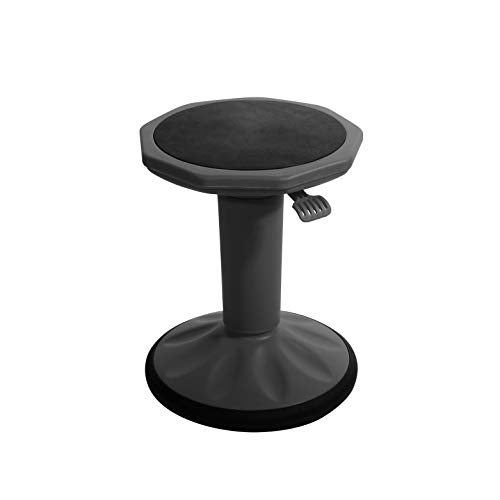
The Pearington SitFree uses a polypropylene seat that rocks side-to-side and front-to-back, rather than the Pettibon chair’s 360-degree exercise pivot or ERGO COLLECT’s specified 15-degree swing. Its height adjusts from 16.5 to 24 inches, and the 12.99-inch square footprint gives it a compact profile for an office or home workspace. The textured seat and non-slip base are intended to limit sliding.
Bottom line: Choose this stool if you want a compact, height-adjustable seat for basic rocking.
How to choose an adult wobble chair
Choose by usable seat height first, then by the kind of movement you want. A desk chair should let your feet rest flat, with knees near hip level; if the seat is too tall, a footrest can help maintain support. For desk work, look for enough height adjustment to align your forearms near desk level without shrugging your shoulders. Wobble seats encourage movement, but they do not provide the same fixed support as a conventional office chair. A practical decision rule: if you cannot keep both feet flat at the stool’s minimum height, pick a lower seat or use a stable chair. Also compare footprint against the space under your desk, especially where a wide base could meet chair legs or drawers.
Wobble chair movement and base styles
Wobble chairs differ in how they move: a pivot may allow rotation, a limited swing may control side-to-side motion, and a rounded or flexible base may allow rocking in more than one direction. A broader base generally gives more floor contact, but it does not make a moving stool equivalent to a fixed chair. Match movement to the task: modest rocking is easier to manage while typing, while wider movement is better suited to intentional exercise breaks. Check that the floor surface is level and the base does not collide with nearby furniture. Avoid using a wobble seat on stairs, uneven flooring or a surface where its base can catch; anyone with balance limitations should favor a stable chair.
Set stool height for a desk
Set the seat so your feet are supported and your shoulders can relax while your hands reach the keyboard. A typical seated elbow angle is close to 90 degrees, but desk height, keyboard position and body proportions change the best setting. Start at the lowest stool height, sit with both feet planted, then raise the seat only enough to bring your forearms comfortably toward desk level. If the seat must rise above a comfortable foot-supported position, add a stable footrest or use a lower desk or chair combination. Measure from floor to the underside of your desk before selecting a stool, and leave room for the seat base to move without hitting desk supports.
Use wobble seating without overdoing it
Use a wobble stool for short work intervals or movement breaks rather than treating it as an all-day substitute for a supportive chair. New users can begin with 15 to 30 minutes and change position if their legs or back become uncomfortable; alternate with standing or stable seated work. Keep the stool on a flat, dry floor and sit centered over its base before shifting. Do not lean far enough that the base edge lifts or the stool tips. A wobble stool is a poor choice for tasks requiring precise stillness, carrying hot drinks, or working near objects that could be knocked over. Stop using the stool if its base, seat or adjustment mechanism feels loose.
Frequently Asked Questions
How high should an adult wobble stool be?
Set the stool so both feet can rest flat and your shoulders stay relaxed at the desk. An elbow angle near 90 degrees is a useful starting point, but desk height and body proportions affect the final setting.
Can adults use a wobble stool all day?
It is better to alternate wobble seating with standing or a stable chair. Begin with 15 to 30 minutes if you are new to moving stools, and change position if discomfort develops.
Are wobble stools suitable for standing desks?
Yes, when the stool height reaches the desk setup and allows supported feet and relaxed shoulders. Measure floor-to-desk height first; a stool that tops out below the needed seat height will not work well.
What floor works best for a wobble chair?
A level, dry, firm floor lets the base move predictably. Avoid stairs, uneven surfaces and loose rugs that can catch or shift under a rocking base.
Are wobble chairs safe for people with balance problems?
A moving stool may be difficult to control for someone with balance limitations. A stable chair with a fixed base is the safer default when steady support is needed.