
Best Inexpensive HVLP Spray Guns Compared

For a versatile air-powered HVLP spray gun, HVLP Spray Gun Kit, 3 Nozzles is the best fit because its three nozzle sizes cover a wider range of coatings than a single-tip setup. Choose a different option if you want two guns for separate tasks or a four-size nozzle range.
HVLP means high-volume, low-pressure: the gun uses a large volume of air at lower atomizing pressure than conventional spray guns. None of these specifications gives a price, so compare cost separately rather than assuming a particular kit is inexpensive.
We earn a commission if you buy through links on this page. As an Amazon Associate I earn from qualifying purchases. Products are compared on manufacturer specifications, not hands-on testing.
- Best overall: HVLP Spray Gun Kit, 3 Nozzles – Includes 1.4, 1.7 and 2.0 mm nozzles plus a 600 cc cup for varied coating tasks.
- Best for larger tips: HVLP Spray Gun Kit, 4 Nozzles – Its four listed nozzle sizes include a 2.5 mm option for coatings that call for a larger tip.
- Best for two-gun setup: HVLP Gravity Gun Set, 0.8 and 1.4 mm – Pairs a 0.8 mm gun with a 150 ml cup and a 1.4 mm gun with a 600 ml cup.
| Product | Best for | Nozzle sizes | Cup capacity | Kit setup | Shop |
|---|---|---|---|---|---|
| HVLP Spray Gun Kit, 3 Nozzles | Versatile coating tasks | 1.4, 1.7, 2.0 mm | 600 cc | One gun, 3 nozzles | Check Price on Amazon |
| HVLP Spray Gun Kit, 4 Nozzles | Larger tip range | 1.4, 1.7, 2.0, 2.5 mm | — | One gun, 4 nozzles | Check Price on Amazon |
| HVLP Gravity Gun Set, 0.8 and 1.4 mm | Separate task guns | 0.8, 1.4 mm | 150 ml; 600 ml | Two guns, 2 nozzles | Check Price on Amazon |
HVLP Spray Guns Compared
Compare nozzle options and kit configurations, then check that your compressor and coating can support the setup you choose.
HVLP Spray Gun Kit, 3 Nozzles
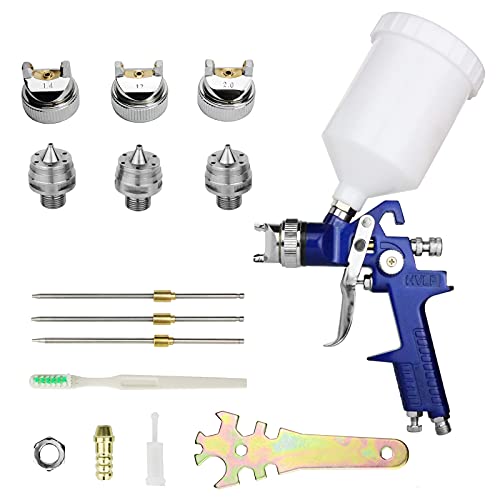
The three-nozzle set gives this air-powered HVLP gun more tip choices than a basic single-nozzle setup. It includes 1.4, 1.7 and 2.0 mm nozzle-and-needle caps and a 600 cc cup, with applications spanning automotive coatings, furniture, walls and crafts. That range can suit a DIYer switching among coating types, provided the coating maker’s instructions support the selected tip and dilution.
The limitation is that the kit’s features do not give an air-consumption figure, so buyers with a small compressor should confirm its compatibility before ordering. Test the spray pattern with water before loading coating.
Bottom line: Pick this if you want three tip sizes in one 600 cc-cup setup.
HVLP Spray Gun Kit, 4 Nozzles

The 2.5 mm tip is the distinguishing option in this four-nozzle kit, alongside 1.4, 1.7 and 2.0 mm sizes. That broader stated range may help when a coating calls for a larger opening, while the gun is intended for automotive paint, furniture, walls and repair work. Check the coating maker’s recommended nozzle size before choosing a tip; a larger number alone does not guarantee a suitable finish.
Its applications are broad, but the maker does not provide air-consumption or operating-pressure figures, so verify compressor fit.
Bottom line: Choose this if your coating calls for a tip up to 2.5 mm.
HVLP Gravity Gun Set, 0.8 and 1.4 mm
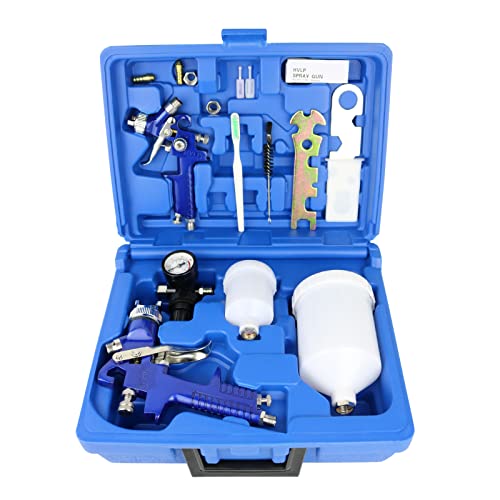
The two-gun arrangement separates a 0.8 mm tip with a 150 ml cup from a 1.4 mm tip with a 600 ml cup. That can be useful when a buyer wants one small-cup gun for detail work and another for broader spraying, rather than changing tips on one gun. The set also includes wrenches and cleaning tools, and its uses range from crafts to furniture and automotive spraying.
The trade-off is a narrower nozzle span than kits with several interchangeable tips; there is no included 1.7 or 2.0 mm size. Check the coating maker’s tip guidance, and confirm the small gun’s capacity suits the amount of material needed.
Bottom line: Pick this if you prefer two guns and distinct cup sizes for separate tasks.
How to choose an HVLP spray gun
Choose an HVLP gun by matching the nozzle to the coating and the air supply to the gun. A 1.3–1.4 mm tip is a common starting range for many basecoats and clearcoats, while thicker primers often call for a larger tip; the coating maker’s recommendation takes priority. A larger opening can pass more material, but it does not automatically produce a better finish.
For air-powered guns, compare compressor delivery in cubic feet per minute (CFM) at the required pressure, not just the tank’s gallon capacity. A tank can buffer short bursts, but a compressor that cannot sustain the gun’s air demand may cause pressure drop during a pass. If the maker gives no CFM or pressure requirement, confirm compatibility before buying.
What nozzle size and cup capacity mean
Nozzle size is the opening through which coating flows, measured in millimeters; common automotive tips often fall around 1.3–1.8 mm, with thicker materials sometimes needing larger openings. Viscosity, coating formulation and the finish target all affect the suitable size, so use the coating maker’s guidance rather than thinning by guesswork.
Cup capacity affects how often a job needs refilling, not spray quality. A 600 ml cup holds four times the volume of a 150 ml cup, which can reduce interruptions on larger areas but adds material weight at the gun. For small parts or detail work, a smaller cup may be easier to manage. This quick guide maps needs to practical choices.
| Need | Choice to consider |
|---|---|
| Several coating types | Multiple tips that match coating guidance |
| Small parts or detail work | Smaller tip and cup |
| Longer spraying intervals | Larger cup, if the added weight is manageable |
HVLP spray gun setup and safe spraying
Set the fan pattern and fluid flow with the coating material or a test surface before spraying the finished work. Keep the gun perpendicular to the surface and move at a steady pace; arcing the wrist changes the spray distance and can create uneven coverage. Follow the coating label for mixing and reduction, since excess thinning can affect coverage and finish.
Spray only with strong ventilation and the respiratory protection specified by the coating’s safety label; many automotive coatings contain hazardous vapors. Keep ignition sources away from flammable paint and solvent vapors, and use eye protection and gloves suited to the product. Never spray toward people, pets or an unprotected nearby area, and collect overspray rather than letting it drift outdoors.
Common HVLP spray gun buying mistakes
The most common mistake is choosing a gun by nozzle count without checking air supply. If the compressor cannot sustain the gun’s required CFM at operating pressure, atomization can become inconsistent; compare delivery ratings under load rather than tank size alone. Another mistake is treating every 1.4 mm tip as interchangeable across coatings: the material’s viscosity and maker guidance still determine whether that tip is appropriate.
Buyers also overlook cleanup. Paint left in passages can dry and obstruct fluid flow, so flush the gun promptly with the solvent or cleaning method specified for the coating. Do not soak seals or use a wire that can enlarge the nozzle opening. A damaged or partly blocked tip can distort the fan pattern even when the gun is adjusted correctly.
Frequently Asked Questions
What nozzle size works for automotive paint?
Many automotive basecoats and clearcoats commonly use a 1.3–1.4 mm tip, while primer may need a larger opening. The coating maker’s instructions should decide the final tip size and any reduction.
How much air does an HVLP spray gun need?
Air-powered HVLP guns vary, so match the compressor’s delivered CFM at operating pressure to the gun’s requirement. Tank capacity alone cannot show whether the compressor will sustain spraying.
How far should an HVLP gun be from the surface?
A working distance around 6–8 inches is common for many spray guns, but the correct distance depends on the gun, coating and fan pattern. Keep the gun perpendicular and use a test surface to confirm coverage.
How should I clean an HVLP spray gun after use?
Flush the gun promptly with the cleaner compatible with the coating, before residue dries in its fluid passages. Remove the nozzle and needle for cleaning as directed, and avoid tools that can scratch or enlarge the tip.
Can HVLP spray guns be used indoors?
Indoor spraying requires strong ventilation and respiratory protection selected for the coating’s safety label. Keep flammable vapors away from ignition sources, and contain overspray so it does not settle on people or nearby surfaces.