
Storage for Cutting Boards: 3 Cabinet Organizers Compared

For storage for cutting boards, the Fikoksol five-slot rack suits most people who need a compact holder and whose boards fit its 1.2-inch slots. Choose an expandable divider rack instead if you need adjustable spacing or room for several wider items.
We earn a commission if you buy through links on this page. As an Amazon Associate I earn from qualifying purchases. Products are compared on manufacturer specifications, not hands-on testing.
- Best overall: Fikoksol Five-Slot Wire Organizer – Five 1.2-inch slots provide a compact way to separate slim boards and trays.
- Best for adjustable width: Expandable Organizer with Metal Base – The organizer expands from 11.8 to 22.8 inches and has 12 adjustable dividers.
- Best for more dividers: Housolution 14-Divider Organizer – Fourteen adjustable dividers and anti-scratch strips accommodate varied cookware.
| Product | Best for | Slots or dividers | Width range | Material | Shop |
|---|---|---|---|---|---|
| Fikoksol Five-Slot Wire Organizer | Slim boards | 5 slots, 1.2 in. each | 7.87 in. wide | Iron wire | Check Price on Amazon |
| Expandable Organizer with Metal Base | Expandable storage | 12 adjustable dividers | 11.8–22.8 in. | Metal base and frame | Check Price on Amazon |
| Housolution 14-Divider Organizer | Many dividers | 14 adjustable dividers | 12–23 in. approx. | Iron | Check Price on Amazon |
Storage for Cutting Boards Compared
Compare each organizer’s spacing and footprint with your boards and available cabinet space.
Fikoksol Five-Slot Wire Organizer
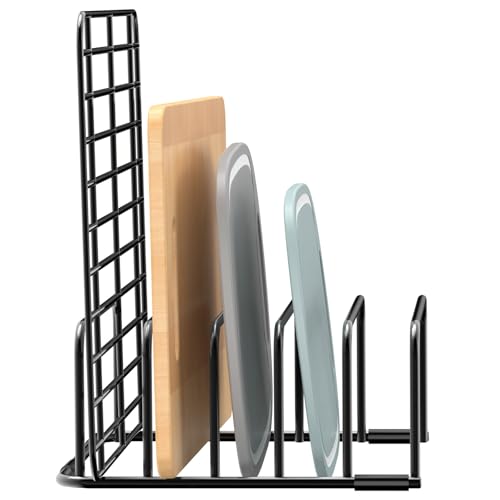
The Fikoksol organizer is the compact option here, with five fixed slots in a 7.87-by-7.24-by-3.28-inch footprint. Its iron-wire construction has a black coating, and the slots can separate cutting boards, baking sheets, or plates. The maker says the rack is unsuitable for utensils thicker than 1.2 inches, including deep bakeware; measure your thickest item before choosing it. Fixed spacing also makes this a poor match for a collection of unusually thick or mixed-size cookware that needs flexible dividers. Choose it when the boards are slim and a small, simple rack is the priority.
Bottom line: Pick this if your boards fit the fixed 1.2-inch slots and you want a compact rack.
Expandable Organizer with Metal Base

The expandable organizer offers the broadest width adjustment, extending from 11.8 to 22.8 inches, while its 12 dividers can be positioned to suit different item widths. The maker says its metal base weighs 2.8 pounds and the organizer supports up to 40 pounds. It can be assembled as one expandable unit or separated into two independent organizers, giving it a different setup from fixed-slot racks. The tradeoff is its larger footprint and greater setup complexity; measure the cabinet area and check shelf clearance before committing. It suits kitchens storing boards alongside pans or lids that need adjustable spacing.
Bottom line: Choose this for adjustable spacing and a cabinet layout that can accommodate its expanded width.
Housolution 14-Divider Organizer

The Housolution rack has 14 adjustable dividers, two more than the other adjustable organizer here, and includes anti-scratch strips on both sides. Its iron construction and curved dividers are intended to hold cutting boards, baking sheets, pans, and plates in separated positions. The overall length is 21.65 inches, so it is less adaptable in footprint than the organizer that expands across an 11.8-to-22.8-inch range. That makes cabinet measurement especially important, particularly if the organizer will sit under a sink or on a countertop. Consider it when divider count and cookware protection matter more than a compact fixed-slot design.
Bottom line: Pick this if you want 14 repositionable dividers and have room for its length.
How to choose cutting board storage
Match the organizer’s spacing to your thickest board, then compare its footprint with the shelf or counter where it will sit. Fixed slots are simple, but a 1.2-inch slot will not take a thicker item; adjustable dividers accommodate more varied widths. For a tall collection, favor vertical separation so boards can be lifted out without moving a stack. Cabinet depth and shelf clearance both matter: measure the usable interior, not just the door opening, and account for any lip or hinge intrusion.
Storage organizers do not replace a clean, dry surface. Wash boards after use and let them dry fully before putting them away; trapped moisture can encourage odors and damage wood. Keep raw-meat boards separate from ready-to-eat food boards, and avoid tightly packing wet boards together.
Fixed slots versus adjustable dividers
Fixed-slot racks suit a small set of similarly sized boards, while adjustable organizers give more flexibility for pans and trays. Spacing should be wide enough to retrieve each item without scraping its neighbors; too much empty room can also let thin boards lean and slide. This table matches organizer style to the storage need.
| Organizer style | Best fit | Check before choosing |
|---|---|---|
| Fixed slots | Similar slim boards | Slot width versus thickest item |
| Adjustable dividers | Mixed board and pan widths | Maximum width and shelf footprint |
Measure cabinet space before setup
Measure usable width, depth, and height where the rack will sit, and compare those dimensions with its full footprint. Expandable organizers need room for the chosen width, while a rack under a cabinet also needs clearance to lift boards out. A quick rule: if a fixed slot is narrower than your thickest board, choose adjustable spacing instead. Check that cabinet doors close freely and that the organizer does not block a drawer, plumbing, or another stored item. Leave enough room to grasp a board’s top edge rather than wedging it tightly against the shelf above.
Keep stored cutting boards clean and dry
Dry boards completely before storage, especially wood boards, because moisture trapped between surfaces can lead to odor or warping. For routine cleaning, wash after food preparation and dry promptly; sanitizing practices differ by material, and wood should not be left soaking in water. Separate boards used for raw meat from those used for produce or cooked foods to reduce cross-contamination risk. Avoid forcing boards into narrow gaps, which can scrape edges and make removal awkward. If a board remains damp, let it air-dry outside the organizer before returning it to storage.
Frequently Asked Questions
How wide should cutting board storage slots be?
Choose a slot wider than the thickest board you plan to store; a 1.2-inch opening will not fit thicker items. For mixed thicknesses, adjustable dividers are more flexible than fixed slots.
Should cutting boards be stored vertically or flat?
Vertical storage in separated slots helps air circulate and makes individual boards easier to retrieve. Store boards only after they are fully dry, and avoid packing them tightly together.
How do I keep wood cutting boards from warping?
Dry wood boards promptly and store them away from standing water or prolonged dampness. Do not leave wooden boards soaking, and allow airflow around them rather than wedging them into a crowded space.
Can cutting boards be stored with baking sheets?
Yes, if each item fits the organizer’s spacing and can be removed without scraping or tipping neighboring items. Adjustable dividers can better accommodate differing widths than fixed slots.