
Top Shelf Big Closet: 4 Storage Options Compared

For most big closets, the ClosetMaid SuiteSymphony shelf is the clearest fit: its 47.7-inch-wide board provides a continuous surface for blankets or small luggage. Choose a cube unit or compartment organizer instead when sorting items matters more than one long shelf.
We earn a commission if you buy through links on this page. As an Amazon Associate I earn from qualifying purchases. Products are compared on manufacturer specifications, not hands-on testing.
- Best overall: ClosetMaid SuiteSymphony 48-Inch Shelf – A nearly 48-inch board creates one broad shelf surface and can be cut to fit.
- Best for cube storage: Furinno FANO 6-Cube Organizer – Six compartments separate folded clothes, towels, shoes and accessories.
- Best for adjustable sections: Hongtamoya Adjustable-Divider Organizer – Adjustable dividers and stackable construction let you change compartment layouts.
| Product | Best for | Width | Height | Storage type | Shop |
|---|---|---|---|---|---|
| ClosetMaid SuiteSymphony 48-Inch Shelf | Long shelf surface | 47.7 in. | 0.625 in. | Open board | Check Price on Amazon |
| Furinno FANO 6-Cube Organizer | Six-cube sorting | 36 in. | 15.4 in. | Six cubes | Check Price on Amazon |
| Hongtamoya Adjustable-Divider Organizer | Flexible compartments | 32.7 in. | 15 in. | Adjustable dividers | Check Price on Amazon |
| HBlife Clear Shelf Dividers, 6 Pack | Separating shelf piles | 11.29 in. | 7.51 in. | Six dividers | Check Price on Amazon |
Top Shelf Big Closet Options
Choose a continuous shelf surface, divided compartments or dividers based on what you need to store.
ClosetMaid SuiteSymphony 48-Inch Shelf

The ClosetMaid SuiteSymphony shelf is the only broad, continuous board in this group, making it the best match for a big closet top shelf. It measures 47.7 inches wide by 13.8 inches long and can be cut to fit the available span. Use it for blankets, small luggage or other items that benefit from an uninterrupted surface.
It can be added above hang rods or used on its own. Support brackets are sold separately, so it suits buyers who already have a compatible mounting plan; factor in the separate bracket purchase before choosing it.
Bottom line: Pick this if you want one long shelf surface and can provide separate support brackets.
Furinno FANO 6-Cube Organizer

The Furinno FANO replaces a long shelf board with six separate storage spaces: four closed-back cubes and two lower open shelves. Its 36-inch width and 11.7-inch depth give it a low, horizontal footprint for a closet, bedroom or laundry room.
The separated spaces help keep folded clothes, towels, baskets, shoes and accessories from mixing together. Choose it when sorting is more important than maximizing a single shelf span. The cube layout is a different kind of storage than a wall-mounted top shelf, so check that its 15.4-inch height fits the intended location.
Bottom line: Choose it when six distinct storage spaces matter more than a continuous shelf.
Hongtamoya Adjustable-Divider Organizer
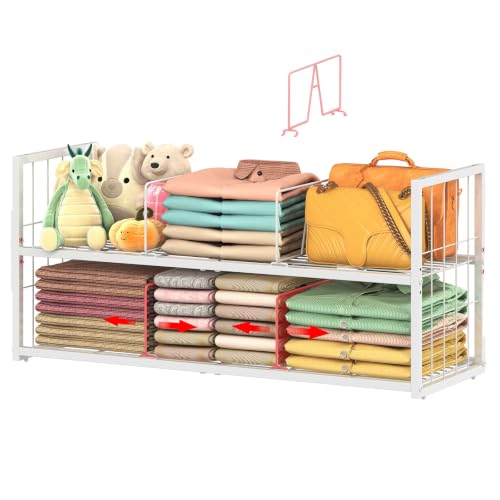
The Hongtamoya organizer stands out for adjustable dividers rather than fixed cube compartments. The 32.7-inch-long, 12.62-inch-wide unit can be arranged for clothing, purses or shoes, and multiple units are designed to stack for a taller storage setup.
This approach suits closets where the items change size or category, including a bedroom or RV closet. Its 15-inch height also needs to fit the available vertical space.
Bottom line: Pick this for compartments you can rearrange or expand by stacking.
HBlife Clear Shelf Dividers, 6 Pack

The HBlife set adds six clear acrylic dividers to an existing shelf rather than supplying a shelf of its own. Slide the dividers into place without tools to separate stacks of sweaters, shirts or purses, and move them to adjust the spacing between groups.
The smooth, rounded design is intended to avoid snagging clothing, and the clear material keeps the shelf visible. This is useful when a big closet already has a board but piles need boundaries. The dividers should not be mounted on a board thicker than 0.95 inches, so measure the shelf before choosing this set.
Bottom line: Choose these when you already have a shelf and need to separate items on it.
How to choose a top shelf for a big closet
Choose a continuous board for bulky items and compartments when you need smaller groups kept separate. A 47.7-inch-wide board provides one long surface; cube and divider systems trade that uninterrupted span for organization. Measure the usable width and depth first, then reserve room for the items you plan to store. As a practical rule, if a single item is wider than one compartment, favor a board rather than a cube layout. For a board installation, include the support method in the plan: brackets are sold separately for the SuiteSymphony shelf. Avoid treating a freestanding organizer as a wall-mounted shelf; their footprints and support needs differ.
Measure closet clearance before choosing
Measure both the shelf span and the vertical opening before settling on a format. The SuiteSymphony board is 47.7 inches wide and 13.8 inches long, while the Furinno is 36 inches wide, 11.7 inches deep and 15.4 inches tall. Those dimensions make them different fits even where both may hold folded items. Leave enough vertical clearance to place and remove the tallest stored item without scraping the ceiling or rod. For shelf dividers, measure board thickness as well as width: the HBlife set’s limit is a board no thicker than 0.95 inches. A level measuring tape check can prevent a mismatch between the closet opening and the organizer footprint.
Top shelf and closet organizer types compared
The main distinction is whether the product creates a surface, divides an existing surface or supplies its own compartments. Use this guide to match the storage format to the items and existing closet structure.
| Storage need | Format | Choose when |
|---|---|---|
| One broad surface | Open shelf board | Items need a continuous place to rest |
| Separate categories | Cube organizer | Folded goods or accessories benefit from individual spaces |
| Changeable sections | Stackable organizer | Compartment sizes need to adapt |
| Keep piles apart | Shelf dividers | A usable shelf is already installed |
Keep the footprint and installation method in view: only a board designed for mounting should be planned as a top shelf surface.
Install and use closet shelves safely
Support is essential for an overhead shelf: use brackets appropriate to the shelf and wall, and secure them into suitable structural support rather than relying on drywall alone. Do not exceed the shelf or bracket maker’s load limit; the specifications here do not provide a capacity, so confirm the allowable load before storing heavy luggage. Keep heavy items low and reserve overhead storage for lighter belongings that can be lifted down under control. For freestanding cube or stackable units, follow their intended orientation and avoid placing a top-heavy load on an unstable stack. Measure first, install securely, and leave a clear path beneath overhead storage.
Frequently Asked Questions
What should go on a closet top shelf?
Blankets, seasonal clothing and small luggage are common top-shelf items because they are used less often than daily clothes. Keep heavy or awkward objects lower so they can be lifted safely.
How deep should a closet top shelf be?
A depth around 12 to 16 inches is a common practical range for closet storage, though closet layout and stored items can change the fit. Measure from the wall to the front edge you can use without interfering with doors or hanging clothes.
How do I keep folded clothes from falling over?
Use shelf dividers to separate stacks, or place folded clothes in individual cubes. Keep stacks low enough that they remain stable when pulling one garment out.
How much weight can a closet shelf hold?
Capacity depends on the shelf material, bracket spacing, fasteners and wall structure, so no single load limit applies to every installation. Confirm the shelf and bracket limits before storing heavy items, and anchor supports into suitable structural framing.
Can a closet shelf be cut to fit?
Some shelf boards are designed to be cut, but the cut edge and support placement still matter. For this board, the maker says it can be cut to fit; plan the cut so the shelf remains supported at both ends.