
Milwaukee M18 Coffee Makers Compared by Battery Fit

For a coffee maker compatible with Milwaukee M18 batteries, Byutrcfuy M18-Compatible Coffee Maker is the closest match because it specifically supports Milwaukee 18V batteries. None of these products is branded Milwaukee; Makita DCM501Z Cordless Coffee Maker and Makita CM501DZ Rechargeable Coffee Maker use Makita battery systems, while BougeRV 144Wh Portable Coffee Maker comes with its own removable battery.
Choose a different option if you need K-Cup compatibility, Makita batteries, or a battery rather than an M18-compatible tool-only unit.
We earn a commission if you buy through links on this page. As an Amazon Associate I earn from qualifying purchases. Products are compared on manufacturer specifications, not hands-on testing.
- Best overall: Byutrcfuy M18-Compatible Coffee Maker – It specifically identifies Milwaukee 18V compatibility and includes a reusable metal filter and separate grinder.
- Best for K-Cups: BougeRV 144Wh Portable Coffee Maker – It supports K-Cup pods and ground coffee, and includes a removable 144Wh battery.
- Best for Makita batteries: Makita DCM501Z Cordless Coffee Maker – It works with Makita 18V LXT or 12V max CXT batteries and can use single-serve packs or grounds.
| Product | Best for | Battery setup | Brew format | Cup capacity | Shop |
|---|---|---|---|---|---|
| Byutrcfuy M18-Compatible Coffee Maker | M18 battery fit | Milwaukee 18V; tool only | Ground coffee; grinder | 8 oz per brew | Check Price on Amazon |
| Makita DCM501Z Cordless Coffee Maker | Makita battery fit | Makita 18V LXT or 12V max CXT | Single-serve packs or grounds | 5 oz per brew | Check Price on Amazon |
| Makita CM501DZ Rechargeable Coffee Maker | Makita battery range | Makita 10.8V, 14.4V, or 18V | — | 240 ml tank | Check Price on Amazon |
| BougeRV 144Wh Portable Coffee Maker | Pods and battery | Included 18V 8Ah / 144Wh battery | K-Cup pods or grounds | 8 oz; 5–6 cups per charge | Check Price on Amazon |
Milwaukee M18 coffee makers and alternatives
Compare battery compatibility first, then match the brew format and capacity to your routine.
Byutrcfuy M18-Compatible Coffee Maker

For Milwaukee 18V battery compatibility, this is the only choice in this group that explicitly names that system. The maker says its 400W heater reaches 195–205°F and brews an 8-ounce cup in a few minutes; it also includes a reusable metal filter and separate grinder. The maker estimates 2–3 cups from a 4Ah battery, and says up to four batteries can be used.
Bottom line: Choose this if using a Milwaukee 18V battery is the deciding requirement.
Makita DCM501Z Cordless Coffee Maker

Unlike an M18-compatible model, this coffee maker is built for Makita 18V LXT or 12V max CXT batteries. Makita says it brews one 5-ounce cup in five minutes on an 18V LXT battery and up to three cups per charge with a 5.0Ah battery. Its permanent drip filter accepts grounds without paper filters, and it also works with single-serve packs. The 3½-inch cup clearance is a practical constraint: measure the mug, especially if you use a taller travel cup. The battery is not included.
Bottom line: Pick this if you already use a compatible Makita battery and want grounds or single-serve packs.
Makita CM501DZ Rechargeable Coffee Maker
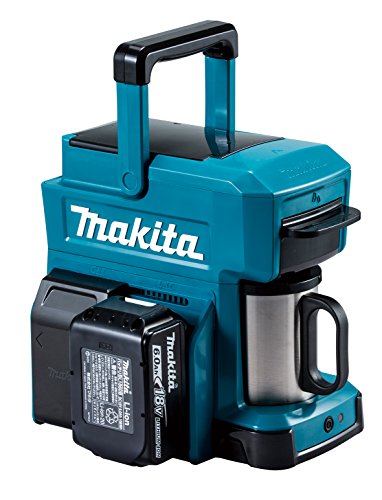
Its distinguishing point is compatibility across Makita slide-type 10.8V, 14.4V, and 18V lithium-ion batteries, rather than Milwaukee M18 batteries. The water tank holds 240 milliliters, and the machine weighs 1.5 kilograms without a battery or cup. That tank size is useful for checking whether its capacity suits your serving; 240 milliliters is about 8.1 US fluid ounces. Battery and charger are sold separately. The product name identifies a Japan-market item, so check plug or charging needs if you expect to use included power accessories.
Bottom line: Choose it if you need the Makita slide-battery range and a 240-milliliter tank.
BougeRV 144Wh Portable Coffee Maker

For someone who wants a battery included, this BougeRV differs from the tool-only choices: its removable battery is rated 8Ah and 144Wh, and the maker estimates five to six 8-ounce cups per charge. It supports K-Cup pods, coffee powder, and ground coffee, and can also run from AC power. The maker gives a 6–8 minute brew time and notes that ambient and water temperature affect the number of cups per charge. Its 18V rating alone does not establish Milwaukee battery compatibility; this is a separate battery system.
Bottom line: Pick this if you want K-Cup compatibility and a removable battery.
How to choose an M18 coffee maker
Start with battery compatibility, not the shared 18V label. Battery systems use brand-specific mounts and electronics, so voltage by itself does not mean packs interchange; look for explicit Milwaukee 18V or M18 compatibility. Next, compare the amount brewed per cycle and the battery estimate, which is not the same as a guaranteed number of servings in every condition. For a single 8-ounce serving, a model specifying 8 ounces per brew may fit; for repeated servings, check its capacity per charge. Also decide whether you use loose grounds or pods. A reusable filter suits grounds, while a pod-compatible machine accommodates single-serve packs. Check cup clearance against your mug height before choosing.
| Need | Feature to verify | Choice in this group |
|---|---|---|
| Milwaukee battery | Explicit Milwaukee 18V fit | Byutrcfuy M18-Compatible Coffee Maker |
| K-Cup pods | Pod compatibility | BougeRV 144Wh Portable Coffee Maker |
| Makita battery | Makita system compatibility | Makita DCM501Z Cordless Coffee Maker or Makita CM501DZ Rechargeable Coffee Maker |
Battery fit and runtime
Battery voltage and brand compatibility are separate checks: an 18V pack from one brand is not automatically interchangeable with another brand’s tool. Confirm the mount and exact battery family before buying a tool-only coffee maker. Capacity in amp-hours (Ah) indicates stored charge within a compatible battery family, while watt-hours (Wh) express energy; multiplying nominal volts by amp-hours gives an approximate Wh rating. Runtime also changes with water temperature, ambient conditions, and how much water the machine heats. Treat cup-per-charge estimates as maker claims, not fixed guarantees. For worksite use, keep batteries and the coffee maker away from water and follow the battery maker’s charging and handling limits.
Pods, grounds, and brew size
Choose the brew format you already keep on hand: grounds need a suitable filter, while single-serve packs need explicit pod support. A permanent or reusable filter removes paper-filter use but still needs rinsing after brewing to clear grounds and oils. Capacity figures also need careful reading: a tank’s milliliters describe water volume, while a per-cup figure describes a brew serving. One US fluid ounce equals about 29.6 milliliters, so 240 milliliters is roughly 8.1 fluid ounces. Leave room below the spout for a mug, and measure its height; a machine’s cup clearance is the maximum physical fit, not necessarily the desired serving size.
Hot-water and battery safety
Coffee makers that heat water can cause scalds; hot water at around 140°F can burn skin in seconds, so keep the brewer stable and out of children’s reach while operating and cooling. Do not handle hot water over a battery or charger, and keep electrical contacts dry. For portable use, operate on a flat, secure surface where the cup cannot tip, and avoid brewing while carrying or driving. A maker’s reported brewing temperature describes water output, not a safe drinking temperature; let coffee cool before sipping. Use only battery packs and power inputs confirmed for that particular machine, because a matching voltage label alone cannot confirm fit or safe power delivery.
Frequently Asked Questions
Can I use any Milwaukee 18V battery with a coffee maker?
Only if the coffee maker explicitly supports the battery family and physical connection. The 18V label alone does not guarantee compatibility, so confirm the exact M18 fit before use.
How many ounces are in a 240 ml coffee tank?
A 240-milliliter tank holds about 8.1 US fluid ounces. The amount of brewed coffee may be lower if some water remains in the machine or grounds.
How long does a cordless coffee maker take to brew?
The models here give estimates ranging from a few minutes to 6–8 minutes, depending on the product. Water temperature and serving size affect heating time.
Can single-serve coffee makers use regular grounds?
Some can, but pod support does not guarantee grounds support. Choose a brewer that explicitly accepts grounds and check whether it needs a filter or adapter.
How should I clean a reusable coffee filter?
Let the filter cool, empty the grounds, and rinse it after each brew so residue does not build up. Avoid rinsing near battery contacts or placing electrical parts in water.