
KSP Wheel Spacers: 5 Sizes and Fits Compared

For many Silverado and Sierra 1500 owners, KSP 1.5-Inch 6×5.5 Spacer is the most versatile starting point because it pairs a 1.5-inch thickness with a 78.1mm hub bore and broad listed fitment. Choose a different spacer when your vehicle needs a different lug pattern, bore, or amount of outward wheel position.
Wheel spacers bolt between the hub and wheel to move the wheel outward; confirm the exact vehicle year, hub bore, and bolt pattern before ordering.
We earn a commission if you buy through links on this page. As an Amazon Associate I earn from qualifying purchases. Products are compared on manufacturer specifications, not hands-on testing.
- Best overall: KSP 1.5-Inch 6×5.5 Spacer – Its 1.5-inch thickness and 78.1mm bore are paired with broad Silverado, Sierra, Tahoe, and Yukon fitment.
- Best for 2-inch stance: KSP 2-Inch 6×5.5 Spacer – The 2-inch spacer has a 108mm hub bore and M14x1.5 studs for its truck applications.
- Best for Tacoma fit: KSP 1.25-Inch Tacoma Spacer – Its 1.25-inch thickness, 106mm bore, and M12x1.5 studs target listed Toyota 6-lug applications.
| Product | Best for | Thickness | Bolt pattern | Hub bore | Shop |
|---|---|---|---|---|---|
| KSP 1.5-Inch 6×5.5 Spacer | Silverado and Sierra | 1.5 in | 6×139.7 mm | 78.1 mm | Check Price on Amazon |
| KSP 2-Inch 6×5.5 Spacer | Two-inch clearance | 2 in | 6×139.7 mm | 108 mm | Check Price on Amazon |
| KSP 1.25-Inch Tacoma Spacer | Toyota 6-lug fit | 1.25 in | 6×139.7 mm | 106 mm | Check Price on Amazon |
| KSP 1.5-Inch F-150 Spacer | 2015-plus F-150 | 1.5 in | 6×135 mm | 87.1 mm | Check Price on Amazon |
| KSP 1.5-Inch 5×5.5 Ram Spacer | Five-lug Ram | 1.5 in | 5×139.7 mm | 77.8 mm | Check Price on Amazon |
KSP Wheel Spacers Compared
Compare thickness, bolt pattern, and hub bore first, then confirm the spacer matches your vehicle and wheel.
KSP 1.5-Inch 6×5.5 Spacer

This 1.5-inch 6-lug spacer is the most broadly specified Silverado and Sierra option here, with fitment spanning many model years and related GM trucks. It uses forged 6061-T6 aluminum, a 78.1mm hub bore, and M14x1.5 studs. The black anodized finish is intended to resist corrosion. Its thickness moves the wheel farther out than a 1.25-inch spacer, so check fender and suspension clearance before selecting it. The fitment is broad, but buyers should verify the vehicle’s exact hub and year before installation.
Bottom line: Choose this for a GM 6-lug application needing a 1.5-inch spacer.
KSP 2-Inch 6×5.5 Spacer
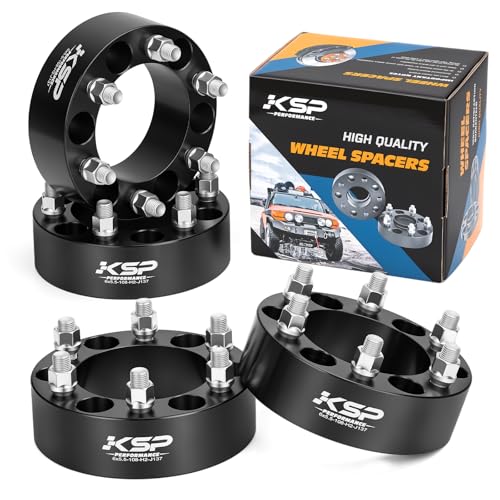
This option has the greatest thickness among these KSP spacers at 2 inches, positioning a compatible wheel farther outward than the 1.25- and 1.5-inch choices. It uses a 6×5.5-inch pattern, a 108mm hub bore, and M14x1.5 studs; the specifications also give a recommended torque range of 85–95 ft-lb. Forged 6061-T6 aluminum and heat-treated grade 10.9 bolts are specified. The key limitation is fit: the 108mm bore differs from the other 6-lug spacers here, so confirm the hub and wheel interface rather than choosing by bolt pattern alone.
Bottom line: Pick this when the vehicle fit calls for a 2-inch spacer and 108mm bore.
KSP 1.25-Inch Tacoma Spacer

This is the thinnest option in the group and is specifically aimed at listed Tacoma, 4Runner, FJ Cruiser, and GX460 applications. Its 106mm hub bore and M12x1.5 studs distinguish it from the GM- and Ford-oriented choices, which use different bore and thread combinations. The spacer is forged 6061-T6 aluminum with a black anodized finish, and its hubcentric design is intended to center on the hub.
Bottom line: Choose this for a compatible listed Toyota 6-lug vehicle needing 1.25 inches.
KSP 1.5-Inch F-150 Spacer

This spacer is the only 6x135mm design in the group and is specified for listed 2015–2026 F-150, Expedition, and Navigator applications. The wheel and vehicle bolt patterns are both 6x135mm; it also has an 87.1mm center bore with a lip and M14x1.5 studs. The fields specify four pieces and a recommended torque range of 85–95 ft-lb. Forged 6061-T6 aluminum and heat-treated grade 10.9 bolts are named. Its pattern and bore make it distinct from the 6×5.5-inch options, so it suits only vehicles and wheels with the matching interfaces.
Bottom line: Pick this for a compatible 6x135mm Ford application.
KSP 1.5-Inch 5×5.5 Ram Spacer

This is the only five-lug spacer in the set, with a 5×5.5-inch pattern and 77.8mm hub bore for listed 2012–2018 Ram 1500 and 2019-plus Ram 1500 Classic five-lug fitment. Its 1.5-inch thickness, M14x1.5 studs, and forged 6061-T6 aluminum set its dimensions and material. The specifications give a recommended torque range of 85–95 ft-lb. The crucial limitation is the five-lug requirement: a six-lug Ram or another 5×5.5 vehicle is not automatically a match. Confirm the hub bore and exact lug configuration before installation.
Bottom line: Choose this for a five-lug Ram with matching hub dimensions.
How to choose KSP wheel spacers
Start with the vehicle and wheel interfaces, then choose thickness; matching only the bolt pattern is not enough. Confirm the vehicle-side pattern, wheel-side pattern, hub bore, and stud thread pitch against the vehicle and wheel specifications. A hubcentric spacer’s center bore must seat correctly on the hub, while its outer lip must center the wheel if the wheel uses that arrangement. A wrong bore or thread pitch can prevent correct seating or fastening. Thickness changes the wheel’s position: 1 inch equals 25.4mm, so a 1.5-inch spacer moves each wheel outward by 38.1mm. Measure available fender and suspension clearance at full steering lock and through suspension travel before selecting a thicker spacer.
Wheel spacer fit and clearance
Fit depends on more than the year range printed in an application list; check the exact trim, axle, wheel, and hub dimensions. Measure the current gap between the tire and the nearest fender or suspension part, then account for the full spacer thickness because the wheel shifts outward by that amount. For instance, a 1.5-inch spacer reduces the effective wheel offset by about 38mm. A spacer can improve clearance on the inner side while bringing the tire closer to the fender edge. Use this guide to screen the options, not replace a vehicle-specific fit check.
| Need | Starting thickness | Verify |
|---|---|---|
| Smaller outward shift | 1.25 in | Hub bore and clearance |
| Middle shift | 1.5 in | Fender and suspension space |
| Larger outward shift | 2 in | Full steering and suspension travel |
Installing and checking wheel spacers
Clean, flat mounting faces and correct fastener torque are essential because the spacer creates an additional bolted joint. Remove rust, dirt, and debris from the hub and wheel contact surfaces so the spacer can sit flush; never stack spacers to reach a desired position. Use a calibrated torque wrench and the torque value specified for the exact vehicle and spacer hardware, since 85–95 ft-lb is included only for some models here and is not a universal setting. Tighten in a star pattern, then recheck fasteners after the break-in distance specified by the manufacturer. Stop if a spacer rocks, a wheel does not seat flush, or a stud lacks safe thread engagement.
Frequently Asked Questions
How much farther out does a 1.5-inch spacer move a wheel?
A 1.5-inch spacer moves each wheel outward by 1.5 inches, or 38.1mm. Across an axle, the track width increases by about 3 inches if both sides use matching spacers.
Does a 6×5.5 spacer fit every 6-lug truck?
No; the hub bore, stud thread, and wheel interface must also match. A 6×5.5 pattern alone does not establish a correct fit.
What does hubcentric mean on a wheel spacer?
A hubcentric spacer has a center bore shaped to seat on the vehicle hub and help center the wheel. The bore must match the hub closely enough for the spacer to sit flush.
When should wheel spacer fasteners be retorqued?
Retorque after the break-in distance specified by the vehicle or spacer manufacturer, using a calibrated torque wrench. Do not apply one torque value universally; the correct value depends on the fastener and vehicle.