
Gauge for Propane Tank: 3 Models Compared by Fit

For most grill and RV owners, CALPOSE QCC1 Gauge is the strongest fit because it covers 5–40 lb tanks with a QCC1 / Type 1 connection.
A propane tank gauge reads pressure as a rough fuel-level cue rather than measuring remaining propane directly; confirm the tank connection before choosing.
We earn a commission if you buy through links on this page. As an Amazon Associate I earn from qualifying purchases. Products are compared on manufacturer specifications, not hands-on testing.
- Best overall: CALPOSE QCC1 Gauge – Fits QCC1 / Type 1 appliances and tanks from 5 to 40 lb.
- Best for temperature scales: GasXpert 5–40 lb Temperature-Scale Gauge – Designed with a three-temperature-scale for 5–40 lb tanks.
| Product | Best for | Connection | Construction | Shop |
|---|---|---|---|---|
| CALPOSE QCC1 Gauge | General grill use | QCC1 / Type 1 | Solid brass | Check Price on Amazon |
| Type 1 Brass Gauge with Leak Detector | Estimated monitoring | QCC1 / Type 1 | Solid brass | Check Price on Amazon |
| GasXpert 5–40 lb Temperature-Scale Gauge | Temperature variation | QCC1 inlet; QCC or POL outlet | — | Check Price on Amazon |
Propane Tank Gauges Compared
Compare the supported tank sizes and connection details first, then choose the dial features that suit your use.
CALPOSE QCC1 Gauge
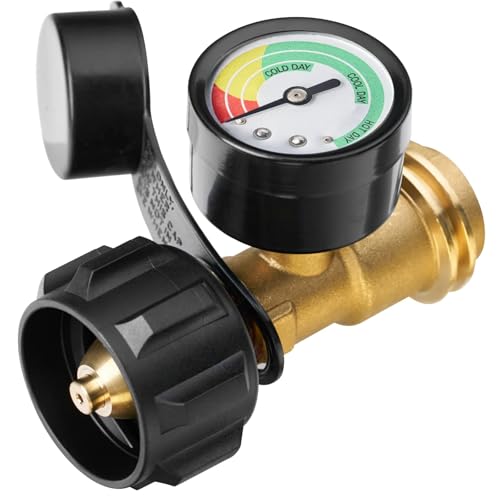
CALPOSE QCC1 Gauge combines a broad 5–40 lb tank range with a QCC1 / Type 1 connection, making it a straightforward match for many grills, heaters, and RV setups. Its three-color progress bar is intended to help you judge when a refill is approaching, and the body is solid brass. The gauge is described by its maker as weatherproof and tool-free to install. Pressure-based readings can shift with ambient temperature, so treat the color as a planning cue rather than an exact amount of fuel. Buyers with non-QCC1 fittings should verify compatibility before ordering.
Bottom line: Choose this for a QCC1 appliance and a tank between 5 and 40 lb.
Type 1 Brass Gauge with Leak Detector

Type 1 Brass Gauge with Leak Detector explicitly frames its dial as an estimate, which is useful for buyers who want a reminder to plan a refill rather than a precise fuel measurement. It fits 5–40 lb tanks with a QCC1 / Type 1 connection and uses solid brass construction. The maker also identifies it as a leak detector, but a gauge should not replace a proper leak check after connecting propane equipment. Temperature changes affect tank pressure and can move the reading even when the quantity of propane has not changed. Its ceiling of 40 lb makes it unsuitable for larger tanks.
Bottom line: Pick this when an estimated level cue and the leak-detector function matter.
GasXpert 5–40 lb Temperature-Scale Gauge
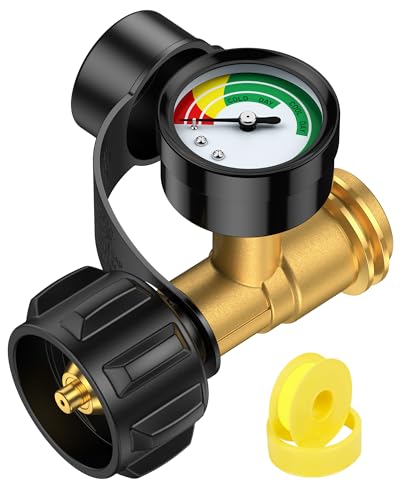
GasXpert 5–40 lb Temperature-Scale Gauge is the choice here with a three-temperature-scale, intended to account for temperature differences in its pressure-based reading. The maker gives it a 5–40 lb DOT tank range and a QCC Type 1 inlet, with QCC or POL female outlet options. Its color-coded needle zones mark sufficient, low, and nearly empty levels. The broader outlet arrangement may suit setups where the outlet type is a deciding constraint, but check which outlet your appliance requires before ordering. The reading remains an estimate, not a direct measurement of propane volume.
Bottom line: Select this if its outlet choice and temperature-scale match your setup.
How a propane tank gauge estimates fuel
A propane tank gauge estimates the contents by sensing pressure, not by weighing the propane. Pressure rises as a tank warms and falls as it cools, so the same fuel amount can produce different dial readings at different temperatures. Color bands are best used as a refill-planning signal over time, not as a precise percentage or a guarantee of remaining burn time. For a more direct check, weigh a portable cylinder and subtract the tare weight stamped on its collar; the difference is the propane weight. A 20 lb cylinder holds up to 20 lb of propane when full, but the tank’s empty weight varies by cylinder.
Match the gauge connection and tank size
Choose a gauge by matching both the inlet connection and the cylinder capacity range. QCC1 / Type 1 is the common modern hand-tightened connection on many grill cylinders, while POL fittings use a left-hand internal connection; they are not interchangeable unless the gauge or an adapter specifically provides that interface. Tank capacity also matters: a 5–20 lb gauge should not be used on a 30- or 40-lb cylinder. If the tank exceeds the gauge’s maximum or the appliance fitting differs, choose a compatible model instead of forcing a connection. The pressure rating and appliance requirements still govern safe use.
Use this quick fit rule before choosing:
| Need | Choose | Reason |
|---|---|---|
| 5–20 lb tank | Any gauge rated for that range | All four options cover this size |
| 30–40 lb tank | One rated up to 40 lb | The 5–20 lb model is undersized |
| POL outlet needed | Gauge with POL female outlet | Outlet type must match the appliance connection |
Use a propane gauge without mistaking it for a leak test
A colored dial can show a trend toward low fuel, but it does not certify that a connection is leak-free. After connecting a cylinder, apply soapy water to the connection and hose joints; growing bubbles indicate a leak, and the gas supply should be shut off. Never use a flame to search for a leak. Keep cylinders upright and outdoors in a ventilated area, away from ignition sources; propane is heavier than air and can collect in low spaces. If a propane odor persists after closing the valve, move away and contact the fire department or propane supplier from a safe location.
Frequently Asked Questions
Are propane tank gauges accurate in cold weather?
Pressure-based gauges can read differently in cold weather because propane pressure falls as the tank cools. Use the dial as a rough trend, and verify remaining fuel by weighing the cylinder when precision matters.
How do I know if a propane gauge fits my tank?
Match the gauge’s inlet type and rated tank capacity to your cylinder and appliance. For example, a gauge capped at 20 lb should not be fitted to a 30- or 40-lb tank.
Can I leave a propane gauge connected between uses?
Follow the gauge and appliance maker’s instructions, and close the cylinder valve whenever the appliance is off. Before each use, inspect the hose and joints and check for leaks with soapy water rather than a flame.
How can I tell how much propane is left without a gauge?
Weigh the cylinder and subtract its stamped tare weight to estimate the propane remaining. A full 20 lb cylinder contains up to 20 lb of propane, though the empty cylinder weight differs by model.