
Zig Zag Scissors for Fabric: 5 Pinking Shears Compared

For general fabric sewing, SINGER 9-inch Pinking Shears is the clearest fit: its 9-inch stainless-steel pinking shears cut a zigzag edge intended to help minimize fraying on woven seams. Choose 5 mm Pinking Shears instead if you want an expressly stated 5 mm tooth spacing; those who need an especially comfortable handle or left-handed suitability may prefer Fri4Free 9-inch Pinking Shears.
Pinking shears are scissors with toothed blades that leave a zigzag edge rather than a straight cut.
We earn a commission if you buy through links on this page. As an Amazon Associate I earn from qualifying purchases. Products are compared on manufacturer specifications, not hands-on testing.
- Best overall: SINGER 9-inch Pinking Shears – Its 9-inch stainless-steel blades are specified for zigzag fabric seams and craft edges.
- Best for 5 mm teeth: 5 mm Pinking Shears – The product specifies 5 mm spacing for a consistent decorative edge.
- Best for left-handed use: Fri4Free 9-inch Pinking Shears – The features state suitability for both left- and right-handed users.
| Product | Best for | Length | Tooth spacing | Handle or grip | Shop |
|---|---|---|---|---|---|
| SINGER 9-inch Pinking Shears | woven seam edges | 9 in | — | Soft grip | Check Price on Amazon |
| 5 mm Pinking Shears | measured zigzags | 9.5 in | 5 mm | — | Check Price on Amazon |
| Fri4Free 9-inch Pinking Shears | left-handed sewing | 9 in | 5 teeth per inch | ABS soft grip | Check Price on Amazon |
| JISTL 9.5-inch Pinking Shears | craft material range | 9.5 in | 5 mm | ABS inner ring | Check Price on Amazon |
| 9-inch Pinking Shears | general craft cutting | 9 in | — | — | Check Price on Amazon |
Zig zag scissors for fabric
Compare blade length, tooth spacing and handling features to match pinking shears to your sewing tasks.
SINGER 9-inch Pinking Shears
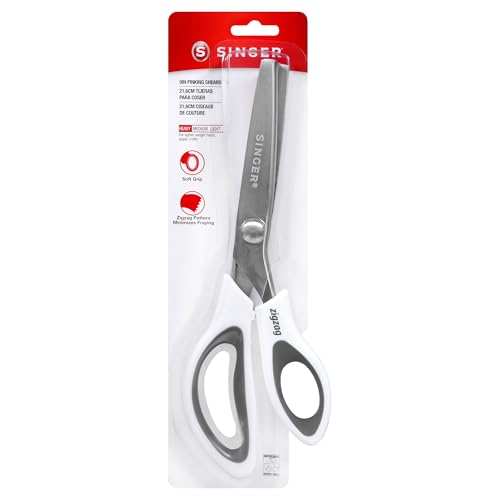
For finishing woven seams, these 9-inch pinking shears are the only option here whose features directly connect the zigzag cut with minimizing fraying on fabric seams. Stainless-steel blades and a soft-grip handle suit sewing and paper crafts, and the sawtooth edge also adds a decorative finish. Choose them when seam trimming is the priority. The specifications do not give a tooth measurement, so buyers who need a particular zigzag pitch should compare by that specification instead.
Bottom line: Pick these for woven seam finishing and a soft-grip handle.
5 mm Pinking Shears

These shears stand out for an explicitly measured 5 mm zigzag tooth spacing, useful when a project calls for a repeatable decorative edge. Hardened stainless steel blades are intended for fabric, lining, paper, PU, leather and craft materials. The product identifies the tooth spacing but gives no handle feature to distinguish the grip, so buyers who prioritize a particular handle shape may want another choice. Use the spacing as the deciding factor when matching a finished edge to a pattern or craft design.
Bottom line: Choose these when 5 mm teeth are the key requirement.
Fri4Free 9-inch Pinking Shears

Left-handed sewists have a specific reason to consider these: the features say the shears suit both left- and right-handed users. They pair a 9-inch blade with 5 teeth per inch and an ABS soft-grip handle, making them a defined option for cutting fabric edges and decorative projects. The limitation is that teeth per inch are not the same expression as a millimeter spacing, so compare using the unit rather than assuming equivalence. A comfortable grip and handedness suitability are the distinguishing points.
Bottom line: Pick these if handedness compatibility and a soft grip matter.
JISTL 9.5-inch Pinking Shears

These shears have the broadest named craft-material range in the group, including fabric, linings, paper, leather, PU and ribbon edging. Their 9.5-inch hardened stainless-steel blades make them the longest by the size, with 5 mm zigzag teeth and an ABS inner handle ring. The product notes that they may feel big and heavy and that the screw cannot be adjusted, which matters for users wanting a lighter feel or adjustable blade tension. Consider them for larger-handled, multi-material craft work.
Bottom line: Choose these for a 9.5-inch pair and varied craft materials.
9-inch Pinking Shears

These are a straightforward 9-inch option for fabric and craft cutting, with hardened stainless-steel blades and stated compatibility with linings, silky materials, paper, PU and leather. Their range is broader than seam-only use, so they suit projects that move between sewing and decorative craft edges. Choose them when the 9-inch size and material range matter more than those specifics.
Bottom line: Pick these for general sewing and craft use at 9 inches.
How to choose pinking shears for fabric
Start with the edge you need: pinking shears leave repeating diagonal teeth, while ordinary shears make a straight edge. Tooth geometry differs by model; the options include 5 mm spacing and 5 teeth per inch, so do not treat those measurements as interchangeable. For a decorative edge whose repeat matters, choose a pair with a pitch. For trimming woven seam allowances, prioritize the model explicitly intended for seam-edge fray reduction. Blade length also affects reach and handling: 9-inch shears are common general-purpose dressmaking shears, while a longer 9.5-inch pair may feel larger in hand. Keep fabric scissors for fabric to preserve their edge; paper and other craft materials can dull cutting blades faster.
What pinking shears can and cannot do
Pinking shears cut a zigzag edge that can help limit fraying on woven fabric, but they do not seal the cut edge. The effect is most useful on stable woven materials; stretchy knits and loosely woven fabrics may still unravel or distort and often need another seam finish. A zigzag edge also is not a substitute for a stitched seam allowance on a garment subject to wear. Use the shears for decorative edges or light seam finishing, and test a scrap before cutting the garment piece because each tooth removes fabric in a repeating pattern. For high-fray fabrics or seams under strain, use a sewn finish such as a serged or overcast edge.
How to match blade size and tooth spacing
A tooth measurement helps predict the appearance of the cut: 5 mm describes the distance between repeating points, while teeth per inch counts points along one inch. The two formats need conversion before comparing, and tooth shape can still affect the resulting edge. Use this quick choice guide before settling on a pair.
| Need | Prioritize | Reason |
|---|---|---|
| Consistent decorative repeat | Measured tooth spacing | Known pitch makes the cut pattern easier to anticipate |
| Woven seam trimming | Seam-focused use | Designed zigzag finish can reduce fraying on suitable woven edges |
| Hand comfort or handedness | Grip and user fit | Handle shape affects control over long cuts |
For repeated long cuts, choose a handle that lets your fingers sit without crowding and that you can open fully without strain. A 9-inch blade is a practical general size; if your hands are small or you prefer finer control, handle fit matters more than gaining another half inch of blade.
How to use and care for fabric pinking shears
Use pinking shears on a flat surface and make each cut with the blades fully engaged through the fabric; small partial bites can leave uneven points. Keep the cut aligned with the fabric edge and avoid twisting the blades, which can disrupt the zigzag. Test scraps first, especially on slippery or delicate cloth, and keep fingers clear of the cutting path. Wipe lint and residue from the blades after use, then store the shears closed in a dry place. Do not cut paper or leather with a pair reserved for fabric if you want to preserve its sharpness. If a cut begins to snag instead of slicing cleanly, stop rather than forcing the blades through the material.
Frequently Asked Questions
Do pinking shears stop fabric from fraying completely?
No; pinking shears can reduce fraying on suitable woven fabric, but they do not seal the edge. Use a stitched finish for fabrics that unravel readily or seams that will see wear.
Are 5 mm teeth the same as five teeth per inch?
No; 5 mm is a spacing measurement, while five teeth per inch is a count across an inch. Convert units before comparing, and remember tooth shape also affects the cut pattern.
Can pinking shears cut stretchy knit fabric?
They can cut fabric, but a zigzag edge alone may not control stretching or unraveling in a knit. Test a scrap first and use a sewn seam finish where the edge needs more stability.
How long should fabric pinking shears be?
Nine inches is a common general-purpose size for sewing shears, balancing reach and handling. Choose a length you can open fully and control comfortably, especially for long cuts.
Can one pair of pinking shears cut paper too?
Some pinking shears are intended for paper crafts, but paper can dull blades faster than fabric. Keep a separate pair for craft materials if preserving a fabric-cutting edge is important.