
Best Stretchy String for Bracelets: 5 Options Compared

For most bracelet makers, 1 mm Stretchy Bracelet String Kit is the strongest all-around pick because its 1 mm cord comes in four rolls and totals 660 feet. Choose a thinner clear cord if your beads have small holes or you want the string to blend in; check that the cord passes through every bead before starting.
We earn a commission if you buy through links on this page. As an Amazon Associate I earn from qualifying purchases. Products are compared on manufacturer specifications, not hands-on testing.
- Best overall: 1 mm Stretchy Bracelet String Kit – Four 165-foot rolls add up to 660 feet, with black, white and rainbow colors.
- Best for small beads: Paxcoo 0.8 mm Clear Elastic Cord – Its 0.8 mm clear cord suits seed beads and other beads with narrower holes.
- Best for one long roll: Paxcoo 1 mm White Elastic Cord – The 1 mm white cord comes in a 328-foot roll.
| Product | Best for | Cord diameter | Roll length | Color | Shop |
|---|---|---|---|---|---|
| 1 mm Stretchy Bracelet String Kit | Color variety | 1 mm | 660 ft total | Black, white, rainbow | Check Price on Amazon |
| Paxcoo 1 mm White Elastic Cord | Long white roll | 1 mm wide, 0.7 mm thick | 328 ft | White | Check Price on Amazon |
| LUSTEMBER 1 mm Elastic String, 4 Rolls | Black and white | 1 mm | — | 2 black, 2 white | Check Price on Amazon |
| Paxcoo 0.8 mm Clear Elastic Cord | Fine clear cord | 0.8 mm | 393 ft | Clear | Check Price on Amazon |
| JULIMAIDONG 0.8 mm Clear Elastic Cord | Clear 200-foot roll | 0.8 mm | 200 ft | Clear | Check Price on Amazon |
Stretchy String for Bracelets
Match cord thickness to bead-hole size, then choose a color and roll length that suit your projects.
1 mm Stretchy Bracelet String Kit
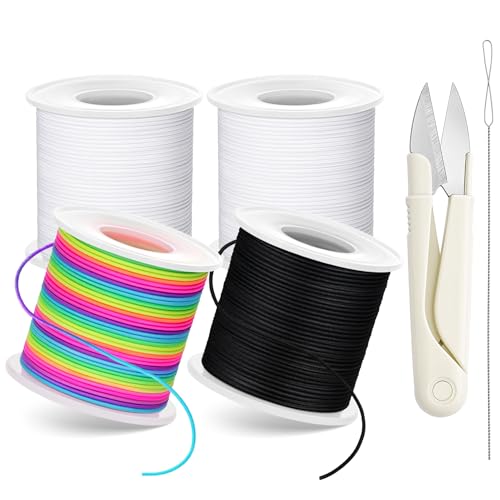
1 mm Stretchy Bracelet String Kit stands out with four 165-foot rolls, including black, white, rainbow and an extra white roll, for a combined 660 feet. The cord blends braided rubber and polyester fabric, and scissors and a beading needle are included. It suits makers who want color choices ready for multiple bracelet designs. At 1 mm, it may not pass through beads with especially small holes, so check bead-hole fit before threading.
Bottom line: Choose this kit if you want several cord colors and included cutting and threading tools.
Paxcoo 1 mm White Elastic Cord
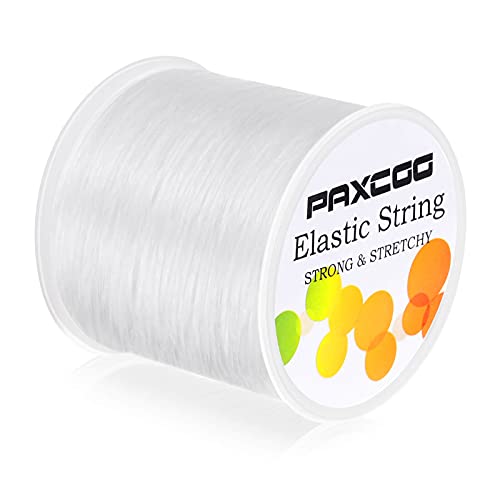
Paxcoo 1 mm White Elastic Cord offers a single 328-foot roll of white flat elastic, measuring about 1 mm wide and 0.7 mm thick. Its polyester-spandex material has a crystal-like appearance, and the flexible cord is designed to thread through small and large beads and to tie into a compact knot. It suits makers who prefer one long, uniform white cord. The flat profile differs from round elastic, so consider how it sits in the bead holes and against the bracelet design.
Bottom line: Pick this cord for a long, single-color supply with a flat profile.
LUSTEMBER 1 mm Elastic String, 4 Rolls

LUSTEMBER 1 mm Elastic String, 4 Rolls separates itself with four rolls split evenly between black and white, which helps coordinate cord color with different bead combinations. The cord is a braided rubber and nylon-polyester fabric blend, and the maker says it can be cut and knotted easily while returning to its original length after stretching within its elastic range. It suits craft projects beyond bracelets, including necklaces and drawstring bags. The roll length is unavailable, so check how much cord is included if quantity is a deciding factor.
Bottom line: Choose it when black-and-white color options matter more than a confirmed total length.
Paxcoo 0.8 mm Clear Elastic Cord
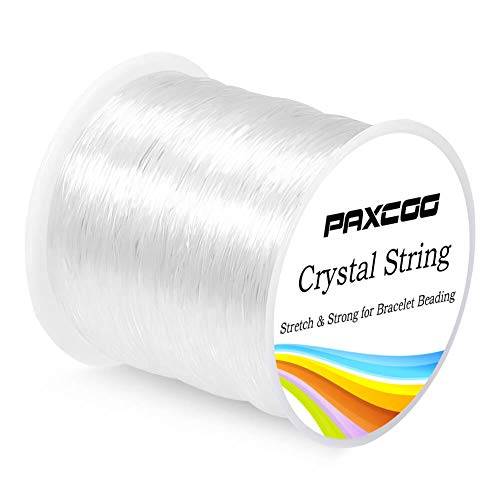
Paxcoo 0.8 mm Clear Elastic Cord is the thinner option for beadwork where a 1 mm cord may be too wide, and its clear finish can be less visible between beads. The roll contains 120 meters, or about 393 feet, of 0.8 mm elastic cord made from elastic plastic rubber. The maker identifies seed, gemstone and glass beads among its intended uses. Choose it when those bead holes and a transparent look are priorities; the thinner diameter may be less suitable when you specifically need a 1 mm cord.
Bottom line: Pick this clear cord for fine beadwork with compatible holes.
JULIMAIDONG 0.8 mm Clear Elastic Cord

JULIMAIDONG 0.8 mm Clear Elastic Cord pairs a 0.8 mm diameter with a 200-foot clear roll, making its length easy to compare with other fine cords. The cord is made of elastic polyester-spandex and is intended for bracelets, necklaces, beading and jewelry crafts. Its maker says the fine cord is easy to tie and can hide knots among beads. It suits makers who want a portable, transparent roll for smaller bead holes. The 0.8 mm size is less versatile for beads that need a thicker cord for a snug fit.
Bottom line: Choose this roll when you want clear 0.8 mm cord in a 200-foot length.
How to Choose Stretchy String for Bracelets
Start with the bead-hole diameter: the cord must pass through every bead, and a thinner cord gives more clearance. These options include 0.8 mm and 1 mm cord; choose 0.8 mm when holes are tight and 1 mm when the beads accept it. Cord construction also changes the feel: round cord, flat elastic and braided fabric-covered cord do not sit identically in a bead hole. A practical rule is to test a short piece through the smallest-hole bead before stringing a full bracelet. Also choose color intentionally: clear cord can recede between beads, while black, white or rainbow cord can become part of the design. A cord that threads easily but leaves beads loose may need a different diameter.
0.8 mm vs. 1 mm Bracelet Cord
Use bead-hole fit to decide between 0.8 mm and 1 mm cord; the smaller diameter is more likely to pass through narrow holes. A nominal diameter does not guarantee fit because bead holes vary, and flat cord dimensions may be stated as width and thickness rather than a single diameter. The 1 mm options here include a flat cord specified as 1 mm wide and 0.7 mm thick, while the clear options are 0.8 mm. Compare the cord shape as well as the measurement. The table gives a quick starting point, not a substitute for checking the smallest bead in your design.
| Need | Starting choice | Check before stringing |
|---|---|---|
| Narrow bead holes | 0.8 mm cord | Pass it through the tightest hole |
| More substantial cord | 1 mm cord | Confirm every bead accepts it |
| Less visible string | Clear cord | Check fit and knot appearance |
How to Tie and Secure Stretch Bracelets
A secure knot and a hidden knot both matter because elastic bracelets flex as they are put on and removed. Make a test knot with a short cord offcut, then check whether it stays tight when gently stretched; some cord types are easier to knot than others. Place the finished knot inside a bead only if the opening is large enough to accept it without forcing. Avoid pulling hard enough to damage the cord or bead edges, and keep sharp tools away from tensioned elastic. Leave a little working tail while tying so the cord does not slip out of your hands, then trim only after the knot holds. If a bead hole has a rough edge, choose a smoother-fitting bead or a protected cord path.
How Much Elastic Cord a Bracelet Uses
Bracelet cord use depends on wrist circumference, bead size and the extra length needed for knotting, so no single roll makes a fixed number of bracelets. Measure the intended wearer’s wrist, then add enough length for the bead pattern and knot tails rather than cutting exactly to wrist size. Large beads consume more cord along the strand than small beads, and repeated knots or multiple passes increase usage. Keep the roll attached until the bracelet is arranged and the cord length is comfortable to handle. For repeat designs, record the cord length used on a sample bracelet as a practical guide. Roll length is useful for comparing supply, but actual yield changes with each design.
Frequently Asked Questions
Will 0.8 mm elastic fit through every seed bead?
No, bead-hole size varies, so test the cord through the smallest seed bead in the project before stringing. A thinner 0.8 mm cord is a reasonable starting point when holes are tight, but the opening must still be large enough.
Is 1 mm or 0.8 mm cord better for bracelets?
Choose 0.8 mm when narrower bead holes are the constraint and 1 mm when all beads accept the thicker cord. These sizes are not interchangeable if the cord does not pass through the smallest hole.
How do I keep an elastic bracelet knot from slipping?
Tie a short test piece first and gently stretch it to check whether the knot holds before using it in a bracelet. Leave a working tail until the knot is secure, and avoid trimming close to an untested knot.
Can clear elastic cord be used with gemstone beads?
Yes, clear elastic cord is intended for gemstone beads, but verify that it passes through the smallest bead hole in your design. Rough bead-hole edges can abrade elastic, so inspect the path before stringing.
How long should elastic cord be for a bracelet?
Measure the wearer’s wrist and add cord for the bead pattern and knot tails; large beads and extra passes use more length. Make one sample bracelet and note its cord use to estimate later pieces.