
E6000 Metal-to-Metal Adhesive: 5 Options Compared

E6000 Premium 2 oz is the most straightforward E6000 metal-to-metal choice because it is a 2 fl oz permanent adhesive that lists metal among its compatible materials. Choose a Plus formula if low odor is a priority, or a multipack if you need smaller tubes.
E6000 is a flexible, multipurpose adhesive; for metal joints, clean contact surfaces and a stable fit matter as much as the formula.
We earn a commission if you buy through links on this page. As an Amazon Associate I earn from qualifying purchases. Products are compared on manufacturer specifications, not hands-on testing.
- Best overall: E6000 Premium 2 oz – A 2 fl oz E6000 adhesive that lists metal among its compatible materials.
- Best for low odor: E6000 Plus 1.9 oz – E6000 Plus is formulated to have lower odor and lists metal adhesion.
- Best for bulk supply: E-6000 High Viscosity 2-Pack – The package contains two 3.7 oz tubes of high viscosity E-6000.
- Best for small projects: E6000 Plus 0.9 oz – Four 0.18 oz tubes provide smaller amounts for individual tasks.
| Product | Best for | Package amount | Formula or format | Shop |
|---|---|---|---|---|
| E6000 Premium 2 oz | General repairs | 2 fl oz | Premium adhesive | Check Price on Amazon |
| E6000 Plus 1.9 oz | Lower-odor work | 1.9 fl oz | Plus, low odor | Check Price on Amazon |
| E-6000 High Viscosity 2-Pack | Larger supply | 2 × 3.7 oz | High-viscosity adhesive | Check Price on Amazon |
| E6000 Plus 0.9 oz | Small Plus jobs | 0.9 fl oz | Plus, low odor | Check Price on Amazon |
| E6000 Craft Mini 4-Pack | Tiny applications | 4 × 0.18 oz | Mini tubes | Check Price on Amazon |
E6000 Metal-to-Metal Adhesives
Compare the adhesive formulas and package amounts to match the job and how much product you need.
E6000 Premium 2 oz

For a straightforward E6000 option that explicitly lists metal, E6000 Premium 2 oz comes in a 2 fl oz tube. The maker describes it as a permanent, waterproof, flexible adhesive that dries clear and can be used indoors or outdoors; those properties may suit joints that need some flexibility rather than a rigid bond. Apply it to both surfaces and let it partially cure for about 2 minutes before mating them, as the maker directs. The cure-time instruction in the product text is incomplete, so this option is less useful when you need a confirmed full-cure schedule before planning the repair.
Bottom line: Choose it for general metal bonding when a 2 fl oz tube and flexible bond suit the job.
E6000 Plus 1.9 oz

E6000 Plus 1.9 oz is the low-odor alternative in a 1.9 fl oz package, and its maker says it offers virtually the same performance characteristics as E6000. The formula is described as waterproof, UV resistant and suitable for indoor and outdoor applications; metal is among its materials. Its practical distinction is odor, not a different metal-use claim, so consider it when odor is a concern but still provide ventilation while working with adhesives. Unlike the Premium option, the maker gives no surface-mating or full-cure timing, so it is harder to plan a time-sensitive repair around a specific schedule.
Bottom line: Choose it when lower odor matters and you want a Plus formula for metal.
E-6000 High Viscosity 2-Pack

E-6000 High Viscosity 2-Pack supplies two 3.7 oz tubes of high viscosity E-6000, making it the largest total package here. Its materials include metal, masonry and concrete, along with wood, glass and fiberglass; the maker also says the flexible bond can be used on items subject to vibration and maintains flexibility in cold temperatures. That combination may suit projects with repeated use or vibration, provided the joint surfaces fit closely. The maker does not give a metal-specific application or cure schedule, so it is a weaker match for a repair that must meet a precise timing requirement.
Bottom line: Choose it when you need the two-tube supply and high viscosity formula.
E6000 Plus 0.9 oz

E6000 Plus 0.9 oz offers the E6000 Plus formula in a 0.9 oz package, the smallest single tube among the Plus options here. Its maker describes it as low odor, waterproof, UV resistant, flexible and paintable, and lists metal among its compatible materials. The smaller amount suits a limited repair or a project where a full-size tube would be more than you need.
Bottom line: Choose it for a smaller metal project where the Plus formula is preferred.
E6000 Craft Mini 4-Pack
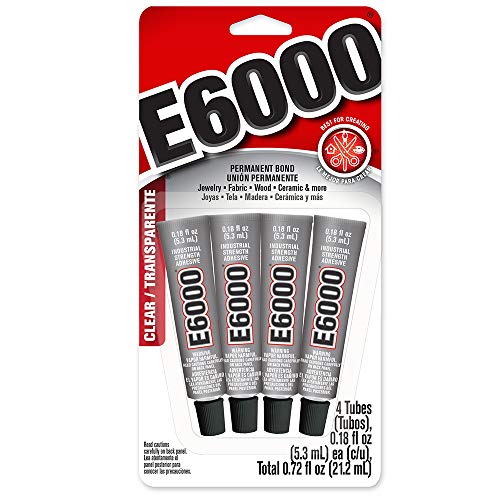
E6000 Craft Mini 4-Pack stands apart with four 0.18 oz mini tubes rather than one larger tube, useful when a project calls for small applications. The maker says the cement does not set instantly and allows at least 5 minutes for adjustments before it starts to set; complete curing takes 24 to 72 hours. Its maker does not specifically name metal among compatible materials, unlike several other options here, so confirm metal compatibility before choosing it for a metal-to-metal joint. The maker also advises using adhesives in a well-ventilated area and promptly removing excess from skin.
Bottom line: Choose it for small tasks when mini tubes and the cure window fit your plan.
Preparing metal surfaces for E6000
Clean metal contact surfaces before applying adhesive; oil, dust and loose rust can interfere with contact. Remove loose corrosion and wipe away residue, then let the surfaces dry completely before bonding. Smooth, glossy metal may benefit from light abrasion to give the adhesive a more consistent surface to grip, followed by removing sanding dust. Keep adhesive off areas that must remain exposed or move freely. If the joint has visible gaps or the pieces do not sit together, adjust the fit rather than relying on a thicker bead to bridge the gap. For a joint that will carry a load, test the bond on a noncritical sample before using it in service.
Choosing a metal-to-metal joint design
A close-fitting overlap is generally a better adhesive joint than two edges meeting end to end, because it provides more contact area. For a small repair, align the pieces before applying adhesive so you can place them without sliding them repeatedly. A tabletop joint can be held steady with a clamp or other support, but avoid squeezing out nearly all the adhesive. If a connection must carry a heavy or safety-critical load, use a mechanical fastener or a purpose-rated joining method instead of relying on craft adhesive alone. The table summarizes which package and formula differences help distinguish these E6000 options.
| Need | Option | Deciding difference |
|---|---|---|
| General metal adhesive | E6000 Premium 2 oz | 2 fl oz; metal named among compatible materials |
| Lower odor | E6000 Plus 1.9 oz or E6000 Plus 0.9 oz | Plus formula |
| More adhesive on hand | E-6000 High Viscosity 2-Pack | Two 3.7 oz tubes |
| Small applications | E6000 Craft Mini 4-Pack | Four 0.18 oz mini tubes |
Allowing the adhesive to cure
Keep bonded surfaces from shifting while the adhesive sets; movement can misalign the joint or weaken contact. The timing differs by product: the Premium directions call for about 2 minutes of partial curing before mating surfaces, while the Craft Mini maker says there are at least 5 minutes to adjust and gives a 24-to-72-hour complete-cure window. Do not treat those times as interchangeable across the range. Avoid loading a bonded metal part until its specific formula has cured as directed. When a repair needs a known return-to-use time, verify the cure schedule for the exact tube before starting.
Handling adhesive safely
Use adhesives in a well-ventilated area and avoid getting them in your eyes or on your skin; the Craft Mini maker specifically advises prompt removal of excess from skin. Keep the work area clear of food and protect nearby surfaces from drips, since residue can be difficult to remove after curing. Wear suitable gloves and eye protection when handling adhesive, and keep the product away from children. Do not use a bonded metal part for food contact unless its product directions expressly allow that use. For outdoor work, protect the uncured joint from rain or movement until the specific formula has had time to cure.
Frequently Asked Questions
How should metal be cleaned before using E6000?
Remove oil, dust and loose rust from the contact area, then let the metal dry fully. Lightly abrade a very smooth surface and wipe away the resulting dust before applying adhesive.
Can E6000 bond metal that will vibrate?
The high viscosity E-6000 maker says its flexible bond may be used on items subject to vibration. For a safety-critical or heavily loaded connection, use a mechanical fastening method rather than relying on adhesive alone.
How long does E6000 take to cure on metal?
The Craft Mini maker gives a 24-to-72-hour complete-cure window, while the Premium directions call for about 2 minutes of partial curing before surfaces are joined. Cure timing is formula-specific, so verify it for the exact tube before planning when to load the joint.
Should a metal joint be clamped while E6000 sets?
Hold the joint steady so the surfaces do not shift during setting; a clamp can help when the piece can take one without slipping or deforming. Avoid excessive pressure that squeezes nearly all adhesive out of the joint.