
Costway Portable AC Units: 3 Models Compared

For a room up to 350 square feet, COSTWAY 10,000 BTU Portable AC, R32 is the strongest fit because its 10,000 BTU capacity matches that coverage. Choose COSTWAY 8,000 BTU Portable AC instead for a smaller room up to 250 square feet and a three-mode unit; portable ACs also need a window for exhaust venting.
We earn a commission if you buy through links on this page. As an Amazon Associate I earn from qualifying purchases. Products are compared on manufacturer specifications, not hands-on testing.
- Best overall: COSTWAY 10,000 BTU Portable AC, R32 – Its 10,000 BTU capacity is paired with maker-rated coverage up to 350 square feet.
- Best for smaller rooms: COSTWAY 8,000 BTU Portable AC – Its 8,000 BTU capacity is maker-rated for rooms up to 250 square feet.
- Best for a gray finish: COSTWAY 10,000 BTU Portable AC, 350 sq. ft., Gray – It pairs 10,000 BTU capacity and 350-square-foot coverage with a gray finish.
| Product | Best for | Capacity | Room coverage | Modes | Shop |
|---|---|---|---|---|---|
| COSTWAY 10,000 BTU Portable AC, R32 | Larger rooms | 10,000 BTU | Up to 350 sq. ft. | 4 modes | Check Price on Amazon |
| COSTWAY 10,000 BTU Portable AC, 350 sq. ft., Gray | Gray finish | 10,000 BTU | Up to 350 sq. ft. | 4 modes | Check Price on Amazon |
| COSTWAY 8,000 BTU Portable AC | Smaller rooms | 8,000 BTU | Up to 250 sq. ft. | 3 modes | Check Price on Amazon |
Costway Portable AC Units
Match the unit’s capacity and stated room coverage to the room you need to cool, then compare modes and setup needs.
COSTWAY 10,000 BTU Portable AC, R32
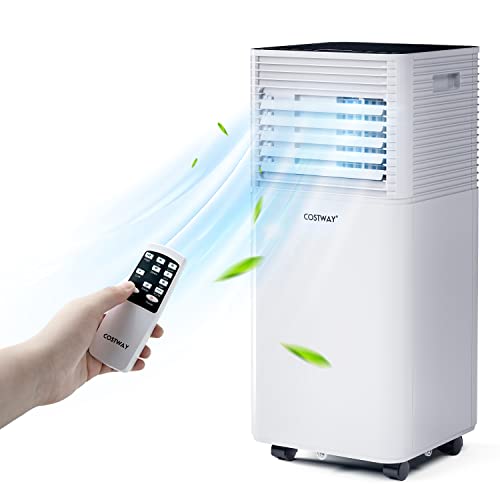
Among these models, this 10,000 BTU unit pairs the largest room coverage with R32 refrigerant. The maker says it can cool spaces up to 350 square feet and offers cooling, ventilation, drying and sleep modes, plus two fan speeds and a 24-hour timer. Its window venting kit and remote control suit someone who wants cooling controls from across the room. The 60.8°F–89.6°F adjustment range is broad, but the unit is still a single-room appliance; it is not a substitute for central cooling across several rooms.
Bottom line: Pick this for a room that falls within its 350-square-foot coverage and for four operating modes.
COSTWAY 10,000 BTU Portable AC, 350 sq. ft., Gray

The gray finish distinguishes this 10,000 BTU model from the other large-room option. The maker says it covers spaces up to 350 square feet and offers cooling, ventilation, drying and sleep modes, with two fan speeds and a 24-hour timer. The unit measures 27.5 inches high, 12 inches long and 12.5 inches wide, useful dimensions to compare with the space beside a window or furniture. Its 60.8°F–89.6°F temperature range offers adjustment, but buyers should leave room for the exhaust hose and airflow around the cabinet.
Bottom line: Choose this if its gray finish suits the room and you want a 10,000 BTU model.
COSTWAY 8,000 BTU Portable AC

At 8,000 BTU, this is the smaller-capacity choice among the three and is maker-rated for rooms up to 250 square feet. It has cool, fan and dry modes, two air speeds, a digital display, remote control and a 24-hour timer. The maker gives a temperature range of 61°F–88°F and a dehumidification capacity of up to 46 pints per day. That dry-mode rating may matter in a humid room, but this unit has three modes rather than the four offered by the 10,000 BTU models.
Bottom line: Pick this for a room within its 250-square-foot coverage where three modes are enough.
Choosing portable AC capacity by room size
Start with room area, but treat a BTU-per-square-foot rule as a rough screen rather than a guarantee. A common starting estimate is about 20 BTU per square foot, while high ceilings, strong sun, poor insulation, or several occupants can increase cooling demand. A 250-square-foot room starts near 5,000 BTU by that rough estimate, but portable units’ published coverage can incorporate different assumptions. Use this measurable rule: if the room is over 250 square feet but no more than 350 square feet, compare the two 10,000 BTU options; if it is 250 square feet or less, the 8,000 BTU model is within its coverage. Keep doors to other rooms closed for more consistent cooling.
Room area means floor length multiplied by width; for an irregular room, split the floor into rectangles and add their areas. Sun exposure and heat-producing electronics can matter as much as a small difference in floor area.
Portable AC venting and room setup
A portable air conditioner removes indoor heat by sending hot exhaust through a hose, so it needs a window connection rather than simply sitting anywhere in the room. Keep the hose as short and straight as the setup allows: extra bends and length can impede airflow. Seal gaps around the window panel to limit warm outdoor air entering the room. These units also circulate air; leave clearance around the intake and outlet instead of pushing the cabinet against curtains or furniture. Expect the room to need a dedicated window opening and nearby power outlet. Condensate handling varies by design, so verify the drain arrangement before buying if continuous dehumidifying is a priority.
For electrical safety, connect the appliance to a grounded wall outlet and avoid extension cords or power strips. Do not block the exhaust hose or run it into an enclosed space, since the heat needs to leave the room.
Comparing portable AC modes and refrigerants
Cooling mode lowers room temperature, fan mode moves air without active cooling, and dry mode removes moisture; sleep mode may alter operation for overnight use, but controls differ by unit. The three-mode model offers cooling, fan and dry, while each four-mode model adds sleep mode. Refrigerant type is another distinction: the two 10,000 BTU units use R32 and R410A respectively. Refrigerant names alone do not tell a buyer how a room will feel, so prioritize capacity, room conditions and vent setup first. A portable AC’s dry mode is not a replacement for correcting leaks or persistent moisture sources, and the dehumidifying capacity figure is not equivalent to cooling coverage.
Portable AC capacity figures may use different rating methods, including older ASHRAE BTU ratings and the DOE Seasonally Adjusted Cooling Capacity (SACC) approach. Compare numbers on the same rating basis when possible; a higher figure from one method may not be directly comparable with another.
Frequently Asked Questions
How much space does a portable AC need around it?
Leave open space around the air intake and outlet so airflow is not blocked; furniture and curtains should not cover either opening. The exhaust hose also needs a clear path to the window, with few bends.
Can a portable AC cool more than one room?
Portable AC units are intended to cool a room, not reliably condition several rooms at once. Open doorways let cooled air escape and add space the unit must serve, so close doors to rooms outside the target area.
Does fan mode lower the room temperature?
Fan mode circulates air but does not provide the same active cooling as cooling mode. Use cooling mode when the goal is reducing room temperature, and fan mode when air movement alone is useful.
Why does a portable air conditioner need a window hose?
The hose carries heat removed from the room outdoors, so it must connect to a suitable window vent. A hose routed into another indoor area returns heat to the living space instead of exhausting it.
What outlet should a portable AC use?
Use a grounded wall outlet and avoid extension cords or power strips for this high-load appliance. Check that the outlet circuit and unit requirements are compatible before operation.