
Best Plumbers Putty for Stainless Steel: 5 Options Compared

WM Harvey Stainless Fixture Setting Compound suits most stainless-steel drain and faucet installations because it is a fixture setting compound sold in two 14-ounce containers. Choose another product only if you need to repair damaged metal rather than form a seal beneath a fixture.
Plumber’s putty is a moldable sealing compound pressed into a ring beneath a drain flange or fixture base; epoxy putty is a hand-mixed repair material, not a direct substitute for that setting task.
We earn a commission if you buy through links on this page. As an Amazon Associate I earn from qualifying purchases. Products are compared on manufacturer specifications, not hands-on testing.
- Best overall: WM Harvey Stainless Fixture Setting Compound – Fixture setting compound intended for faucets, bowls, rims and strainers, in a two-pack.
- Best for single-container setting: 14 oz Faucet and Strainer Setting Compound – A 14-ounce compound identified for setting frames, faucets and basket strainers.
- Best for metal repair: J-B Weld SteelStik 8267-2 – Steel-reinforced epoxy putty with a one-hour cure claim and two sticks.
| Product | Best for | Intended use | Package amount | Color | Shop |
|---|---|---|---|---|---|
| WM Harvey Stainless Fixture Setting Compound | Fixture setting | Setting fixtures | 2 × 14 oz | White | Check Price on Amazon |
| 14 oz Faucet and Strainer Setting Compound | Single-container setting | Setting faucets and strainers | 14 oz | Beige | Check Price on Amazon |
| J-B Weld SteelStik 8267-2 | Metal repair | Metal repair | 2 × 2 oz | Dark gray | Check Price on Amazon |
| J-B Weld SteelStik 8267 | Small metal repair | Metal repair | 2 oz | Dark gray | Check Price on Amazon |
| Steel-Reinforced AB Epoxy Putty Kit | Multi-surface repair | Household repair | — | Gray | Check Price on Amazon |
Plumbers Putty for Stainless Steel and Related Putty Options
Start with products made for setting fixtures; epoxy repair putties serve a different purpose.
WM Harvey Stainless Fixture Setting Compound

WM Harvey Stainless Fixture Setting Compound is the clearest match for setting a stainless-steel drain or faucet: its compound is described for bowls, faucets, rims and strainers, rather than for rebuilding damaged metal. The two 14-ounce containers provide more material than the single-container option in this group. The maker says the putty stays soft in its container and does not crack, crumble or harden even if left open; it also says the compound meets Federal Specification HH-C-536. Form a ring beneath the fixture. This is a setting compound, not a structural repair adhesive.
Bottom line: Choose this for routine fixture setting when you want two containers of setting compound.
14 oz Faucet and Strainer Setting Compound

14 oz Faucet and Strainer Setting Compound is a single 14-ounce option for setting frames, faucets and basket strainers, making it a straightforward alternative when a two-container pack is unnecessary. Its name also identifies it as workable for stainless-steel fixtures, matching the requested application. The product is described as beige, unlike the white setting compound. The material does not establish whether the color remains visible after installation, so keep excess putty out of exposed seams. The uses center on fixture setting; this is not the steel-reinforced epoxy type intended for filling or rebuilding damaged surfaces.
Bottom line: Pick this when you need one 14-ounce container for faucet or strainer setting.
J-B Weld SteelStik 8267-2

J-B Weld SteelStik 8267-2 is a steel-reinforced epoxy repair putty, not a conventional seal pressed beneath a drain flange. The two 2-ounce sticks are hand-mixed, and the maker says the material sets in 5 minutes and cures in 1 hour. It also gives a 4,000 PSI tensile-strength claim and says the cured material withstands continuous temperatures up to 350°F. Its role is rebuilding or repairing metal, so it may suit a damaged metal part where an adhesive repair is appropriate. It is not the right choice for creating the usual flexible bedding seal between a stainless fixture and sink.
Bottom line: Choose this for a metal-repair job, not for setting a stainless-steel drain.
J-B Weld SteelStik 8267
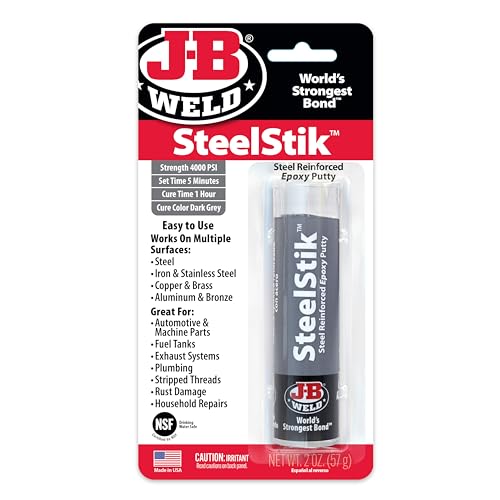
J-B Weld SteelStik 8267 offers one 2-ounce steel-reinforced epoxy stick for a small metal repair, rather than a supply of fixture setting compound. The maker describes it as hand-mixable, non-rusting and safe for contact with potable water under its NSF certification; it claims a 5-minute set and 1-hour cure. That makes the product distinct from plumber’s putty, which forms a seal beneath a fixture instead of hardening into a repair material. Do not choose it solely because a fitting is made of stainless steel.
Bottom line: Pick this for a small metal repair where cured epoxy, rather than fixture putty, is suitable.
Steel-Reinforced AB Epoxy Putty Kit

Steel-Reinforced AB Epoxy Putty Kit is a two-component household epoxy repair kit for filling cracks, holes, dents and chips across several material types, including metal, wood, ceramic, tile and plastic. Its instructions call for cutting equal parts of components A and B and kneading them by hand. That broad repair role separates it from the two fixture setting compounds, which are intended to bed faucets or strainers. The package amount is not given, so the 2-pack count should not be mistaken for a weight. This epoxy is a poor fit when the job is simply sealing a stainless-steel drain flange into a sink.
Bottom line: Choose this for mixed-material household repairs, not fixture bedding.
How to choose plumber’s putty for stainless steel
Choose a fixture setting compound when the job is bedding a drain flange, faucet base or strainer, rather than filling damage in the metal. Putty is pressed into a continuous ring under the flange; tightening the fixture compresses the ring to seal the contact area. Stainless steel is a common sink material for this kind of installation. Before applying putty, check the fixture maker’s instructions because some assemblies specify a different sealant or include a gasket. Use enough material to form an unbroken ring, but avoid forcing excess into the drain opening. For a crack or missing metal, use a repair method intended for that damage instead of treating setting putty as an adhesive.
Where the seal goes on a stainless sink
A drain seal belongs beneath the flange where it meets the sink, not on the drain threads that connect the plumbing below. Roll putty into a continuous rope, place it around the flange underside, then seat and tighten the drain assembly. A visible squeeze-out around the flange edge is a sign to remove excess after tightening; gaps in the putty ring can leave an incomplete seal. Faucet bases differ: some rely on a gasket or a maker-specified sealant, so do not assume putty is appropriate for every faucet. For stone or other porous counter materials, verify compatibility before using putty, since some formulations can stain those surfaces.
Plumber’s putty versus epoxy putty
Plumber’s putty stays moldable enough to form a bedding seal, while two-part epoxy putty is kneaded together and hardens as it cures. Those roles are not interchangeable: use setting compound beneath a fixture flange, and reserve epoxy for a repair that calls for a hardened filler or bonding material. Epoxy set and cure times matter; a short set time does not mean the repair is fully cured. A practical decision rule is simple: if the goal is to seal the joint under an intact drain flange, select a fixture setting compound; if the goal is to rebuild damaged metal, consider a metal-repair epoxy that suits the substrate and conditions.
| Job | Material type | Why |
|---|---|---|
| Seal beneath drain flange | Plumber’s putty | Moldable bedding seal |
| Repair a damaged metal surface | Metal-repair epoxy | Hardens after mixing and curing |
| Set faucet with gasket | Use specified seal method | Fixture instructions determine compatibility |
Common stainless fixture sealing mistakes
The most common mistake is using pipe-thread tape or sealant as a substitute for the seal beneath a drain flange: the flange-to-sink contact and threaded pipe joint are separate connections. Another is choosing epoxy because its name includes “steel”; that material cures hard and is intended for repairs, not routine fixture bedding. Keep the putty ring continuous and centered so it surrounds the opening without intruding into the drain passage. Remove squeezed-out excess rather than leaving a ragged exposed bead. If a fixture manufacturer calls for a gasket or a specific sealant, use that method instead of assuming plumber’s putty is compatible. Before buying, confirm the fixture’s required sealing method.
Frequently Asked Questions
Can plumber’s putty be used on stainless steel sinks?
Yes, fixture setting plumber’s putty is commonly used beneath a drain flange on a stainless-steel sink. Form a continuous ring under the flange and follow the fixture maker’s specified seal method if it calls for something else.
How much plumber’s putty goes under a drain flange?
Use enough to roll a continuous rope that encircles the underside of the flange. A complete ring matters more than a fixed length because flange diameters vary.
Should I put plumber’s putty on drain threads?
No, the bedding seal under the flange and the threaded plumbing connection below it are separate joints. Use the connector’s specified sealing method for its threads, rather than relying on the flange putty.
Can epoxy putty replace plumber’s putty on a sink drain?
No, epoxy putty is mixed and cures into a hardened repair material, while plumber’s putty beds the fixture flange. Choose epoxy for a repair that calls for a cured filler, not for a routine drain installation.
How do I keep plumber’s putty from leaking?
Make a continuous ring beneath the flange and seat the drain evenly so the material compresses around the contact area. If the fixture specifies a gasket or another sealant, use that method instead of assuming putty is compatible.