
Best Weighted Swing Trainer Golf: 4 Options Compared

The 13 Under Golf TA25 suits most golfers because its three 100 g screw-in weights and built-in grip trainer cover tempo, swing speed and grip practice in one 40-inch stick.
Choose a different style if you want a counterbalanced feel or a compact 25.5-inch weighted club; a weighted swing trainer adds resistance or feedback to practice rather than replacing a playable golf club.
We earn a commission if you buy through links on this page. As an Amazon Associate I earn from qualifying purchases. Products are compared on manufacturer specifications, not hands-on testing.
- Best overall: 13 Under Golf TA25 – Three screw-in 100 g weights and a built-in grip trainer make it versatile for warm-ups.
- Best for counterbalance: Orange Whip 47-Inch Trainer – Its 47-inch counterbalanced design provides a distinct swing-plane and balance feel.
| Product | Best for | Length | Weight configuration | Training feature | Shop |
|---|---|---|---|---|---|
| 13 Under Golf TA25 | Versatile warm-ups | 40 in | 3 × 100 g screw-in weights | Built-in grip trainer | Check Price on Amazon |
| Orange Whip 47-Inch Trainer | Counterbalanced feedback | 47 in | Counterbalanced system | Counterbalanced swing aid | Check Price on Amazon |
| Uiuilz Weighted Alignment Trainer | Alignment drills | — | Weighted brick | 9 mm stick holes | Check Price on Amazon |
| Gowolf 40-Inch Adjustable Trainer | Incremental resistance | 40 in | 250–335 g with add-on weights | 35 g and 50 g add-ons | Check Price on Amazon |
Weighted Golf Swing Trainers
Compare the trainers by length, how their weight is configured and the practice features each one emphasizes.
13 Under Golf TA25
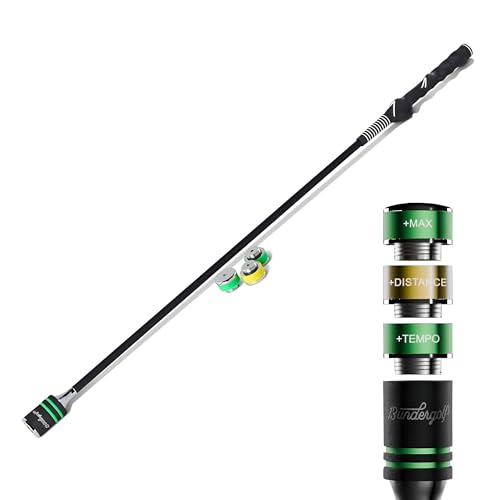
Three screw-in 100 g weights set this 40-inch trainer apart: use the 100 g, 200 g or 300 g added-weight configurations for different tempo and speed drills. A built-in molded grip trainer reinforces a repeatable hand position during each swing, and the 40-inch stick is sized to fit in a golf bag. Brand says it is intended to train tempo, lag and swing speed in short sessions. The trade-off is its shorter-than-full-club length, which may not suit golfers seeking a longer, counterbalanced swing feel.
Bottom line: Choose this if you want adjustable resistance and grip practice in one warm-up stick.
Orange Whip 47-Inch Trainer

The 47-inch length and counterbalanced system distinguish this trainer from the shorter, adjustable-weight sticks. Orange Whip says its design provides feedback for swing plane, balance and coordination, making it a fit for golfers focused on a continuous swing motion rather than changing weight settings. The weight is about 1.85 lb. Its fixed counterbalanced format offers a different feel from removable-weight models, so it is less suited to buyers who want to increase or decrease resistance by swapping weights.
Bottom line: Pick this if counterbalanced feedback matters more than adjustable weight settings.
Uiuilz Weighted Alignment Trainer

Unlike a swing stick, this blue weighted alignment trainer brick is built around 9 mm holes for standard alignment sticks. Its markings provide visual guidance, and the assembled design is made for left- and right-handed golfers. Use it to structure alignment and swing-path drills with a stick rather than to rehearse a full weighted-club motion. The product name and features emphasize alignment work, so golfers specifically seeking a handheld weighted trainer for tempo or speed should choose a stick-style option instead.
Bottom line: Choose this for stick-based alignment and swing-path practice, not weighted-stick warm-ups.
Gowolf 40-Inch Adjustable Trainer

The Gowolf offers a 40-inch format with smaller add-on weights than the 100 g increments of the TA25. Its base weight is 250 g, and adding the 35 g and/or 50 g weights brings the total to as much as 335 g. That gradual adjustment may suit golfers who want to vary resistance in smaller steps, while the compact length is intended for warm-ups and practice in tighter spaces. The specifications do not give a grip-trainer feature, so buyers prioritizing hand-position guidance should consider a model that explicitly includes one.
Bottom line: Pick this if you want a 40-inch trainer with smaller weight increments.
How to choose a weighted golf swing trainer
Choose by the practice feedback you want, then match length and load to the drill. A fixed counterbalanced trainer emphasizes rhythm and balance, while removable weights let you change resistance; molded training grips add a hand-position cue. For a portable warm-up stick, around 40 inches is a practical middle ground in this group, while 47 inches offers a longer arc. A compact 25.5-inch aid is better suited to shorter controlled drills than a full-length swing rehearsal. Do not assume a heavier trainer builds a better swing: added load can alter timing, so begin with the lightest setting and use smooth swings rather than forcing speed.
Weighted trainer types and their differences
Weighted swing trainers generally use either adjustable resistance or a fixed counterbalanced design, and those formats create different practice cues. A stick with screw-in weights changes total load while keeping its basic shape; a counterbalanced model uses weight distribution to provide feedback through the motion. A weighted alignment brick is a separate tool: it accepts alignment sticks and helps set visual paths, but it is not swung like a weighted club. Use the table to match the aid to the drill rather than comparing all weights as though they measured the same thing.
| Trainer type | Best suited drill | What changes |
|---|---|---|
| Adjustable-weight stick | Tempo or resistance practice | Removable weight amount |
| Counterbalanced stick | Balance and swing rhythm | Weight distribution |
| Alignment brick | Path and setup guidance | Alignment-stick placement |
Choosing length and weight safely
Trainer length changes the swing arc and the space needed around you, so clear the full path before swinging. A 40- or 47-inch stick needs more room than a 25.5-inch trainer; outdoors, allow room for the clubhead and any follow-through, and indoors keep well away from ceilings, lights and windows. Start with the lightest available setting and make controlled swings before adding load. Extra resistance can change timing and place more stress on the hands, wrists and shoulders, especially if you swing hard or repeat many swings without rest. Stop if you feel pain, and avoid swinging near another person.
How to use a weighted trainer for warm-ups
A weighted trainer works best as a brief movement primer, not as a substitute for full-speed swings with a golf club. Begin with slow, balanced swings, then progress to a few smooth repetitions at your normal tempo before hitting balls. A five-minute session is a reasonable short warm-up target for the TA25’s intended routine, but reduce the time if the added load causes fatigue or your motion changes. Keep the grip pressure relaxed and avoid trying to create maximum speed with the heaviest setting. For alignment practice, place the stick in the brick’s holes and use the visual guide while standing clear of the swing path.
Frequently Asked Questions
How heavy should a golf swing trainer be?
Start with the lightest setting that lets you swing smoothly. On the TA25, the screw-in weights add 100 g, 200 g or 300 g; increase load only if your tempo stays controlled.
Can I swing a weighted trainer indoors?
Only if the full swing path is clear, including the follow-through. A 40-inch stick or 47-inch trainer needs generous clearance from ceilings, windows, furniture and other people.
Does a weighted swing trainer replace a golf club?
No, it is a practice aid for resistance, rhythm or alignment cues rather than a playable club. Rehearse with a regular club as well so practice includes its length and feel.
What is the difference between a weighted stick and an alignment brick?
A weighted stick is swung to practice tempo or resistance, while a brick holds alignment sticks to create visual setup or swing-path guides. The brick’s 9 mm holes are made for standard alignment sticks.
How long should a weighted swing trainer warm-up take?
A short session of about five minutes is enough for a warm-up routine, with fewer swings if fatigue affects your motion. Use smooth repetitions rather than trying to swing the heaviest setting at full speed.