
Best Glutinous Rice Brand: 3 Picks Compared by Use

Fusion Select Sanpatong Thai Sticky Rice is the best glutinous rice brand pick for cooks who want Thai-grown whole sticky rice in a 10-pound bag. Choose Soeos Sweet Sticky Rice, 2 lb instead for a smaller 2-pound bag, or Soeos Glutinous Rice Flour, 2 x 16 oz if your recipe calls for flour rather than whole grains.
Glutinous rice is a short-grain rice variety prized for its sticky, chewy texture; despite the name, “glutinous” refers to texture, not gluten.
We earn a commission if you buy through links on this page. As an Amazon Associate I earn from qualifying purchases. Products are compared on manufacturer specifications, not hands-on testing.
- Best overall: Fusion Select Sanpatong Thai Sticky Rice – Thai-grown whole sticky rice in a 10-pound bag suits frequent batches of traditional dishes.
- Best for a smaller pantry: Soeos Sweet Sticky Rice, 2 lb – The 2-pound bag is a smaller whole-rice option for desserts and rice cakes.
- Best for baking: Soeos Glutinous Rice Flour, 2 x 16 oz – Finely ground glutinous rice flour is suited to mochi, pastries, and dumpling skins.
| Product | Best for | Form | Package weight | Shop |
|---|---|---|---|---|
| Fusion Select Sanpatong Thai Sticky Rice | Frequent Thai dishes | Whole rice | 10 lb | Check Price on Amazon |
| Soeos Sweet Sticky Rice, 2 lb | Small rice batches | Whole rice | 2 lb | Check Price on Amazon |
| Soeos Glutinous Rice Flour, 2 x 16 oz | Mochi and baking | Flour | 2 lb | Check Price on Amazon |
Glutinous Rice Brands and Flour Compared
Choose whole grains for steamed sticky rice, or flour when a recipe needs a smooth, chewy dough.
Fusion Select Sanpatong Thai Sticky Rice

For cooks who make Thai sticky rice often, this 10-pound bag offers the largest whole-grain quantity among these picks. Fusion Select identifies the rice as Sanpatong Thai sticky rice grown in Thailand and describes its flavor as slightly sweet, with a soft, chewy texture. It suits mango sticky rice and other meals built around steamed whole grains. The tradeoff is the larger package: occasional cooks may prefer a smaller bag to limit how much pantry space it occupies. Whole rice also needs soaking and steaming, unlike ready-to-use flour.
Bottom line: Pick this for frequent Thai sticky rice dishes and room to store a 10-pound bag.
Soeos Sweet Sticky Rice, 2 lb
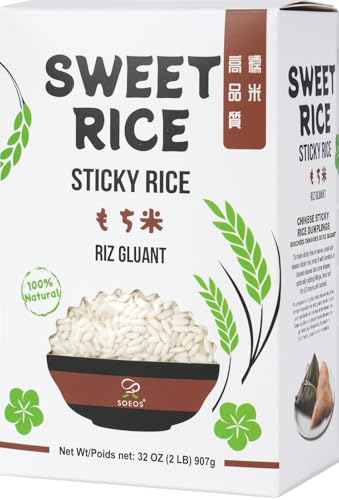
For a smaller whole-rice purchase, this 2-pound bag is easier to fit into a pantry than the 10-pound option. Soeos describes the grains as mildly sweet and soft-chewy, with uses including mango sticky rice, mochi, rice cakes, and dumplings. The maker also says the rice cooks quickly, but the product facts give no cooking time; plan preparation around your recipe rather than assuming a specific schedule. This is still whole grain rice, so it will not replace glutinous rice flour in recipes that need a finely ground ingredient.
Bottom line: Choose this for whole-grain desserts or rice cakes in a 2-pound package.
Soeos Glutinous Rice Flour, 2 x 16 oz

Unlike the other two picks, this is flour rather than whole sticky rice, making it the match for recipes that call for glutinous rice flour. The package contains two 16-ounce portions, for 2 pounds total. Soeos describes the flour as finely ground with a neutral flavor and suggests it for mochi, rice balls, pastries, dumpling skins, and noodles. Its form is the key limitation: flour cannot produce a bowl of steamed whole sticky rice. Check that your recipe specifically calls for glutinous rice flour, since ordinary rice flour may behave differently.
Bottom line: Pick this when the recipe calls for glutinous rice flour, not whole grains.
How to Choose Glutinous Rice for Your Recipe
Choose whole glutinous rice for steamed grains and rice flour for doughs or batters. Glutinous rice has very little amylose and a high proportion of amylopectin, which makes cooked grains cling together and gives many rice-based sweets their chewy texture. Whole grains are generally soaked before steaming; flour can be mixed directly into a recipe’s other ingredients. The name does not mean the rice contains gluten: rice is naturally gluten-free, though packaged foods can encounter cross-contact during processing. If avoiding gluten for medical reasons, check the package’s allergen and cross-contact guidance. For a recipe that names a specific form, match that form rather than substituting by name alone.
Soaking and Steaming Whole Sticky Rice
Soak whole glutinous rice for about 4 to 6 hours, then steam it until tender and translucent; soaking helps the grains cook evenly. Thai sticky rice is commonly steamed in a basket or perforated steamer rather than simmered like long-grain rice, which can leave it waterlogged. A practical decision rule is to choose whole rice when the recipe serves intact grains, and flour when it asks for a powder or dough. After steaming, keep the rice covered so its surface does not dry out. Cooked rice should be refrigerated within 2 hours, or within 1 hour when the room is above 90°F, to reduce food-safety risk.
Whole Rice Versus Glutinous Rice Flour
Whole rice and rice flour serve different jobs, so the recipe’s texture is the deciding factor. Whole grains stay distinct enough to serve as sticky rice alongside a meal or dessert; flour disperses into batters and forms smooth, chewy doughs. The comparison below maps common recipe needs to the correct form.
| Recipe need | Choose | Reason |
|---|---|---|
| Steamed sticky rice or mango sticky rice | Whole grains | They cook into cohesive grains |
| Mochi, rice balls, or dumpling skins | Glutinous rice flour | Powder incorporates into dough |
| Pastry or noodle recipe naming flour | Glutinous rice flour | Matches the required form |
Storing Rice and Handling Leftovers
Store uncooked rice in a cool, dry, sealed container to limit moisture and pantry pests; larger bags take more storage space and may be slower to use. Keep cooked rice out of the temperature danger zone: refrigerate leftovers within 2 hours, or within 1 hour above 90°F. Divide a large batch into shallow containers so it cools faster, and reheat leftovers to 165°F. Do not leave cooked rice sitting at room temperature for an extended period, since Bacillus cereus spores can survive cooking and grow as rice cools. Choose a package size you can store securely and use at a steady pace.
Frequently Asked Questions
Does glutinous rice contain gluten?
Glutinous rice itself is naturally gluten-free; “glutinous” describes its sticky texture. Packaged products can be exposed to cross-contact, so people avoiding gluten for medical reasons should check allergen and handling guidance.
How long should sticky rice soak before steaming?
Soak whole glutinous rice for about 4 to 6 hours before steaming for even cooking. A recipe or rice variety may call for a different preparation, so use its specified method when available.
Can I use regular rice flour instead of glutinous rice flour?
Not as a direct one-for-one substitute in chewy recipes such as mochi. Glutinous rice flour has a high-amylopectin starch profile that gives dough its characteristic chew, while regular rice flour produces a different texture.
How long can cooked sticky rice sit out?
Refrigerate cooked rice within 2 hours, or within 1 hour if the room is hotter than 90°F. Cool it in shallow containers and reheat leftovers to 165°F.
Should whole sticky rice be boiled or steamed?
Steaming is the common method for Thai sticky rice because it cooks the soaked grains without submerging them. Soak for roughly 4 to 6 hours first, then steam until tender and translucent.