
Soapbox Shampoo and Conditioner Sets Compared by Hair Need

Soapbox Coconut & Shea Set, 16 oz is the best starting point for most people seeking a Soapbox shampoo and conditioner set because it is made for dry hair and features coconut oil, jojoba oil, aloe, and shea butter. Choose Soapbox Biotin & Super Fruit Set, 33.8 oz for volume or Soapbox Argan Oil & Vanilla Set, 33.8 oz for frizz instead; each targets a different hair concern.
Shampoo cleans the scalp and roots, while conditioner helps smooth and detangle the lengths. These sets pair both steps in matching formulas.
We earn a commission if you buy through links on this page. As an Amazon Associate I earn from qualifying purchases. Products are compared on manufacturer specifications, not hands-on testing.
- Best overall: Soapbox Coconut & Shea Set, 16 oz – Targets dry hair and features coconut oil, jojoba oil, aloe, and shea butter.
- Best for volume: Soapbox Biotin & Super Fruit Set, 33.8 oz – The biotin and super fruit formula is made to support fullness and volume.
- Best for frizz: Soapbox Argan Oil & Vanilla Set, 33.8 oz – Argan oil, shea butter, and vitamin E feature in the set made for frizzy hair.
| Product | Best for | Bottle size | Hair focus | Featured ingredients | Shop |
|---|---|---|---|---|---|
| Soapbox Coconut & Shea Set, 16 oz | Dry hair | 16 fl oz each | Dry hair | Coconut oil, jojoba oil, aloe, shea butter | Check Price on Amazon |
| Soapbox Biotin & Super Fruit Set, 33.8 oz | Volume needs | 33.8 fl oz each | Volume | Biotin, elderberry, plum oil, vegan collagen | Check Price on Amazon |
| Soapbox Argan Oil & Vanilla Set, 33.8 oz | Frizz control | 33.8 fl oz each | Frizzy hair | Argan oil, shea butter, vitamin E | Check Price on Amazon |
Soapbox shampoo and conditioner sets
Match the set’s hair focus to your main concern, then compare bottle size and featured ingredients.
Soapbox Coconut & Shea Set, 16 oz

For dryness, this set pairs a coconut-and-shea focus with a smaller bottle size than the two 33.8-ounce options. The shampoo and conditioner are each 16 fl oz, and the formulas feature coconut oil, jojoba oil, aloe, and shea butter. Soapbox says the pair helps restore moisture and soften hair; the set is also described as sulfate-free, silicone-free, vegan, and color safe. Choose it when moisture is your main concern and you prefer the 16-ounce size. It is less tailored to shoppers whose priority is added volume or frizz control.
Bottom line: Choose this set if dry hair is your main concern and 16-ounce bottles suit your routine.
Soapbox Biotin & Super Fruit Set, 33.8 oz

Volume is the defining focus of this larger Soapbox pair: each bottle is 33.8 fl oz, and the formulas feature biotin, elderberry, plum oil, and vegan collagen. Soapbox says the set supports fullness and volume and strengthens hair. The pair is sulfate-free, silicone-free, vegan, and color safe, according to the maker. This is the more relevant choice when limp-looking hair is the concern and you want the larger bottle format. Its volume-focused purpose makes it a less direct match for someone primarily seeking a set aimed at dryness or frizz.
Bottom line: Pick this pair if fullness and the larger bottle size are your priorities.
Soapbox Argan Oil & Vanilla Set, 33.8 oz
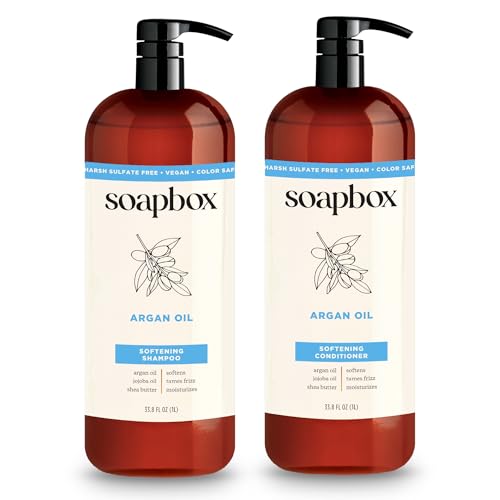
Frizz control separates this 33.8-ounce-per-bottle set from the dry-hair and volume-focused pairs. Its featured ingredients are argan oil, shea butter, and vitamin E. Soapbox says the duo helps smooth strands and reduce frizz, while the shampoo cleans without stripping natural moisture. The set is sulfate-free, silicone-free, vegan, and color safe, according to the maker. It suits shoppers who want a larger pair aimed at smoother-feeling hair. If volume is the primary goal, the biotin set is more specifically focused on fullness.
Bottom line: Choose this set when frizz is the main concern and you want 33.8-ounce bottles.
How to choose a Soapbox shampoo and conditioner set
Start with the hair concern named for the set: dryness, volume, or frizz. Shampoo is generally worked into the scalp and roots, where oil and residue accumulate; conditioner is concentrated on the midlengths and ends, which are older and more prone to dryness and tangling. A practical decision rule is to choose the set matching your main concern, not every concern at once. Then compare bottle size: the dry-hair pair is 16 fl oz per bottle, while the volume and frizz pairs are 33.8 fl oz each. The featured oils and other ingredients help distinguish formulas, but an ingredient name alone does not predict how your hair will respond.
How to use shampoo and conditioner
Wet hair thoroughly, then massage shampoo into the scalp rather than scrubbing the lengths; rinse until the water runs clear. Apply conditioner mainly from midlength to ends, where hair is typically drier, and rinse after distributing it evenly. How often to shampoo depends on scalp oil, activity, styling products, and hair texture: oily scalps may need more frequent washing than dry or tightly textured hair. For a new formula, use a small amount first and adjust based on how your scalp and lengths feel. Avoid getting shampoo or conditioner in your eyes; rinse with clean water if contact occurs.
What sulfate-free and color-safe mean
Sulfate-free identifies formulas made without sulfate cleansing agents, but it does not guarantee a particular result or mean that every person will prefer the feel. Color-safe is a maker’s suitability claim, not a promise that hair color will never fade; washing frequency, water temperature, and the color service all affect fading. Lukewarm water can be gentler on the hair than very hot water, and less frequent washing can reduce how often color is exposed to water and cleanser. If you have a sensitive scalp or a recent chemical service, test a small amount and ask your stylist about a compatible routine.
How to compare the bottle sizes
Bottle size is useful for planning how often to replace a set, but the amount of product used per wash matters too. A 33.8-fl-oz bottle holds a little more than twice the amount of a 16-fl-oz bottle; that is a quantity comparison, not a guarantee of twice the number of washes. Long or dense hair may use more conditioner per wash, while short hair can use less. Keep shampoo and conditioner caps closed and store bottles where they cannot fall into a shower or tub. The larger pair takes more storage space, so measure shelf height before choosing it if bathroom storage is tight.
Frequently Asked Questions
Should shampoo go on the scalp or hair ends?
Work shampoo mainly into the scalp and roots, where oil and product residue collect. Rinsing carries cleanser over the lengths; vigorous scrubbing of dry ends can increase tangling.
Where should conditioner be applied on hair?
Apply conditioner mainly from midlength to ends, which are generally drier than the scalp. Use less near the roots if your hair gets oily quickly.
Does color-safe shampoo prevent color from fading?
No shampoo can guarantee that hair color will not fade. Washing frequency, water temperature, and the type of color service all affect how long color lasts.
How much shampoo should I use per wash?
Start with a small amount, then add more only if needed to cover the scalp. Hair length, density, and styling-product buildup affect how much is useful.
Can I use shampoo and conditioner every day?
Daily washing suits some oily scalps, while dry or textured hair may need less frequent shampooing. Adjust based on scalp oil and how dry the lengths feel.