
Best Chair Leg Protectors for Wood Floors Compared

For most people, VIUME Universal L Silicone Covers is the most adaptable pick because it fits round, square, and irregular legs within stated size ranges. If your legs are a known round or square size, VIUME Universal S Round Covers or Ansible Square L Silicone Covers may be a closer match; X-Protector 1-Inch Round Felt Pads is a stick-on felt option rather than a silicone cap.
We earn a commission if you buy through links on this page. As an Amazon Associate I earn from qualifying purchases. Products are compared on manufacturer specifications, not hands-on testing.
- Best overall: VIUME Universal L Silicone Covers – Its fit covers round, square, and irregular legs across multiple size ranges.
- Best for square legs: Ansible Square L Silicone Covers – The silicone cap is sized for square legs 1-1/16 to 1-5/8 inches per side.
- Best for adhesive felt: X-Protector 1-Inch Round Felt Pads – The 48-piece set uses 1-inch round felt pads with adhesive.
| Product | Best for | Fit | Pad style | Count | Shop |
|---|---|---|---|---|---|
| VIUME Universal L Silicone Covers | Mixed leg shapes | Round 1-5/16–2 in; square 1-3/16–1-9/16 in | Built-in felt | 24 | Check Price on Amazon |
| VIUME Universal S Round Covers | Small round legs | Round 15/16–1-5/16 in | Built-in felt | 24 | Check Price on Amazon |
| Ansible Square L Silicone Covers | Larger square legs | Square 1-1/16–1-5/8 in per side | Built-in felt | 24 | Check Price on Amazon |
| X-Protector 1-Inch Round Felt Pads | Stick-on felt pads | Round 1 in diameter | Adhesive felt, 1/5 in thick | 48 | Check Price on Amazon |
Chair Leg Protectors for Wood Floors
Match each protector to the leg shape and measurement before choosing a pad style.
VIUME Universal L Silicone Covers

Unlike the other options, this VIUME set gives fit ranges for round, square, and irregular legs. The clear silicone covers have built-in felt pads, and the ranges are 1-5/16 to 2 inches in diameter for round legs, 1-3/16 to 1-9/16 inches per side for square legs, and 4-9/16 to 6-1/4 inches around irregular legs. VIUME says the one-piece design stays attached and helps chairs glide while reducing scraping noise. It suits households with different leg shapes, but its size ranges still require measuring each leg before choosing it.
Bottom line: Choose this set when your chairs have mixed leg shapes that fit its ranges.
VIUME Universal S Round Covers

For smaller round legs, this VIUME set has a narrower stated fit than the larger universal covers. Each soft silicone cap slips over a leg without cutting, glue, or tools, and the felt pad is formed into the cap rather than attached separately. VIUME says the integrated pad helps prevent separation and reduces noise while chairs move. The product is intended for round legs measuring 15/16 to 1-5/16 inches across. Its limitation is its shape and size range: it is not the right match for square legs or round legs outside that diameter.
Bottom line: Pick these when your round chair legs measure 15/16 to 1-5/16 inches across.
Ansible Square L Silicone Covers

This Ansible set is the square-leg specialist among these choices, with a range of 1-1/16 to 1-5/8 inches per side. The clear silicone caps have felt bottoms and are intended for hardwood, laminate, vinyl, other hard surfaces, and tile; the maker says the felt helps reduce scraping noise on smooth hard floors. Measure a square leg side rather than its diagonal to compare it with the range. These caps are not designed for carpet, so choose another approach if the chair primarily sits on carpet.
Bottom line: Choose these for square legs within the side-length range on hard flooring.
X-Protector 1-Inch Round Felt Pads
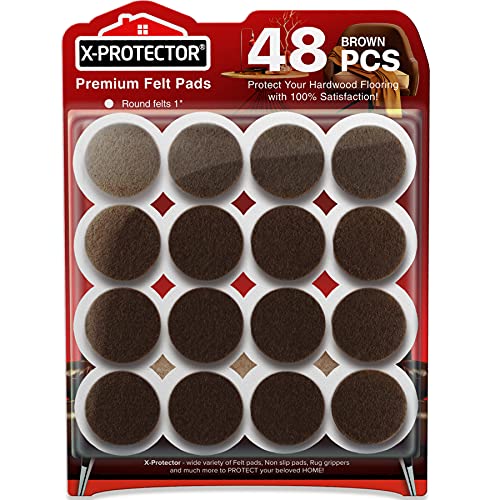
Unlike the silicone covers, X-Protector uses adhesive-backed felt pads that attach directly to furniture feet. The set contains 48 brown, round pads measuring 1 inch across and 1/5 inch thick. The maker says the adhesive is intended to hold the felt in place and that the pads help prevent scratches and noise on wood, laminate, and tile. This style suits flat, clean leg bottoms that can take an adhesive pad. It does not wrap around or grip the sides of a leg, so it is less suited to uneven or curved bottoms.
Bottom line: Pick these when a flat chair-foot bottom can take a one-inch adhesive pad.
How to Choose Chair Leg Protectors for Wood Floors
Measure the part of each leg that will meet the protector, then match its shape and size to the product range. For round legs, measure diameter across the bottom; for square legs, measure one side, not the diagonal. Irregular shapes need a perimeter measurement if the protector gives that kind of range. A close fit matters because an oversized cover may shift, while a pad too small may leave floor-contacting edges exposed.
Pad attachment is the other key choice. A silicone cover surrounds the leg and carries a felt bottom, while an adhesive felt pad sticks to the foot itself. The cover style is removable; the adhesive style depends on a clean, dry contact surface. Choose by the actual leg shape and floor-contacting area, not just the chair’s overall appearance.
Silicone Covers and Adhesive Felt Pads Compared
Silicone covers wrap around chair legs, while adhesive felt pads attach to the underside. Covers are useful when a leg falls within a shape-and-size range; adhesive pads can suit a flat foot where a cover would not fit. Both approaches use felt where the chair meets the floor, but attachment differs: a cover grips the leg, while an adhesive pad relies on its bond to the foot.
The table maps the main choice to a measurable condition. It does not replace checking the specific fit range: a round leg and square leg of similar width need different measurements. For a dining set with mixed leg shapes, measure each chair rather than assuming every foot is identical.
| Need | Starting choice | Measure |
|---|---|---|
| Round leg with a known diameter | Round silicone cover | Diameter across the leg |
| Square leg | Square silicone cover | One side length |
| Flat bottom without a matching cover | Adhesive felt pad | Flat contact area |
How to Measure Chair Legs Before Fitting
Measure at the bottom of the leg, where the protector will sit, because tapering can make the top and bottom widths different. For a round leg, use the diameter; for a square leg, measure the side length. For irregular legs, measure around the outside only when the protector’s range is given as a perimeter. Compare the measurement with the entire fit range, rather than picking a cover based on a single dimension from the chair’s frame.
When legs differ across a set, measure each one and sort by shape and size before fitting. A protector that fits one chair may not fit another, even in the same room. For adhesive pads, check that the foot has a flat area large enough for the pad and clean it before attaching; dirt or residue can interfere with adhesion.
Keeping Felt Protectors Effective on Wood Floors
Felt works best when its floor-contacting surface stays free of grit. Small particles trapped in a pad can act like abrasive debris as a chair moves, so inspect the bottoms periodically and clean or replace worn, dirty, or detached pads. Chairs that slide often need more frequent checks than rarely moved furniture because their protectors see more movement and contact.
Move a chair by lifting it when practical rather than dragging it across the floor, especially if a pad is missing or damaged. Check that a silicone cover still fits securely and that every chair foot has a protector before regular use. A pad that has compressed, shifted, or collected debris is a reason to service it, not to assume the floor remains protected.
Frequently Asked Questions
How do I measure a round chair leg for a protector?
Measure the diameter across the bottom of the leg, where the cover will sit. If the leg tapers, use the bottom measurement and compare it with the cover’s range.
Should square chair legs be measured diagonally?
No; compare one side length with the protector’s side-length range. A diagonal measurement is larger and will not match the square-cap fit specification.
Can chair leg protectors be used on carpet?
The Ansible square silicone covers are not designed for carpet, according to their use. Felt-on-floor protectors are intended to reduce scraping on hard surfaces, so use a protector specifically suited to carpet when carpet is the primary surface.
How often should felt chair pads be checked?
Inspect felt pads periodically and whenever a chair begins scraping or moving unevenly. Replace a pad if it is worn through, loose, or holding visible grit that could contact the floor.
Do chair protectors prevent every wood-floor scratch?
No protector can guarantee that a floor will never scratch; grit or a missing pad can still contact the surface. Keep the contact area clean and verify that every leg has a well-fitting protector.