
North Face Router Transit Backpack: 3 Models Compared

The North Face Router is the best match for a transit backpack if you need the most room: its 40-liter capacity exceeds the Recon’s 30 liters and Surge’s 31 liters. Choose a smaller pack if a 21-inch-tall, 12.5-inch-wide bag would be cumbersome for your commute.
These are laptop daypacks with organized compartments; the Router is the named model, while the Recon and Surge are alternatives with less capacity.
We earn a commission if you buy through links on this page. As an Amazon Associate I earn from qualifying purchases. Products are compared on manufacturer specifications, not hands-on testing.
- Best overall: The North Face Router 40L – Its 40-liter capacity is the largest of the three packs.
- Best for a smaller carry: The North Face Recon 30L – Its 30-liter capacity is the lowest among these options.
- Best for front-pocket access: The North Face Surge 31L – It has three large front zippered pockets.
| Product | Best for | Capacity | Dimensions (H × W × D) | Shop |
|---|---|---|---|---|
| The North Face Router 40L | Maximum capacity | 40 L | 21 × 12.5 × 9 in | Check Price on Amazon |
| The North Face Recon 30L | Compact everyday carry | 30 L | 19.3 × 11.6 × 7.5 in | Check Price on Amazon |
| The North Face Surge 31L | Front-pocket organization | 31 L | 20 × 12 × 7 in | Check Price on Amazon |
North Face Router Transit Backpack and Alternatives
Compare capacity, dimensions, and organization to choose a daypack that suits your commute and carry load.
The North Face Router 40L
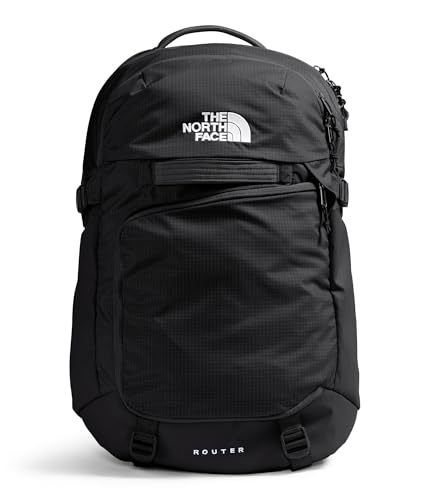
The Router gives you 40 liters of capacity, more than either alternative, making it the clearest fit for commuters carrying a laptop plus bulky work or travel items. It measures 21 × 12.5 × 9 inches and has a protective laptop sleeve for devices up to 14 inches. The large main compartment, padded tablet sleeve, fleece-lined external pocket, and two bottle pockets divide up daily gear. The FlexVent suspension system is certified by the American Chiropractic Association. Its size can be a drawback on crowded transit or for light carry; choose a smaller pack if you do not need the extra volume.
Bottom line: Choose this if your commute calls for the most capacity and a laptop up to 14 inches.
The North Face Recon 30L

The Recon is the smallest-capacity option here, with 30 liters and dimensions of 19.3 × 11.6 × 7.5 inches, so it suits a more compact daily load than the Router. It includes a stretch-mesh exterior pocket for a jacket or bulky item, daisy-chain attachment points, two bottle pockets, a padded tablet sleeve sized for most 8-inch tablets, and a fleece-lined pocket. Its FlexVent suspension system is certified by the American Chiropractic Association. The available fit detail gives a tablet size but no laptop limit, so it is a weaker choice if you need a confirmed laptop fit.
Bottom line: Pick this for a smaller daypack with a stretch-mesh gear pocket and attachment points.
The North Face Surge 31L

The Surge separates itself with three large, easy-access front zippered pockets, useful when work items need to stay organized apart from the main compartment. Its 31-liter capacity sits between the Router and Recon, and its 20 × 12 × 7-inch profile is shallower than the other two. The pack has a padded laptop sleeve, a stand-up design, a water-repellent finish, and a FlexVent suspension system certified by the American Chiropractic Association. Its maker does not establish a laptop size limit, so check device fit before choosing it if your laptop is unusually large.
Bottom line: Choose this if front-pocket access matters and 31 liters meets your carrying needs.
How to choose a transit backpack
Start with the load you carry, then compare capacity and outside dimensions. A 30- to 40-liter daypack covers a broad range from daily work gear to room for bulky items; the three choices here span that range. Measure your laptop diagonally and compare it with a sleeve limit, since a 14-inch screen measurement is not the laptop’s full width or height. For a commute with crowded aisles, favor a slimmer profile: a 7-inch depth takes less room front to back than a 9-inch depth. Also consider access: multiple front pockets help separate small work essentials, while a large main compartment favors bulkier loads.
Capacity and dimensions for transit
Capacity alone does not determine how a backpack fits on a train or under a desk; height, width, and depth matter too. Use this comparison to weigh volume against the physical footprint, with dimensions shown as height × width × depth.
| Pack | Capacity | Dimensions | Deciding fit |
|---|---|---|---|
| The North Face Router 40L | 40 L | 21 × 12.5 × 9 in | Largest load |
| The North Face Recon 30L | 30 L | 19.3 × 11.6 × 7.5 in | Lowest volume |
| The North Face Surge 31L | 31 L | 20 × 12 × 7 in | Shallowest depth |
Choose a pack no deeper than the space you can comfortably carry through your usual commute; if you have less than 8 inches of front-to-back room, the 9-inch-deep Router is the least suitable of these three.
Laptop sleeves and organization
Match a laptop sleeve to the device’s actual outer dimensions, not just its screen diagonal. The Router supports laptops up to 14 inches, while the Recon’s 8-inch figure applies to its tablet sleeve, not a laptop. The Surge has a padded laptop sleeve, but no size limit is established here. Sleeve padding helps separate a device from other cargo, but it is not a substitute for a rigid protective case when a laptop may be struck or dropped. For loose essentials, the Router and Recon include fleece-lined external pockets; the Surge instead emphasizes three front zippered pockets.
Backpack suspension and carrying safety
Keep a loaded backpack close to your back and use both shoulder straps to distribute weight more evenly; a swinging, one-strap carry can strain posture and make balance harder on stairs. Pack heavier items nearest your back and avoid carrying more than you can lift and control comfortably, especially when boarding or exiting transit. The Router, Recon, and Surge each include FlexVent suspension systems certified by the American Chiropractic Association, but certification does not establish a safe load limit or guarantee a particular fit. Adjust the straps so the pack sits snugly rather than hanging well below your waist, and reassess the load if shoulder or back discomfort develops.
Frequently Asked Questions
How large a backpack fits under a commuter seat?
Measure the available space, since seat clearance differs by vehicle and seat design. These packs range from 19.3 to 21 inches tall and 7 to 9 inches deep, so compare the pack’s dimensions with your actual space.
Does a 14-inch laptop fit in the Router backpack?
The Router is specified for laptops up to 14 inches. Screen diagonal alone does not confirm fit, so compare your laptop’s outside width and height with the sleeve before relying on it.
Is the Recon suitable for an 8-inch tablet?
Yes, its padded tablet sleeve fits most 8-inch tablets. Tablet size is distinct from laptop size, so do not use that figure to judge laptop fit.
What is the difference between water-repellent and waterproof?
Water-repellent fabric can shed some moisture, but it is not the same as a waterproof construction. For sustained rain, use a rain cover or dry bag rather than relying on a water-repellent finish alone.
How should I pack a backpack for a train commute?
Place heavier objects close to your back and keep frequently used small items in accessible pockets. A snug, balanced pack is easier to control on stairs and when moving through a crowded aisle.