
Best Grease for Trailer Hitch Ball: 5 Options Compared

Unisport Trailer Hitch Ball Lubricant, 6 oz is the best grease for a trailer hitch ball for most owners because its 6-ounce waterproof formula is made for hitch balls and other towing parts. Choose another option if a temperature range or included ball covers matter more than multipurpose use.
Hitch ball grease is a lubricant applied between the ball and coupler to reduce friction and wear during towing.
We earn a commission if you buy through links on this page. As an Amazon Associate I earn from qualifying purchases. Products are compared on manufacturer specifications, not hands-on testing.
- Best overall: Unisport Trailer Hitch Ball Lubricant, 6 oz – A 6-ounce waterproof grease made for hitch balls, ball mounts and other towing components.
- Best for temperature range: 3-IN-ONE Trailer Hitch Gel Lube – Its operating range spans -100°F to 500°F.
- Best for ball covers: ACECARE Hitch Ball Lubricant, 5 oz, with Covers – The package includes two hitch ball covers for 2-inch and 2-5/16-inch balls.
| Product | Best for | Package size | Formula or feature | Shop |
|---|---|---|---|---|
| Unisport Trailer Hitch Ball Lubricant, 6 oz | Multipurpose towing | 6 oz | Waterproof grease | Check Price on Amazon |
| 3-IN-ONE Trailer Hitch Gel Lube | Wide temperature use | Standard | Gel lube | Check Price on Amazon |
| BTAS Trailer Hitch Ball Lubricant with PTFE, 5 oz | PTFE formula | 5 oz | Synthetic with PTFE | Check Price on Amazon |
| Mission Automotive Ball Grease, 4 oz | Non-staining use | 4 oz | Waterproof, non-staining | Check Price on Amazon |
| ACECARE Hitch Ball Lubricant, 5 oz, with Covers | Covered ball storage | 5 oz | High-film-strength lubricant | Check Price on Amazon |
Grease for Trailer Hitch Balls
Compare the package size and formula claims, then match the lubricant to how you tow and store your trailer.
Unisport Trailer Hitch Ball Lubricant, 6 oz

For buyers who want a single grease for several towing parts, this 6-ounce waterproof formula is intended for hitch balls, ball mounts, receivers, locks, king pins, jacks and winches. The maker says the high-film-strength, non-running grease helps protect against corrosion and reduce friction and wear. Its multipurpose scope makes it a practical fit for owners maintaining more than the ball-and-coupler contact point. The limitation is that the specifications give no operating temperature range, so buyers who tow in extreme heat or cold should compare that requirement before choosing.
Bottom line: Choose this if one waterproof grease for several hitch components is the priority.
3-IN-ONE Trailer Hitch Gel Lube

The standout here is a temperature range of -100°F to 500°F, useful for buyers whose towing conditions vary widely. The maker says the thick gel coating reduces friction and wear on hitch balls, helps prevent rust for up to one year, and makes connecting and disconnecting smoother and quieter. It is also intended for bearings, rollers and gears, so it reaches beyond the ball-and-coupler joint. The package size is given as standard rather than by volume, which matters to buyers comparing quantity or planning how much to keep on hand.
Bottom line: Pick this when the temperature range is a deciding factor.
BTAS Trailer Hitch Ball Lubricant with PTFE, 5 oz

Unlike the other options, this 5-ounce lubricant specifically combines PTFE with an aluminum-complex synthetic formulation. The maker says it has no petroleum content and includes anti-wear additives for metal surfaces; it is also described as waterproof and suitable for hitch balls, king pins, locks, jacks and other towing accessories. That wider compatibility may suit owners looking to lubricate multiple metal components with one product. The maker does not give a temperature range, so this is less useful for choosing by cold- or heat-performance claims.
Bottom line: Choose this if a synthetic, PTFE-containing formula is your priority.
Mission Automotive Ball Grease, 4 oz
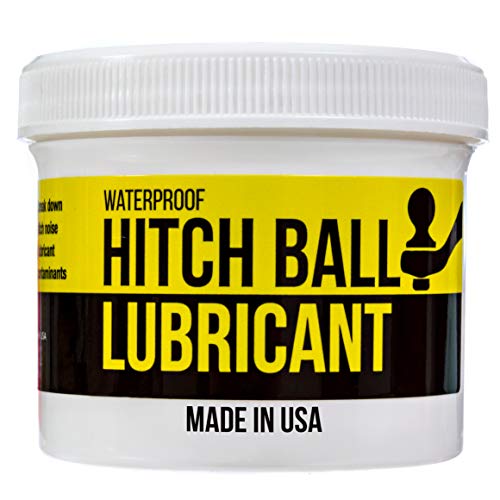
This option distinguishes itself with a non-staining formula, alongside a waterproof claim. The maker says the grease reduces friction, wear and noise, and that its non-melting properties help it stay put without frequent reapplication. Intended uses include receiver hitches, gooseneck ball greaser mounts, hitch pins, couplers, jacks and other towing accessories. Its 4-ounce package is smaller than several alternatives here, which may matter if you maintain many components or tow frequently. The specifications give no temperature claim for buyers with demanding weather conditions.
Bottom line: Pick this if avoiding staining is more important than package size.
ACECARE Hitch Ball Lubricant, 5 oz, with Covers
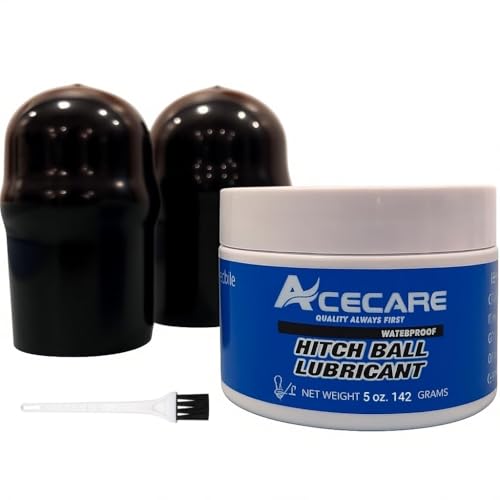
The distinguishing extra is a pair of hitch ball covers sized for 2-inch and 2-5/16-inch balls, useful for covering the ball between towing sessions. The 5-ounce lubricant is intended for hitch balls, king pins, locks, receivers and ball mounts; the maker says its high-film-strength formula resists water and helps reduce friction, wear, rust and noise. The included covers make this a combined lubrication-and-storage choice rather than a grease-only package.
Bottom line: Choose this if the included covers match your ball size and storage routine.
How to choose trailer hitch ball grease
Choose a lubricant formulated for hitch ball and coupler contact, then weigh its water resistance against your towing conditions. Grease keeps the metal contact surfaces separated by a lubricating film; a dry or contaminated ball can increase friction and wear. For frequent rain, boat ramps or road spray, prioritize a water-resistant formula. For broad temperature swings, compare an operating range rather than assuming every grease behaves alike. Use the smallest amount that leaves a thin coating on the ball; excess grease can collect grit and transfer to hands or clothing. Before coupling, inspect the ball and coupler for dirt, rust or damage, since grease does not repair a worn or cracked towing component.
Hitch ball sizes and coupler fit
Match the ball diameter to the coupler marking; common trailer ball diameters are 1-7/8 inches, 2 inches and 2-5/16 inches. A ball that is too small can separate from a coupler, while an oversized ball will not seat correctly. Diameter is only one part of fit: ball shank diameter and length must also suit the mount, and the trailer’s tongue weight must remain within the ratings of the ball, mount and vehicle. Use the lowest applicable rated capacity in the towing system. Grease cannot compensate for mismatched sizes or an overloaded setup, so confirm the coupler’s size and the component ratings before towing.
This quick guide separates grease decisions from mechanical fit checks.
| Need | What to prioritize |
|---|---|
| Wet or road-spray exposure | Water-resistant or waterproof grease |
| Large temperature swings | A temperature range |
| Ball storage between trips | A cover sized to the ball diameter |
| Coupler fit | Exact ball diameter and component ratings |
Applying grease and keeping the coupler clean
Apply a thin, even film to the clean ball before coupling; a thick glob is more likely to trap grit and spread onto clothing. Wipe away dirt and old contaminated grease with a clean rag before adding fresh lubricant. Check the ball and coupler contact surfaces each time you hitch, and reapply when the film has washed away or the surfaces look dry. Inspect periodically for scoring, flat spots, rust pits or looseness; lubrication does not make a damaged ball safe to use. Keep grease away from brakes, tires and electrical contacts, and wash hands after handling towing lubricants.
Trailer hitch grease safety and maintenance
Grease is not a substitute for the towing system’s rated capacity or secure coupling. Confirm the ball mount, ball, coupler, safety chains and trailer load are suitable for the tow before departure; the lowest rating governs. Secure the coupler latch and perform a visual check after coupling, with the trailer supported safely during any adjustment. Keep lubricant in its closed container away from children and pets, and avoid contact with eyes and skin; clean spills promptly because a greasy surface can be slippery. Recheck the ball after wet or dusty trips, since water and grit can thin or contaminate the lubricating film.
Frequently Asked Questions
How often should I grease a trailer hitch ball?
Apply grease when the hitch ball is dry or its film has washed away, and inspect it before each hookup. Rain, road spray and dusty conditions can make cleaning and reapplication necessary sooner.
Can I use regular automotive grease on a hitch ball?
Use a grease intended for hitch ball contact when possible, especially for wet exposure, because water resistance matters at the ball-and-coupler joint. Apply a thin coat and keep excess grease off hands, clothing and nearby components.
What size trailer hitch ball do I need?
The coupler marking determines the required ball diameter; common sizes are 1-7/8, 2 and 2-5/16 inches. Check the shank and load ratings too, since diameter alone does not confirm a safe fit.
Should a trailer hitch ball be covered when not towing?
A fitted cover can keep dirt and debris off a greased ball between trips. Match the cover to the ball diameter, since common sizes include 2 inches and 2-5/16 inches.
Does hitch ball grease prevent rust?
A grease film can help shield metal from moisture, and some formulas make specific rust-prevention claims. Clean away contaminated grease and inspect the ball for rust pits or damage before towing.