
Best Back Brace for Lifting Heavy Objects Compared

Ergodyne ProFlex 1600, 4XL suits most people seeking a work back brace for lifting heavy objects because it combines a 9-inch elastic body, support stays, and detachable suspenders. Choose another model if you need a size other than 4XL or prefer a different strap or belt design.
A work back brace is a supportive belt worn around the torso; it does not replace safe lifting technique or equipment for moving heavy loads.
We earn a commission if you buy through links on this page. As an Amazon Associate I earn from qualifying purchases. Products are compared on manufacturer specifications, not hands-on testing.
- Best overall: Ergodyne ProFlex 1600, 4XL – Its 9-inch elastic body, support stays, and detachable suspenders offer a defined combination of support and positioning features.
- Best for adjustable straps: Work Back Brace with Shoulder Straps, L – Its shoulder straps are adjustable and removable, and reinforced support stays are included.
- Best for customizable fit: BraceAbility Work Back Brace, Large – It has adjustable, removable criss-cross suspenders and gives a specific measuring point: the belly button.
| Product | Best for | Support construction | Strap setup | Size | Shop |
|---|---|---|---|---|---|
| Ergodyne ProFlex 1600, 4XL | Firm elastic support | 9-inch elastic body; polypropylene stays | Adjustable, detachable suspenders | 4XL | Check Price on Amazon |
| Work Back Brace with Shoulder Straps, L | Flexible strap use | Reinforced support stays | Adjustable, removable shoulder straps | L | Check Price on Amazon |
| BraceAbility Work Back Brace, Large | Criss-cross suspenders | Elastic support belt | Adjustable, removable criss-cross suspenders | Large | Check Price on Amazon |
| Adjustable Work Back Brace, Large | Simple adjustable belt | Adjustable lower-back support | No shoulder straps mentioned | Large | Check Price on Amazon |
| SHIBEKO Work Back Brace, M | Suspender-style design | Built-in bionic lumbar panel | Two adjustable, removable shoulder straps | M | Check Price on Amazon |
Back Braces for Lifting Heavy Objects
Compare the support construction and strap configuration first, then confirm that the selected size fits your body.
Ergodyne ProFlex 1600, 4XL

Ergodyne ProFlex 1600, 4XL stands out for its 9-inch all-elastic body and polypropylene support stays. Ergodyne says the body provides firm support; its contoured high-cut front is intended to allow mobility, while rubber-track webbing helps keep the belt from riding up. Adjustable, detachable suspenders add a way to keep the belt positioned. This is a strong match for someone who wants a wide support panel and suspender option. The tradeoff is the 4XL size: buyers who need another size should choose a different model and verify its fit before use.
Bottom line: Choose this if a 9-inch elastic body and detachable suspenders match your preferred fit.
Work Back Brace with Shoulder Straps, L

Work Back Brace with Shoulder Straps, L differs from a basic belt with its adjustable, removable shoulder straps and reinforced support stays. The suspender-style straps are intended to help keep the lumbar belt in position during movement, and the product is designed for tasks including construction, gardening, and moving. Its main advantage is the option to wear the belt with or without the straps. That flexibility suits workers who want to adjust the setup to the task. The size is L, so anyone outside that size should compare sizing before choosing it.
Bottom line: Pick this if you want the option to remove the shoulder straps.
BraceAbility Work Back Brace, Large

BraceAbility Work Back Brace, Large is distinct for its adjustable, removable criss-cross suspender straps and explicit fit-measuring guidance: measure around the body at the belly button, not the waist. Its elastic construction is intended for breathable, low-profile wear during work. That measuring point can help buyers compare their body measurement with the manufacturer’s sizing guidance before selecting a size. This model suits someone who wants suspenders that can be customized or removed. The size shown here is Large, so it may not fit buyers who need a different size.
Bottom line: Choose this if criss-cross straps and belly-button sizing guidance suit your fit needs.
Adjustable Work Back Brace, Large
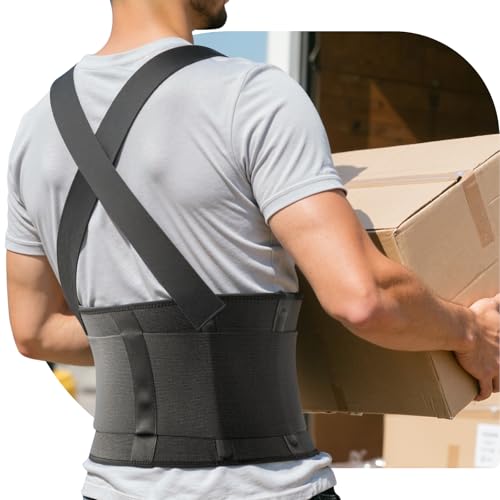
Adjustable Work Back Brace, Large is the straightforward belt-style option in this group: the product name and features emphasize adjustable lower-back support rather than shoulder straps or support stays. The maker says the brace is intended for physically demanding work such as construction and warehousing, and describes its fabric as breathable. This may suit someone who wants an adjustable belt without a suspender-style setup. Its size is Large, and the specifications do not establish a specific support-panel height or strap arrangement, so buyers who prioritize those features should consider a model that names them.
Bottom line: Pick this if you want an adjustable belt and do not need a suspender setup.
SHIBEKO Work Back Brace, M

SHIBEKO Work Back Brace, M combines a built-in bionic lumbar panel with two adjustable, removable shoulder straps, setting it apart from the belt-only option. The maker describes it as a work brace for construction, warehouse, and moving jobs; its claims about pain relief and spinal effects are not a reason to select it. The practical distinction is the panel-and-suspender configuration for buyers who want both features in one work brace. The shown size is M, so check size compatibility before choosing it if your measurements fall outside that range.
Bottom line: Choose this if you prefer a built-in lumbar panel with two removable straps.
How to Choose a Work Back Brace
Choose by fit, support construction, and whether shoulder straps help keep your preferred belt position. Work braces commonly use elastic panels, stays, or suspenders; a wider panel covers more of the torso, while straps can reduce belt slippage but may restrict movement. A brace is not a substitute for reducing a load, using a cart or lift aid, or keeping the load close to your body. For loads that block your view or require twisting, get help or use mechanical assistance rather than relying on a brace. Match the brace to the task and clothing, and test that you can bend, squat, and reach comfortably before doing strenuous work. If a belt shifts, pinches, or limits movement, stop and adjust or remove it.
Brace Fit and Sizing
Measure where the maker directs, because waist and belly-button measurements can differ enough to change the fit. BraceAbility Work Back Brace, Large specifically directs users to measure around the body at the belly button; use the sizing guidance for the chosen model rather than assuming that two brands’ Large sizes match. A belt should sit securely without making normal breathing or bending difficult. Straps should keep the belt positioned without pulling the shoulders forward or restricting arm movement. Try the brace over the clothing you expect to wear at work, since thicker layers change the fit. If the belt cannot stay in place when you bend and stand, or it causes numbness or discomfort, loosen or remove it instead of tightening it further.
Safe Lifting With a Back Brace
A back brace does not make an unsafe lift safe, so plan the lift before putting on a belt. Keep a load close to your body, avoid twisting while carrying it, and pivot with your feet to change direction. Split a bulky load into smaller pieces when possible, and use a cart or ask for help when the object blocks your view or cannot be held close. Braces do not have a universal load rating that makes a certain weight safe to lift. Decide by the object’s shape, grip, distance, and your ability to control it; if you cannot lift and set it down smoothly, use assistance. Stop if pain or other symptoms develop.
Work Belt Features Compared
Strap design and support construction are the clearest differences among these work braces. A belt with stays adds structure, while suspenders offer another way to hold a belt in position; neither feature sets a safe lifting limit. Use the table to narrow the style, then choose by fit and comfort.
| Need | Feature to look for | Product |
|---|---|---|
| Wider elastic support | 9-inch body and stays | Ergodyne ProFlex 1600, 4XL |
| Removable straps | Adjustable suspenders | Work Back Brace with Shoulder Straps, L or BraceAbility Work Back Brace, Large |
| Built-in lumbar panel | Panel with two straps | SHIBEKO Work Back Brace, M |
| Belt-only setup | Adjustable belt | Adjustable Work Back Brace, Large |
Frequently Asked Questions
Can a back brace prevent a lifting injury?
A brace cannot guarantee injury prevention or make an excessive load safe. Keep loads close, avoid twisting under load, and use a cart or help when you cannot control an object securely.
Should a work back brace feel tight?
A work brace should feel secure without restricting breathing or normal movement. If tightening causes numbness, discomfort, or limited bending, loosen or remove it.
Where should I measure for a back brace?
Follow the sizing directions for the specific brace; BraceAbility Work Back Brace, Large directs users to measure around the body at the belly button rather than the waist. Try the chosen size over typical work clothing to check for slipping or pinching.
Do shoulder straps make lifting safer?
Shoulder straps can help keep a belt in position, but they do not raise a safe lifting limit. Remove or adjust straps if they restrict arm movement or interfere with reaching.
When should I use a lifting aid instead?
Use a cart, mechanical aid, or another person when a load blocks your view, cannot be held close, or is too awkward to control smoothly. A back brace is not lifting equipment.