
EZGO TXT 36V Controller Upgrade Options Compared

For a PDS EZGO TXT with a compatible 36–48V system, Navitas TSX3.0 600A PDS is the higher-current upgrade choice; the deciding factor is whether your cart uses PDS rather than DCS. Owners of a DCS cart should choose Navitas 440A TXT DCS Kit, while those seeking a 36V PDS replacement rather than a higher-output upgrade can consider Dasbecan 350A PDS Controller.
We earn a commission if you buy through links on this page. As an Amazon Associate I earn from qualifying purchases. Products are compared on manufacturer specifications, not hands-on testing.
- Best overall: Navitas TSX3.0 600A PDS – A 600-amp TSX3.0 for EZGO TXT PDS models from 2000–2010, with a programmer and solenoid included.
- Best for DCS carts: Navitas 440A TXT DCS Kit – A 440-amp controller kit explicitly made for EZGO TXT DCS 36V carts, with a 16-pin harness and solenoid.
- Best for stock replacement: Dasbecan 350A PDS Controller – A 36V, 350-amp PDS controller for 2000–2009 TXT carts that replaces several Curtis numbers.
| Product | Best for | System fit | Included parts | Shop |
|---|---|---|---|---|
| Navitas TSX3.0 600A PDS | PDS performance upgrade | TXT PDS, 2000–2010 | Programmer, solenoid | Check Price on Amazon |
| Navitas 440A TXT DCS Kit | DCS upgrade kit | TXT DCS, 36V | 16-pin harness, solenoid | Check Price on Amazon |
| Dasbecan 350A PDS Controller | PDS stock replacement | TXT PDS, 2000–2009 | Controller only | Check Price on Amazon |
EZGO TXT 36V Controller Upgrades
Match the controller to your cart’s drive system before comparing current ratings or included components.
Navitas TSX3.0 600A PDS

For a PDS TXT, this 600-amp TSX3.0 is the highest-current option among the compatible choices here. Navitas says it is designed to increase acceleration, hill-climbing torque, and speed, and it includes Bluetooth, an OTF programmer, and a solenoid. Performance changes can vary with the motor, batteries, and other drive components, so the controller alone does not guarantee a particular speed or range. The 36–48V compatibility gives it broader voltage coverage than a 36V-only replacement. It is not the right pick for a DCS cart; confirm the PDS system and electrical compatibility before installation.
Bottom line: Choose this for a compatible PDS TXT when you want the highest current rating in this group.
Navitas 440A TXT DCS Kit
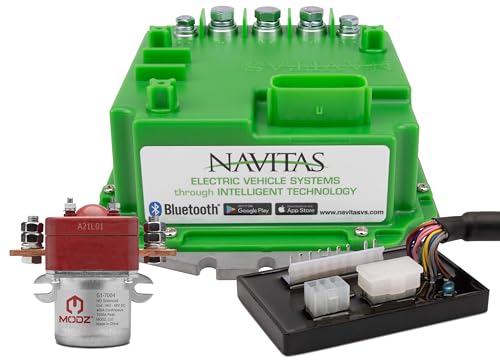
Unlike the PDS-focused options, this kit specifically targets EZGO TXT DCS 36V carts and pairs a 440-amp controller with a plug-and-play 16-pin harness and MODZ heavy-duty solenoid. Navitas says the kit can add 1–3 mph with a stock motor and improve efficiency at lower speeds; actual results depend on the cart’s motor and electrical system. Bluetooth app functions include a speedometer, gear indicator, battery-voltage monitoring, and lockout. The DCS designation is the key limitation: a PDS owner should not choose this kit based only on the shared TXT name or 36V rating.
Bottom line: Choose this when your TXT is a 36V DCS cart and you want the harness and solenoid bundled.
Dasbecan 350A PDS Controller

This is the straightforward 36V, 350-amp PDS replacement rather than a higher-current upgrade. Dasbecan says it fits 2000–2009 EZGO TXT carts with ITS throttle and replaces Curtis numbers including 73326G02 through 73326G07 and 609803. Its function is controlling cart speed and direction. Compared with the Navitas choices, it has no listed app, programmer, harness, or solenoid in the product name and features, so it suits an owner who needs the matching controller itself rather than a bundled upgrade kit. Confirm your cart’s PDS setup, throttle type, and replacement number before ordering.
Bottom line: Choose this for a 2000–2009 TXT PDS cart needing a matching 36V, 350-amp replacement.
How to choose an EZGO TXT controller upgrade
Choose by drive system first, then voltage and current rating. TXT controllers are not interchangeable simply because the cart is a TXT: PDS and DCS identify different electrical control systems, and a controller made for one should not be selected for the other. The options here separate into PDS controllers and a DCS kit, so identify the system from the cart’s existing controller, wiring, or service documentation before weighing performance claims.
Voltage is the next gate: a 36V-only part should not be treated as compatible with a 48V cart. Amp ratings are current capacity, not a guaranteed speed figure; a larger rating does not establish a specific gain without matching motor and battery components. Use this quick decision guide:
| Your cart and goal | Direction to consider |
|---|---|
| TXT PDS, 2000–2010, higher-current upgrade | Navitas TSX3.0 600A PDS |
| TXT DCS, 36V, kit with harness and solenoid | Navitas 440A TXT DCS Kit |
| TXT PDS, 2000–2009, 36V replacement | Dasbecan 350A PDS Controller |
Before installation, verify system type, battery voltage, motor compatibility, throttle configuration, and included wiring against your cart.
PDS and DCS fit for EZGO TXT carts
PDS and DCS are distinct drive-system configurations, so fitment language matters more than the TXT name alone. The Dasbecan controller specifies PDS and ITS throttle for model years 2000–2009; the 600-amp Navitas specifies TXT PDS for 2000–2010; the 440-amp kit specifies TXT DCS at 36V. Those model-year and system boundaries are not interchangeable.
Use the installed controller’s label and your cart’s wiring or service records to establish the configuration. A 36V rating alone cannot tell you whether a controller fits. Also compare connector and harness arrangements, throttle type, solenoid requirements, and motor compatibility. If you cannot establish whether the cart is PDS or DCS, confirm that identification before choosing a controller; a wrong-system part can prevent a proper installation even when the voltage and vehicle family appear to match.
What controller amperage means for an upgrade
Controller amperage describes the current rating, not a guaranteed cart speed or range. The choices here include 350-, 440-, and 600-amp ratings, but motor capability, battery condition, wiring, and other drive components affect what a cart can deliver. Navitas says its 600-amp controller is engineered to increase acceleration, hill-climbing torque, and speed, while the DCS kit maker gives a 1–3 mph gain with a stock motor; those claims are not promises for every configuration.
Pick only a rating supported by the cart’s motor and electrical components. More current can increase demands on those components, so do not assume that the largest rating is automatically the best match. If retaining a stock motor is important, compare the kit’s stock-motor use and verify compatibility for your exact cart before installation. Treat speed claims as system-dependent rather than as a controller-only result.
Controller installation and electrical safety
Golf cart controllers connect to high-current battery circuits, so isolate the battery pack before working on wiring. A common 36V pack uses six 6V batteries in series, but verify the pack’s actual configuration and voltage rather than relying on battery count or cart appearance. Avoid bridging terminals with tools, and keep metal jewelry away from exposed electrical connections.
Match the replacement connectors, polarity, throttle wiring, and solenoid arrangement before connecting the pack. A bundled harness or solenoid can simplify parts matching, but it does not remove the need to verify cart-specific fit. Secure connections and route cables away from moving or hot components. If the cart’s system type or wiring is uncertain, have a qualified golf-cart technician identify it before installation; a mistaken connection can damage electrical components or create a fire hazard.
Frequently Asked Questions
How can I tell whether my EZGO TXT is PDS or DCS?
Check the existing controller label and compare the cart’s wiring or service documentation for the drive-system designation. PDS and DCS controllers are not interchangeable just because both fit TXT carts; verify the system before ordering.
Can a 36V controller work on a 48V EZGO TXT?
Only use a controller whose voltage range includes the cart’s battery-pack voltage. A 36V-only controller should not be assumed to work on a 48V cart, while a 36–48V rating covers both nominal system voltages when the rest of the cart is compatible.
Does a higher-amp golf cart controller always make it faster?
No; amperage alone does not determine speed. Motor, batteries, and the rest of the electrical drive system affect results, and controller makers’ performance claims may vary across configurations.
What should be disconnected before replacing a golf cart controller?
Isolate the battery pack before touching controller wiring because the pack can deliver high current. A common 36V configuration uses six 6V batteries in series, but verify the actual pack and use the cart’s service procedure.
Will a controller upgrade increase my cart’s driving range?
Range cannot be inferred from controller amperage alone. Battery capacity and condition, motor load, terrain, speed, and driving conditions all affect how far a cart travels between charges.