
Battery Charger With Desulfation Mode: 5 Models Compared

For a 12V battery charger with desulfation mode, TowerTop 25A 12V Charger is the named model, with up to 25A output and support for several lead-acid battery types. Choose a different option if you need 6V charging, lithium compatibility, or lower current for a small battery.
Desulfation is a charger mode intended to address sulfate buildup in lead-acid batteries; it is not a guarantee that a damaged battery can be restored.
We earn a commission if you buy through links on this page. As an Amazon Associate I earn from qualifying purchases. Products are compared on manufacturer specifications, not hands-on testing.
- Best overall: TowerTop 25A 12V Charger – Offers up to 25A output and lists AGM, standard, gel, and deep-cycle battery compatibility.
- Best for 12V and 24V: E-FAST 25A 12V/24V Charger – Supports automatic detection of 12V or 24V connections and gives 25A at 12V or 15A at 24V.
- Best for 6V batteries: NOCO GENIUS1 1A Charger – Supports 6V and 12V batteries with a 1A output.
| Product | Best for | Output | Voltage | Chemistry | Shop |
|---|---|---|---|---|---|
| TowerTop 25A 12V Charger | Higher 12V output | Up to 25A | 12V | AGM, STD, gel, deep-cycle | Check Price on Amazon |
| E-FAST 25A 12V/24V Charger | Dual-voltage charging | 25A at 12V; 15A at 24V | 12V, 24V | Lead-acid, LiFePO4 | Check Price on Amazon |
| NOCO GENIUS1 1A Charger | Low-current charging | 1A | 6V, 12V | Lead-acid, LiFePO4 | Check Price on Amazon |
| PLXX 0–15A 12V/24V Charger | Lead-acid capacity range | 0–15A | 12V, 24V | Lead-acid | Check Price on Amazon |
| WAVLINK 20A 6V/12V/24V Charger | Multiple voltages | 20A | 6V, 12V, 24V | Lead-acid, lithium, LiFePO4 | Check Price on Amazon |
Battery Chargers With Desulfation Mode
Compare each charger’s output, supported voltage, and battery chemistry before choosing for your battery.
TowerTop 25A 12V Charger

TowerTop 25A 12V Charger stands out for its 25A maximum output among these 12V-focused choices. The manufacturer says it has four current settings—2A, 10A, 25A, and Auto—and identifies AGM, standard, gel, and deep-cycle batteries as compatible. Its named functions include auto desulfation and battery repair, along with engine start and winter mode.
This model suits buyers charging larger 12V batteries who want selectable current. Its compatibility does not include lithium batteries, so choose another charger if your battery is LiFePO4; for any battery, match the selected charging mode to its chemistry and capacity.
Bottom line: Choose this if you need up to 25A for a compatible 12V lead-acid battery.
E-FAST 25A 12V/24V Charger

E-FAST 25A 12V/24V Charger is the only option here that combines 12V and 24V operation with LiFePO4 compatibility. The manufacturer gives a maximum of 25A for 12V batteries and 15A for 24V batteries, and describes automatic voltage detection. Five current choices include 2A, 8A, 20A, 25A, and Auto; its title also identifies a 200-second booster mode.
This charger fits owners with different vehicle battery voltages or a compatible lithium battery. The output differs by voltage, so use the 12V or 24V rating that matches the battery rather than assuming 25A is available in either mode.
Bottom line: Pick this for compatible 12V and 24V batteries, including LiFePO4.
NOCO GENIUS1 1A Charger
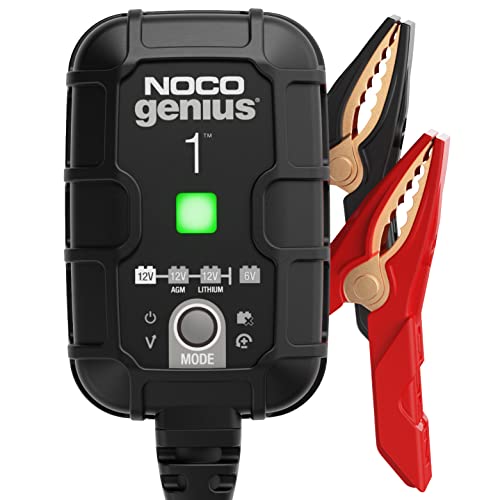
NOCO GENIUS1 1A Charger has a 1A output and supports both 6V and 12V batteries, including lead-acid and LiFePO4 types. The manufacturer describes it as a charger, maintainer, trickle charger, and desulfator, with a temperature sensor that adjusts charging for ambient conditions. Force Mode is also included.
The low output suits small batteries or maintenance charging where a slower charge is acceptable. It is not the choice for someone seeking a high-current charge: compared with the 25A options, 1A takes longer to replenish a large battery. Confirm the battery voltage and chemistry are among the supported types before use.
Bottom line: Choose this for a compatible 6V or 12V battery when 1A is sufficient.
PLXX 0–15A 12V/24V Charger

PLXX 0–15A 12V/24V Charger gives a battery capacity range of 4–300Ah, a useful distinction for buyers matching a charger to batteries of different sizes. It supports 12V and 24V lead-acid types including AGM, gel, flooded, EFB, calcium, and deep-cycle. The maker describes seven-stage charging, fast and slow rates, repair, and winter mode.
This model suits a household with several compatible lead-acid battery sizes and both voltage types. Its 0–15A range is below the 25A maximum of some other options, and lithium chemistry is not included in its compatibility list. Check your battery’s capacity and voltage against the charger’s supported range.
Bottom line: Pick this for a compatible lead-acid battery in its 4–300Ah range.
WAVLINK 20A 6V/12V/24V Charger

WAVLINK 20A 6V/12V/24V Charger covers the widest voltage spread in this set, with 6V, 12V, and 24V support and a 20A rating. The manufacturer lists lead-acid, lithium, and LiFePO4 compatibility, plus charging, maintenance, desulfation, and mandatory modes. A display and protections including reverse-polarity and over-current protection are also identified.
This is a fit for buyers who need one charger for more than one supported battery voltage or chemistry. Its 20A rating is lower than the 25A maximum available on some alternatives, and the features do not provide a per-voltage output breakdown. Verify the required battery voltage and chemistry before connecting it.
Bottom line: Choose this when 6V, 12V, or 24V coverage and multiple chemistries matter.
How to choose a desulfation battery charger
Choose by battery voltage, chemistry, and capacity first; desulfation mode alone does not establish compatibility. Lead-acid chargers use staged charging to replenish and maintain a battery, while desulfation modes typically apply controlled pulses or a recovery process intended for sulfated lead-acid batteries. Lithium batteries require charging profiles designed for their chemistry, so select a model that explicitly supports the battery type. A practical rule: if your battery is 24V, rule out 12V-only models before comparing current. Then match output to your use: 1A favors slow maintenance or small batteries, while higher rated output can reduce charging time if the battery accepts it. A desulfation feature cannot repair every old, damaged, or deeply discharged battery.
Voltage and battery chemistry compatibility
Match the charger setting to the battery label: 6V, 12V, and 24V are not interchangeable. Battery chemistry matters just as much: flooded, AGM, and gel lead-acid batteries have different charging requirements, and LiFePO4 needs a lithium-compatible charger profile. For a battery marked AGM or gel, choose a charger that explicitly includes that type rather than relying on a broad “car battery” label. The table gives a quick screen for voltage and chemistry; capacity and current still need to suit the particular battery.
| Need | Check before choosing |
|---|---|
| 6V battery | Charger explicitly supports 6V |
| 24V battery | 24V support and its rated output |
| LiFePO4 battery | Explicit LiFePO4 compatibility |
| Small battery | Low-current setting and capacity guidance |
| Lead-acid recovery | Desulfation mode and battery condition |
What desulfation mode can and cannot do
Desulfation modes are intended for lead-acid batteries with sulfate buildup, but a mode label is not a promise of recovery. Sulfation can result when a lead-acid battery remains undercharged; severe deterioration, a failed cell, or physical damage may not be corrected by a charger. Use the correct chemistry setting and do not apply a lead-acid recovery mode to lithium batteries unless the manufacturer explicitly supports that chemistry and mode. As a safety rule, charge batteries in a ventilated area and keep sparks or flames away from lead-acid batteries, which can release explosive hydrogen gas during charging. Stop using a battery that is swollen, leaking, or unusually hot.
Charging current and battery size
Current affects how quickly a charger can replenish a battery, but the battery’s capacity and acceptable charge rate matter too. A 1A unit is suited to gradual charging or maintenance, whereas a 20A or 25A charger can supply more current when the battery and selected mode allow it. Do not choose solely by the charger’s maximum: confirm the battery’s amp-hour rating and the charger’s supported capacity or recommended charge rate. For dual-voltage models, check output at the voltage you need; a charger may deliver different current at 12V and 24V. Automatic and selectable-current modes can help manage different batteries, but the correct voltage and chemistry remain essential.
Frequently Asked Questions
Can a desulfation charger restore a dead battery?
Sometimes a charger may recover a sulfated lead-acid battery, but it cannot reliably restore every dead battery. A failed cell, physical damage, or severe aging can prevent recovery; stop if the battery becomes hot, leaks, or swells.
Can I use desulfation mode on a lithium battery?
Use desulfation mode on a lithium battery only if the charger explicitly supports that chemistry and mode. Many desulfation functions target lead-acid batteries, so check for explicit LiFePO4 compatibility before connecting one.
How much charger current does a car battery need?
The right current depends on battery capacity and its acceptable charge rate. A 1A charger is slow, while 20A or 25A output can charge faster when the battery supports it; match the charger’s setting to the battery.
Should I leave a battery charger connected overnight?
Only leave a charger connected if it has a maintenance mode intended for ongoing connection and the battery chemistry is supported. Charge in a ventilated space, keep ignition sources away, and stop if the battery becomes hot or vents unusually.
What voltage charger does a 24V battery need?
A 24V battery needs a charger explicitly rated for 24V operation. A 12V-only charger is not a substitute, and the charger’s output at 24V can differ from its 12V rating.