
Hormodin 3 Rooting Hormone: 5 Products Compared

OHP Hormodin #3 is the named Hormodin 3 product, and its 0.8% IBA formula is made for difficult-to-root varieties, including many evergreens and dormant leafless cuttings. Choose another powder if your cuttings call for a different IBA strength or a general home-garden formula.
Rooting hormone powder is applied to the cut end before planting; the cutting type and hormone strength are key factors in choosing a formula.
We earn a commission if you buy through links on this page. As an Amazon Associate I earn from qualifying purchases. Products are compared on manufacturer specifications, not hands-on testing.
- Best overall: OHP Hormodin #3 – It is Hormodin 3, with 0.8% IBA for difficult-to-root varieties and dormant cuttings.
- Best for hardwood: Hormex #16 Hardwood Powder – Its 1.6% IBA formula is aimed at difficult hardwood cuttings.
- Best for home gardens: Garden Safe Take Root, 2 oz, 2-pack – It names common garden cuttings including roses, African violets and geraniums.
| Product | Best for | IBA concentration | Package size (g) | Target cuttings | Shop |
|---|---|---|---|---|---|
| OHP Hormodin #3 | Difficult cuttings | 0.8% | — | Evergreens, dormant cuttings | Check Price on Amazon |
| Hormodin Rooting Compound, 1/2 Pound | Bulk propagation | 0.8% | 226.8 g | Difficult varieties, evergreens | Check Price on Amazon |
| Hormodin #2, 0.3% IBA | Woody cuttings | 0.3% | 453.6 g | Woody and semi-woody plants | Check Price on Amazon |
| Hormex #16 Hardwood Powder | Hardwood cuttings | 1.6% | 21 g | Hardwood, trees, evergreens | Check Price on Amazon |
| Garden Safe Take Root, 2 oz, 2-pack | Home garden cuttings | — | 56.7 g, 2-pack | Garden and houseplant varieties | Check Price on Amazon |
Hormodin 3 rooting hormone and alternatives
Compare formulas by IBA concentration and the kinds of cuttings each product is intended to support.
OHP Hormodin #3

OHP Hormodin #3 is the exact Hormodin 3 match, with 0.8% IBA for difficult-to-root varieties, including many evergreens and dormant leafless cuttings. The formula is a powder applied to cuttings during propagation. It suits growers working with challenging stems who want the Hormodin #3 strength.
Its use is narrower than a general-purpose home garden powder, so choose a different formula if your cuttings are common soft-stem plants or you specifically need a lower or higher IBA concentration.
Bottom line: Choose this for difficult varieties and dormant leafless cuttings where 0.8% IBA fits.
Hormodin Rooting Compound, 1/2 Pound

Hormodin Rooting Compound, 1/2 Pound shares Hormodin’s 0.8% active ingredient concentration with OHP Hormodin #3, but its half-pound jug distinguishes it for larger propagation batches. The powder needs no measuring or mixing: dip the cutting, tap away excess, then plant. The yield claim is 17,500 cuttings.
This is a related Hormodin compound rather than a product explicitly identified as #3, so buyers who specifically need the Hormodin 3 name should choose OHP Hormodin #3. Its bulk quantity may also be more than occasional home propagation requires.
Bottom line: Choose this for frequent propagation when a half-pound container suits your workflow.
Hormodin #2, 0.3% IBA

Hormodin #2, 0.3% IBA is the lower-strength Hormodin option, at 0.3% IBA rather than the 0.8% concentration in OHP Hormodin #3. Its intended range includes many woody and semi-woody plants, including some evergreens, and the one-pound jar suits ongoing propagation work. The application is a simple dip, tap and plant routine.
The lower concentration and plant focus make it a different fit from Hormodin 3 for more difficult varieties and dormant leafless cuttings. Select it when the woody or semi-woody cutting type is the deciding factor, not just the shared Hormodin name.
Bottom line: Choose this when a 0.3% formula for woody or semi-woody cuttings is the better fit.
Hormex #16 Hardwood Powder

Hormex #16 Hardwood Powder is the highest-concentration alternative here, with 1.6% IBA and a focus on hardwood cuttings such as trees, conifers and woody shrubs. The 21 g bottle is said to treat up to 200 cuttings, and the application directions describe moistening the end, dipping, tapping off excess and planting.
That concentration and hardwood focus set it apart from Hormodin 3’s 0.8% formula. Choose it for the specified tough hardwood stems; it is not the matching choice for someone seeking the Hormodin 3 product name.
Bottom line: Choose this when you are propagating hardwood stems and want the 1.6% formula.
Garden Safe Take Root, 2 oz, 2-pack
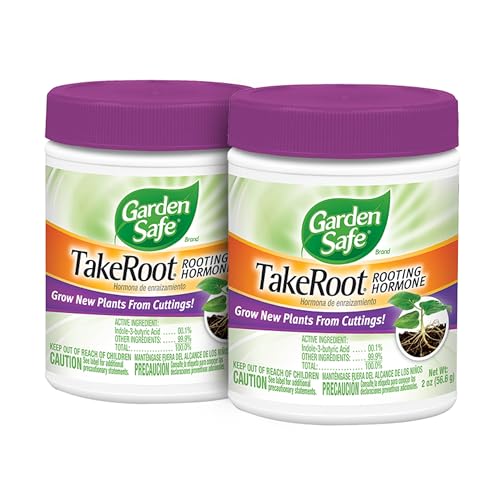
Garden Safe Take Root, 2 oz, 2-pack is the home-garden alternative, naming African violets, roses, poinsettias, philodendrons, geraniums and coleus among its suitable cuttings. It uses IBA but does not provide a concentration here. The directions say to moisten a cutting, stir its cut end in powder, tap off excess and plant.
That broad plant list makes it distinct from the Hormodin formulas aimed at particular woody or difficult-to-root material. The missing concentration makes direct strength comparison impossible, so choose it for the named home and garden varieties rather than matching a specific IBA percentage.
Bottom line: Choose this for the home and garden varieties when concentration is not your selection criterion.
How to choose rooting hormone strength
Match the powder to the cutting type rather than assuming a higher IBA percentage is universally better. The options here range from 0.3% IBA for woody and semi-woody plants to 1.6% for hardwood cuttings, while Hormodin #3 and the half-pound Hormodin compound are both 0.8%.
Soft, semi-hardwood and hardwood cuttings differ in stem maturity: hardwood is dormant, mature wood, while softwood is fresh, flexible growth. Those categories affect propagation success along with species, season and humidity. Use the product’s target as a starting point; for example, the 1.6% formula names hardwood stems, and the Hormodin 3 formula calls out difficult varieties and dormant leafless cuttings.
Before dipping, prepare a clean cutting with a fresh cut near a node and keep the rooting medium evenly moist rather than waterlogged. Avoid dipping cuttings directly into the original container if you can pour a small working amount into a separate dish; discard leftover powder to reduce contamination risk.
Rooting hormone application and propagation conditions
Rooting powder application is a dip-and-plant process, but clean technique and the rooting environment matter as much as the powder. Make a fresh cut, remove leaves that would sit below the medium, moisten the stem end if the product directions call for it, then dip and tap away loose powder before planting.
Use a clean propagation medium with drainage and keep it damp, not saturated; standing water can deprive cuttings of oxygen and encourage rot. A clear cover or humidity dome can slow moisture loss, but vent it regularly and keep foliage from staying wet. Bright indirect light is generally safer than direct midday sun, which can overheat enclosed cuttings. Rooting time varies substantially by plant, stem maturity and temperature, so inspect gently rather than repeatedly pulling a cutting from the medium.
Rooting hormone choices by cutting type
The product differences are easiest to compare by target cutting and IBA concentration. The table separates Hormodin 3 from related or alternative formulas so a matching name is not confused with a matching strength.
| Cutting need | Product match | IBA |
|---|---|---|
| Difficult varieties, dormant leafless cuttings | OHP Hormodin #3 | 0.8% |
| Woody and semi-woody plants | Hormodin #2, 0.3% IBA | 0.3% |
| Hardwood stems | Hormex #16 Hardwood Powder | 1.6% |
| Named home and garden plants | Garden Safe Take Root, 2 oz, 2-pack | — |
Choose the exact Hormodin 3 match when that formula is the requirement; choose by plant group when the cutting type is the priority. For another Hormodin compound at 0.8%, Hormodin Rooting Compound, 1/2 Pound is sold in a half-pound jug.
Common rooting hormone mistakes
Too much powder is a common avoidable error: excess coating can be tapped off before planting, as the application directions for these powders indicate. A thick clump does not substitute for a clean cut or suitable moisture conditions.
Another mistake is treating all stems alike. Hardwood cuttings are mature dormant stems, while softwood cuttings are new flexible growth; their rooting behavior differs, and a formula aimed at one group may not be the right selection for another. Do not confuse the 0.8% Hormodin #3 formula with the 0.3% #2 or 1.6% hardwood product. Keep powders out of reach of children and pets, avoid inhaling dust, and wash hands after handling; follow the product label for protective precautions.
Frequently Asked Questions
What does IBA mean in rooting hormone powder?
IBA means indole-3-butyric acid, a synthetic auxin used as a rooting hormone. The percentages indicate concentration, so 0.8% and 1.6% are not interchangeable strengths.
How should I apply rooting hormone to cuttings?
Apply powder to the cut end, then tap away excess before planting. Some products direct users to moisten the stem first; use the directions for the specific powder you selected.
Can dormant cuttings use Hormodin 3?
Hormodin 3 is prepared for difficult-to-root varieties, including many evergreens and dormant leafless cuttings. Whether it suits a particular plant also depends on the species and cutting condition.
How much rooting hormone powder should coat a cutting?
A light coating on the cut end is sufficient; tap off loose excess before planting. Excess powder is not a substitute for the right concentration or a suitable propagation medium.
What is the difference between hardwood and softwood cuttings?
Hardwood cuttings come from mature, dormant stems, while softwood cuttings come from fresh, flexible growth. Stem maturity changes the propagation approach, so match the hormone formula to the product’s target.