
Multi Plug in Outlet: 5 Wall Extenders Compared

For most people, Rotating 6-Outlet Extender is the best fit because it combines six AC outlets, four USB ports and a rotating plug. A multi plug outlet extender adds receptacles at a wall outlet but does not increase the circuit’s capacity.
Choose Cable Matters 6-Outlet Wall Tap instead if you need a simple six-outlet tap without USB ports; for a screw-secured design, check whether your receptacle is a standard duplex outlet before choosing Teiobar 6-Outlet USB Extender or QINLIANF 5-Outlet Extender.
We earn a commission if you buy through links on this page. As an Amazon Associate I earn from qualifying purchases. Products are compared on manufacturer specifications, not hands-on testing.
- Best overall: Rotating 6-Outlet Extender – Six AC outlets, four USB ports and a 180-degree rotating plug cover several everyday needs.
- Best for a simple tap: Cable Matters 6-Outlet Wall Tap – Adds six AC outlets and uses both receptacles for a stable wall connection.
- Best for screw mounting: Teiobar 6-Outlet USB Extender – Adds six AC outlets and secures to a duplex outlet with a center screw.
- Best for a five-outlet setup: 5-Outlet 4-USB Extender – Provides five AC outlets and four USB ports in a three-sided design.
| Product | Best for | AC outlets | USB ports | Shop |
|---|---|---|---|---|
| Rotating 6-Outlet Extender | Flexible placement | 6 | 4 (2 USB-C) | Check Price on Amazon |
| Cable Matters 6-Outlet Wall Tap | Simple expansion | 6 | — | Check Price on Amazon |
| Teiobar 6-Outlet USB Extender | Screw-secured fit | 6 | 4 (2 USB-C) | Check Price on Amazon |
| 5-Outlet 4-USB Extender | Compact charging | 5 | 4 (1 USB-C) | Check Price on Amazon |
| QINLIANF 5-Outlet Extender | Fixed duplex mounting | 5 | 4 (1 USB-C) | Check Price on Amazon |
Multi Plug in Outlet Extenders
Compare outlet count, USB charging, surge rating and mounting style to match the extender to your receptacle and devices.
Rotating 6-Outlet Extender

Rotating 6-Outlet Extender stands out for its rotating plug, which can turn 180 degrees to accommodate horizontal or vertical receptacles. The three-sided body has six AC outlets with wide spacing, plus four USB ports: two USB-C and two USB-A. The maker rates the surge protection at 1,800 joules and USB output at 5 volts, 3.1 amps total. Its grounded indicator light is another useful cue. This is a fit for a crowded desk or shared charging spot; choose a fixed extender if you do not need a rotating plug.
Bottom line: Pick this when flexible orientation and a mix of AC and USB charging matter.
Cable Matters 6-Outlet Wall Tap

Cable Matters 6-Outlet Wall Tap is the straightforward choice for six AC connections without a USB charging section. Its wall tap uses both receptacles on a standard dual-outlet plate, a two-point attachment intended to keep the extender steady when cords are plugged in or removed. It accepts grounded three-prong and ungrounded two-prong cords. The compact tap can suit a space behind furniture where a corded power strip is awkward. It does not add USB ports, so choose another option if you want to charge USB devices directly from the extender.
Bottom line: Choose this for a stable six-outlet tap and no need for built-in USB.
Teiobar 6-Outlet USB Extender

Teiobar 6-Outlet USB Extender combines six spaced AC outlets with four USB ports and a center screw for securing the extender to a duplex receptacle. That mounting detail may help where cords are frequently connected or removed. The maker rates its surge protection at 900 joules, and the product is ETL listed. This option suits a standard duplex outlet when a fixed attachment is useful. Its screw mounting is not compatible with every receptacle style; the maker specifically says it cannot be secured to a GFCI outlet, so check the outlet type first.
Bottom line: Pick this for a screw-secured duplex fit with USB charging.
5-Outlet 4-USB Extender

5-Outlet 4-USB Extender provides five AC outlets and four USB ports in a three-sided wall-mounted design, giving up one AC outlet compared with six-outlet choices. Its USB section has three USB-A ports rated up to 2.4 amps each and one USB-C port rated up to 3 amps. The maker rates surge protection at 1,680 joules. The USB-C port and multi-device layout suit a bedside or dorm setup with several charging cables. Choose a six-outlet model if you expect to connect six AC plugs at once.
Bottom line: Choose this when four USB ports matter more than a sixth AC outlet.
QINLIANF 5-Outlet Extender
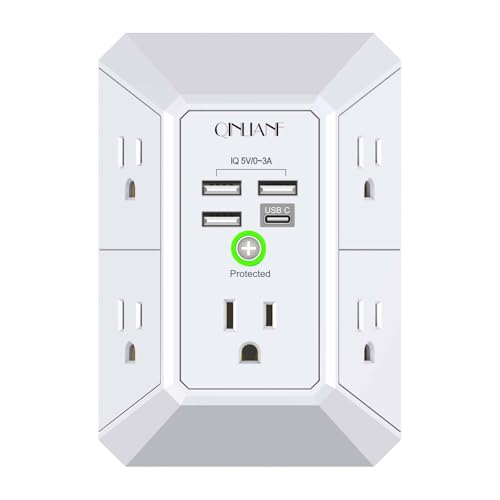
QINLIANF 5-Outlet Extender offers five AC outlets, four USB ports and a center screw to secure the extender to a duplex receptacle. Its three-sided layout has 2.1 inches of spacing between AC outlets, which can help when plugs have broad housings. The maker rates surge protection at 1,680 joules. This is suited to a fixed wall setup where wider outlet spacing is more useful than a sixth AC connection. The screw-secured design is intended for duplex outlets and cannot be secured to a GFCI receptacle, so verify compatibility before choosing it.
Bottom line: Pick this when you want the wider spacing and can use a duplex receptacle.
How to choose a multi plug in outlet
Start with the number and type of plugs you need at the wall, then compare spacing, USB ports and mounting. Outlet extenders here provide five or six AC receptacles; USB ports are a separate charging option and do not replace AC outlets. A joule rating is a measure of surge energy absorption, not the amount of power the extender can supply. This quick guide separates common needs.
| Need | What to prioritize |
|---|---|
| Large plug housings | Wide spacing between AC outlets |
| Phones and USB devices | USB-A/USB-C port mix and total output |
| Frequent cord changes | Secure fit across both receptacles or screw mounting |
| Surge protection | Joule rating, while remembering it does not add circuit capacity |
Count the plugs you will use at once rather than the number of devices you own; some devices charge over USB instead of using an AC plug.
Outlet extender safety and electrical load
A multi plug extender does not increase the wall circuit’s power limit: every connected device still draws from the same branch circuit. Add the wattage of the devices that may run simultaneously and keep the total within the receptacle, extender and circuit ratings. Rotating 6-Outlet Extender’s maker gives a 15-amp, 1,875-watt rating; do not assume that rating applies to the other extenders. High-wattage appliances such as portable heaters can consume a large share of a circuit’s capacity, so avoid sharing a loaded extender with other substantial loads.
Use a grounded outlet for three-prong equipment, and never remove a ground pin to make a plug fit. Stop using a unit with a loose fit, heat, discoloration or damaged housing. Surge protection is not a substitute for correct grounding or for keeping the electrical load within limits.
Wall fit and mounting differences
Check the receptacle type and the space around it before choosing a wall-mounted extender. Some designs occupy both receptacles, while center-screw models are intended to fasten to a duplex wall outlet; the screw-secured products here cannot be secured to a GFCI outlet. Receptacle orientation also matters when nearby furniture or a second wall plate could block a large body. Measure available clearance around the outlet and compare it with the extender’s shape, especially if the outlet sits behind a desk or bed.
Wide spacing can prevent one bulky adapter from covering a neighboring outlet, but the actual plug housings vary. A rotating plug can help align a unit on a sideways or vertical receptacle; it does not make an incompatible receptacle suitable. Check grounding and mounting fit before connecting equipment.
USB ports and surge ratings explained
USB port count alone does not tell you how quickly multiple devices can charge. Look at the total output as well as the number of USB-A and USB-C ports; Rotating 6-Outlet Extender specifies 5 volts and 3.1 amps total, while 5-Outlet 4-USB Extender gives per-port maximums for its USB-A and USB-C connections. A shared USB output can limit the power available when several devices charge together.
Surge ratings are measured in joules, but a higher number does not mean an extender can support more plugged-in appliances or eliminate every electrical risk. The products with ratings here range from 900 to 1,800 joules. For sensitive electronics, match the surge-protection approach to the equipment and keep the extender’s AC load within its rating.
Frequently Asked Questions
Does a multi plug outlet increase circuit capacity?
No, an outlet extender only adds connection points; the wall circuit still supplies the total load. Add the wattage of devices running at the same time and stay within the lowest applicable rating for the circuit and extender.
Can I plug a space heater into an outlet extender?
A space heater can draw a large share of a circuit’s capacity, so avoid running it through a multi plug extender shared with other loads. Check the heater’s wattage and use only a receptacle and circuit rated for that load.
How do I know whether an extender fits?
Check whether the product uses both receptacles or a center mounting screw, and confirm your wall outlet type. The screw-secured designs here are for duplex outlets and cannot be secured to a GFCI receptacle.
What does a surge protector joule rating mean?
The joule rating indicates how much surge energy the protection is rated to absorb, not how much ordinary appliance load it can carry. Compare the rating alongside the extender’s AC electrical rating and never exceed the lower applicable load limit.
Can USB ports charge several devices at once?
Yes, but charging power can be shared across ports. Check the total USB output or per-port limits; for example, a total of 3.1 amps may be divided among connected devices.