
MLA 30 Loop Antenna: Five Versions Compared by Fit

For most shortwave listeners, MLA-30+ Max Loop, BNC is the straightforward MLA-30+ choice because it specifies a BNC connector and 0.5–30 MHz coverage. Choose MLA-30+ Loop with 10 m Feeder if you need its included 10-meter feeder, or MLA30+ USB-Powered Active Loop if its USB power and SMA/BNC ports suit your setup.
An MLA-30 is an active receiving loop for radio signals; it is not a transmitting antenna. Before choosing MLA-30 Active Receiving Loop, confirm whether its lower frequency limit is 100 kHz or 0.5 MHz, since its name and features give different figures.
We earn a commission if you buy through links on this page. As an Amazon Associate I earn from qualifying purchases. Products are compared on manufacturer specifications, not hands-on testing.
- Best overall: MLA-30+ Max Loop, BNC – It specifies 0.5–30 MHz coverage and a BNC connector.
- Best for a long feeder: MLA-30+ Loop with 10 m Feeder – Its name specifies an included 10-meter feeder.
- Best for USB power: MLA30+ USB-Powered Active Loop – It specifies USB power and SMA/BNC ports.
| Product | Best for | Frequency range | Connection or power | Shop |
|---|---|---|---|---|
| MLA-30+ Max Loop, BNC | BNC receiver setups | 0.5–30 MHz | BNC connector | Check Price on Amazon |
| MLA-30 Active Receiving Loop | Broadband listening | Conflicting: 100 kHz / 0.5–30 MHz | — | Check Price on Amazon |
| MLA-30+ Plus Rainproof Loop | Rain-exposed placement | 0.5–30 MHz | — | Check Price on Amazon |
| MLA-30+ Loop with 10 m Feeder | Long cable runs | 0.5–30 MHz | — | Check Price on Amazon |
| MLA30+ USB-Powered Active Loop | USB power setups | 0.5–30 MHz | SMA/BNC ports; USB power | Check Price on Amazon |
MLA 30 Loop Antennas Compared
Compare the frequency ranges and setup details before matching an active loop to your receiver.
MLA-30+ Max Loop, BNC

MLA-30+ Max Loop, BNC distinguishes itself with a specified BNC connector and 0.5–30 MHz range, making it a clear match when those details fit your receiver. Its dimensions are 7.48 × 7.48 inches, with a height of 1.57 inches. The maker says the loop can suppress local radiated noise by up to 30 dB compared with long-wire antennas; actual reception depends on placement and local interference. The features describe rotation to aim the antenna’s null toward interference. Choose another option if you need a feeder length or power method explicitly identified.
Bottom line: Choose it when your receiver uses BNC and the range covers your listening bands.
MLA-30 Active Receiving Loop
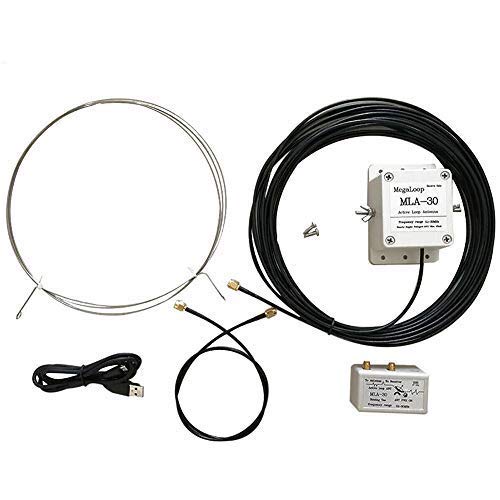
MLA-30 Active Receiving Loop is the option whose name gives a 100 kHz lower limit while its features give 0.5–30 MHz, so resolving that mismatch is the key decision before purchase. Its features describe a built-in low-noise amplifier and compatibility with shortwave, medium-wave, HAM, and SDR receivers. The maker says the amplifier enhances weak-signal reception and reduces interference. No connector or feeder length is established here, so this option suits buyers willing to confirm those setup requirements as well as its actual lower frequency limit.
Bottom line: Choose it only after confirming the lower frequency limit and receiver connection.
MLA-30+ Plus Rainproof Loop

MLA-30+ Plus Rainproof Loop identifies itself as a rainproof MLA-30+ Plus loop, a useful distinction for an outdoor installation exposed to weather. It is described for medium- and shortwave reception and gives no connector or included feeder length in its specifications. The maker says rotating the loop can align its null with an interference source, and cites directivity as a way to improve signal-to-noise ratio. Buyers planning a fixed rooftop setup should consider how they will rotate the loop, while anyone matching a particular receiver should verify the required connection before choosing this version.
Bottom line: Choose it for a rain-exposed setup where you can still rotate the loop.
MLA-30+ Loop with 10 m Feeder

MLA-30+ Loop with 10 m Feeder stands out for including a 10-meter feeder, making cable length the clearest reason to select it over the other versions. Its name gives a 0.5–30 MHz operating range, and the features describe rooftop or balcony installation and loop rotation to aim a null at interference. The maker says the design can suppress local radiated noise by up to 30 dB compared with long-wire antennas. The connector and power method are not established here, so check that both match your receiver and installation before committing to a long cable run.
Bottom line: Choose it when a 10-meter feeder fits your installation and receiver connection.
MLA30+ USB-Powered Active Loop
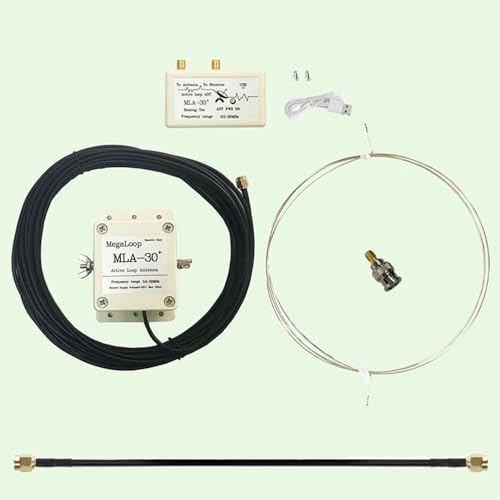
MLA30+ USB-Powered Active Loop is the only option that explicitly combines USB power with SMA/BNC ports, which can simplify matching a receiver and available power source. It specifies 0.5–30 MHz coverage for medium- and shortwave reception, and a compact setup for balconies or rooftops. The maker says the design provides noise suppression of up to 30 dB and recommends rotation to aim the antenna’s null toward interference. Its features do not establish a feeder length, so buyers needing a particular cable reach should verify that separately.
Bottom line: Choose it when USB power and its SMA/BNC ports suit your receiver.
How to Choose an MLA 30 Loop Antenna
Start with the frequency range and receiver connection, then decide whether cable and power details fit your installation. The shortwave band generally spans 3–30 MHz, while medium-wave broadcast reception in the United States is roughly 0.53–1.7 MHz; an antenna’s range should cover the bands you plan to receive. Active loops use an amplifier, so the receiver setup must also accommodate the antenna’s power arrangement. The product options here vary in named connector, USB power, and included feeder, rather than establishing a universal connection or power standard.
Rotation is a practical feature, not a substitute for receiver compatibility. Loop antennas can have a directional null: turn the loop to reduce a persistent interfering signal, then check whether the desired station remains usable. If your receiver requires a specific connector or a cable longer than 10 meters, confirm those fit requirements before choosing a version.
Frequency Coverage and Receiver Fit
Coverage from 0.5 to 30 MHz spans much of the medium-wave and shortwave listening range, but compare the lower limit against the stations you want. The 0.5 MHz boundary equals 500 kHz, below the usual US AM broadcast band starting near 530 kHz; a lower limit of 100 kHz reaches lower still. One option gives both figures in different places, so confirm which applies before relying on it for lower-frequency listening.
Connector and power compatibility are separate checks. BNC and SMA are distinct connector types, and a receiver may not accept both directly; match the antenna port to the receiver input or plan for an appropriate adapter. An active antenna also needs its amplifier powered. Do not assume an unspecified power method or feeder is included just because another MLA-30 variant identifies one.
Placement and Rotation for a Receiving Loop
Place a receiving loop where it can be rotated and away from nearby electrical noise sources such as switching power supplies and LED lighting. Moving an indoor antenna several feet from electronics can change interference pickup; compare reception at more than one position rather than treating one location as final. The loop’s directional null can help when a noise source comes from a stable direction, but reflections and multiple sources can make the best orientation less obvious.
For balconies and rooftops, secure the antenna against wind and keep the feed cable from becoming a trip or snag hazard. The maker describes these models for outdoor placement, but that does not establish safe mounting hardware for a particular railing or roof. Receiving loops are not transmit antennas: do not connect a transmitter or transmit through them unless the manufacturer explicitly rates the exact antenna for transmission.
Power, Cable, and Outdoor Safety
Plan the cable route and power arrangement before mounting an active loop outdoors. One version identifies a 10-meter feeder, while another identifies USB power; those are different setup facts and should not be presumed for the remaining variants. Keep connectors dry and protected, use a secure mount, and avoid routing a cable where it can be crushed by a window or door.
Any outdoor antenna can be exposed to lightning, even when used only for receiving. Disconnect the antenna from the radio before thunderstorms and follow local electrical and building requirements for permanent installations; never work on a roof or mast during storm conditions. A receiving antenna must not be treated as lightning protection or as a safe substitute for a properly grounded installation.
Frequently Asked Questions
Can an MLA 30 loop antenna transmit?
No; these products are described as active receiving antennas, not transmitting antennas. Do not connect a transmitter unless the manufacturer explicitly rates the exact antenna for transmitting.
What frequency range should I check for shortwave?
Shortwave generally occupies 3–30 MHz, so a 0.5–30 MHz range covers that band on paper. Confirm the antenna’s lower limit if you also want medium-wave or lower-frequency reception.
How should I turn a loop to reduce interference?
Rotate the loop in small increments and listen for the direction that reduces the unwanted signal. Loop nulls are directional, but nearby reflections or multiple noise sources can make the best angle vary by location.
Does every MLA 30 include a 10-meter cable?
No; only one of these options specifies a 10-meter feeder. If your route needs more than 10 meters, verify the included cable length and connector before mounting.
Can I mount an active loop outdoors in a storm?
No; disconnect an outdoor antenna from the radio before thunderstorms and do not work on a roof or mast during storm conditions. A rainproof label does not make an antenna lightning-safe.