
Castor Oil to Repel Voles: 4 Lawn Formulas Compared

For a lawn where stated coverage matters, Baar MolEvict 1-Gallon is the strongest starting point: its maker says one gallon covers up to 20,000 square feet. Choose a different formula if you need a smaller container or prefer the 32-ounce hose-end option.
Castor oil repellents are applied to lawns to make treated soil or food sources less appealing to voles; results depend on correct identification, coverage and repeat application.
We earn a commission if you buy through links on this page. As an Amazon Associate I earn from qualifying purchases. Products are compared on manufacturer specifications, not hands-on testing.
- Best overall: Baar MolEvict 1-Gallon – Its coverage is up to 20,000 square feet per gallon.
- Best for hose-end use: Baar MolEvict 32-Ounce – The 32-ounce size is intended for hose-and-sprayer application and covers 5,000 square feet.
- Best for gallon size: Natural Elements Castor Oil, 1 Gallon – It is a 1-gallon castor oil formula for lawn and yard treatment.
| Product | Best for | Container size | Stated coverage | Application | Shop |
|---|---|---|---|---|---|
| Baar MolEvict 1-Gallon | Large lawns | 1 gal | Up to 20,000 sq ft | Liquid lawn application | Check Price on Amazon |
| Baar MolEvict 32-Ounce | Hose-end application | 32 fl oz | 5,000 sq ft | Garden hose and sprayer | Check Price on Amazon |
| Natural Elements Castor Oil, 1 Gallon | Large-area treatment | 1 gal | — | Lawn and yard treatment | Check Price on Amazon |
| Nature’s MACE Castor Oil, 32 Ounce | Seasonal treatment | 32 fl oz | — | Lawn treatment | Check Price on Amazon |
Castor Oil to Repel Voles
Compare these castor oil lawn treatments by container size, stated coverage and application approach.
Baar MolEvict 1-Gallon

For the largest coverage among these options, MolEvict comes in a 1-gallon container rated by its maker for up to 20,000 square feet. The maker says the formula coats food sources such as grubs and worms, encouraging moles and voles to look elsewhere. That makes it a fit for buyers treating a broad lawn rather than a small patch. The coverage figure is an upper limit, so measure the area and avoid assuming one container will cover more than that. The product also names gophers and armadillos, but this comparison focuses on vole use.
Bottom line: Choose this for a larger lawn when its 20,000-square-foot coverage matches your measured area.
Baar MolEvict 32-Ounce

This 32-ounce MolEvict size is the hose-end choice, with coverage of 5,000 square feet rather than the 1-gallon size’s broader coverage. The maker says to apply it with a garden hose and sprayer twice monthly, then as needed for maintenance. That schedule is useful to buyers planning recurring lawn treatments, but it also means this is not a one-and-done option. Measure the treatment area first and use the label’s dilution and application directions; do not extrapolate coverage from container size alone.
Bottom line: Pick this when a hose-and-sprayer format and 5,000-square-foot coverage suit your lawn.
Natural Elements Castor Oil, 1 Gallon
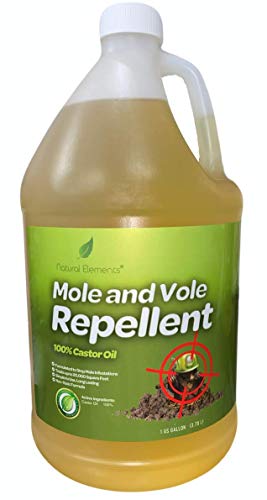
Natural Elements emphasizes a 100% castor oil formula in a 1-gallon size, while its specifications do not give a coverage figure. The maker says the formula affects moles’ and voles’ sensory perception and works gradually, so this option is aimed at buyers willing to use a repellent approach rather than expect immediate results. The gallon format suits yard treatment, but without a coverage rate you cannot confidently match the container to a measured lawn area. Confirm the application rate before buying if you need to calculate how much to treat.
Bottom line: Choose this if a gallon castor oil formula matters more than having a coverage rate.
Nature’s MACE Castor Oil, 32 Ounce

Nature’s MACE pairs a 32-ounce container with a claim of all-season repellency, unlike the products here that provide numeric coverage figures. The maker says its formula taints food sources and leaves an unpleasant smell for moles and voles, and claims it will not wash off with rain or irrigation when applied as directed. Those are performance claims, not a guarantee for every yard.
Bottom line: Pick this when a smaller container and the maker’s all-season claim are priorities.
How Castor Oil Repellents Work on Voles
Castor oil repellents are intended to make treated soil or food sources unpleasant, not to trap or poison voles. Voles are rodents that feed on vegetation and can gnaw roots, bulbs and bark; moles are insect-eating mammals that make tunnels while searching for prey such as earthworms. Distinguish them before treatment: surface runways and plant damage point toward voles, while raised ridges and soil mounds are more characteristic of moles. A castor oil formula aimed at both may be relevant, but it will not fix every cause of lawn damage. Treat the active area rather than only the visible mound, and base the amount on the measured square footage and the label rate.
How to Choose Castor Oil for a Lawn
Choose by treated area and application method first: the 32-ounce MolEvict option gives a 5,000-square-foot figure, while its gallon option is rated for up to 20,000 square feet. A product without a numeric coverage rate is harder to plan, especially for a large lawn; confirm its label rate before purchase if you need a reliable container count. Hose-end products can simplify broad application, while a liquid without a specified applicator may require a compatible sprayer. Match the label’s water-in instructions and reapplication schedule to your plans. As a decision rule, measure the lawn and select a formula whose coverage meets or exceeds that area, rather than estimating from bottle size.
| Need | Choice | Planning note |
|---|---|---|
| Up to 5,000 sq ft, hose-end use | MolEvict 32-ounce | Follow label rate and schedule |
| Up to 20,000 sq ft | MolEvict 1-gallon | Coverage is a maker claim |
| No numeric area rate provided | Other formulas here | Check the label before calculating quantity |
Vole or Mole Damage Before Treatment
Identify the animal before applying a repellent because voles and moles damage yards differently. Voles leave narrow surface runways through grass and may feed on roots, bulbs or the lower bark of young trees; moles more often leave raised soil ridges and mounds from underground travel. A castor oil product labeled for both animals may suit a mixed problem, but signs alone can be ambiguous, particularly where lawns have both tunnels and plant injury. Check several areas of the yard, including the base of damaged plants, rather than treating only one conspicuous mound. If the damage pattern does not match vole feeding or surface runways, reassess the pest before choosing a vole repellent.
Applying Lawn Repellent Safely
Apply repellents only at the label rate and keep people and pets off treated grass until the label permits re-entry or the application has dried, whichever guidance is more restrictive. Hose-end products need even coverage across the intended treatment zone; concentrate neither the product nor the spray beyond label directions. Rainfall, irrigation and watering-in directions matter because formulas differ: one maker may claim rain resistance while another directs use under a recurring schedule. Do not transfer one product’s schedule or coverage to another size or brand. Store the container in its original packaging, away from children and pets, and avoid runoff into drains, ponds or waterways.
Frequently Asked Questions
How long does castor oil take to repel voles?
Castor oil repellents may work gradually rather than immediately; one formula’s maker specifically describes a gradual effect. Judge progress over the label’s treatment interval and reapply only as directed.
Will rain wash castor oil vole repellent away?
Rain performance depends on the formula: Nature’s MACE claims its treatment will not wash off during rain or irrigation when used as directed. Check the specific product label instead of assuming that claim applies to every castor oil repellent.
Can castor oil stop voles from eating plant roots?
Castor oil repellents are intended to make treated areas or food sources less appealing, but they do not physically protect roots. For vulnerable bulbs or young trees, use a physical barrier such as hardware cloth with openings no larger than 1/4 inch, installed without leaving gaps.
How often should I reapply castor oil for voles?
Reapply on the schedule printed for the specific formula; the 32-ounce MolEvict product says to apply twice monthly and then as needed for maintenance. Do not use that interval for a different brand unless its label gives the same direction.
Are voles and moles affected by the same repellent?
Some castor oil products are labeled for both, but the animals have different diets and damage patterns. Voles are rodents that feed on plants, while moles primarily seek soil-dwelling prey, so identify the problem before choosing a treatment.