
Dog Repellents That Work: 4 Options by Use

For most people, Nature’s MACE Dog MACE Granules is the clearest fit because its granules are made for outdoor areas and cover up to 1,400 square feet. Choose Nature’s Miracle Pet Block Spray instead for indoor training, or a different granular formula if you need a product described for both indoor and outdoor use.
Dog repellents use scent to make treated areas less appealing; they work as training aids rather than guaranteed barriers, so application and the dog’s habits matter.
We earn a commission if you buy through links on this page. As an Amazon Associate I earn from qualifying purchases. Products are compared on manufacturer specifications, not hands-on testing.
- Best overall: Nature’s MACE Dog MACE Granules – Outdoor granules cover up to 1,400 square feet and target digging, marking, and plant damage.
- Best for indoor training: Nature’s Miracle Pet Block Spray – A 16-ounce spray is formulated for unwanted indoor areas and surfaces.
- Best for digging: I Must Garden Dog & Cat Granules – Granules are intended for flower beds, gardens, pots, and grass, and are described for indoor and outdoor use.
- Best for yard beds: Bonide Go Away! Granules – Granules target lawns, gardens, flower beds, trees, and shrubs.
| Product | Best for | Use | Form | Package size | Shop |
|---|---|---|---|---|---|
| Nature’s MACE Dog MACE Granules | Outdoor area coverage | Lawn, yard, garden | Granules | 40 oz | Check Price on Amazon |
| Nature’s Miracle Pet Block Spray | Indoor surfaces | Indoor training | Spray | 16 oz | Check Price on Amazon |
| I Must Garden Dog & Cat Granules | Digging deterrence | Indoor and outdoor | Granules | 48 oz | Check Price on Amazon |
| Bonide Go Away! Granules | Garden boundaries | Yard and garden | Granules | 48 oz | Check Price on Amazon |
Dog Repellents by Use
Match the application type to the area you want to protect, then use it as directed.
Nature’s MACE Dog MACE Granules

For outdoor area coverage, this formula has a coverage of up to 1,400 square feet, unlike the other options here. Nature’s MACE says the granules help discourage digging, marking, and damage to lawns, gardens, flower beds, patios, and fences. The 2.5-pound package is spread over treated areas; the maker advises reapplying every 1–2 weeks or after rain. It suits a defined outdoor zone where you can refresh the application. Its limitation is that it is not the indoor spray choice, and scent aversion may require repeated application while a dog learns to avoid the spot.
Bottom line: Choose this for a measured outdoor area where coverage and repeat application matter.
Nature’s Miracle Pet Block Spray

For indoor training, this is the only spray among these options, making it easier to target particular unwanted areas or surfaces than to spread granules. Nature’s Miracle says its essential-oil fragrance acts as a signal to keep dogs away from treated areas, and that it is safe for pets and homes when used and stored as directed. The 16-ounce bottle suits spot treatment in the home. The limitation is its indoor-training focus: choose an outdoor granular product for garden beds or lawn areas instead. Keep application and storage within the product directions, especially around pets.
Bottom line: Pick this for targeted indoor training on unwanted areas or surfaces.
I Must Garden Dog & Cat Granules

This formula is the broadest-use granular option here: it is described for indoor and outdoor use and specifically targets digging in flower beds, gardens, pots, and grass. Its 3-pound container holds 48 ounces of granules made with botanical oils. The maker says it will not harm plants and recommends careful application according to the included directions for best results. It may suit someone trying to break a digging habit across several kinds of areas. The limitation is that breaking an established behavior can require proper application and other behavior-modification techniques; it is not a one-step physical barrier.
Bottom line: Choose this when digging is the main habit and you need indoor/outdoor flexibility.
Bonide Go Away! Granules
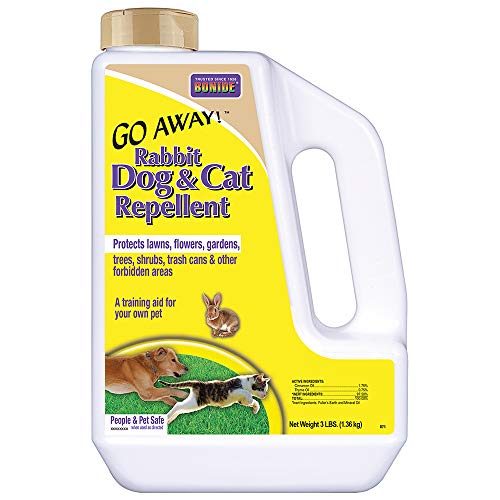
For a mixed yard boundary, this product names rabbits and cats along with dogs, while its use areas include lawns, gardens, flower beds, trees, and shrubs. The 3-pound granules contain cinnamon and thyme oils; Bonide says the natural active ingredients are people- and pet-safe when used as directed. That makes it a relevant choice when multiple animals are entering planted areas. The limitation is that the maker frames it as a training aid that may need other behavior-modification techniques to break an existing habit. It is a yard product, not the indoor spot-treatment spray.
Bottom line: Pick this for yard and garden areas where more than dogs need discouraging.
How to Choose a Dog Repellent
Choose by location first: a spray is suited to targeted indoor areas, while granules are intended for outdoor lawns, gardens, and beds. A scent deterrent changes how appealing a spot is; it does not physically block access, so a gate or fence is the more direct option when access must be prevented. Dogs can repeat a habit after the scent fades or washes away, so pair deterrence with redirecting the behavior you want. For a defined area, measure its length and width in feet and multiply them to estimate square footage; when the area exceeds a product’s coverage, select a different coverage plan rather than assuming one container is enough.
Indoor Spray Versus Outdoor Granules
Indoor sprays and outdoor granules differ mainly in where and how they are applied. Sprays let you treat particular surfaces or spots; granules can be distributed across a bed, lawn, or other ground area. Product formulas and directions are not interchangeable, even when both rely on scent. Use the intended application type for the surface, and do not apply a yard granule indoors unless its directions allow that setting.
A quick matching guide:
| Need | Application type | Selection cue |
|---|---|---|
| Indoor spot training | Spray | Targeted surfaces or areas |
| Outdoor beds or lawn | Granules | Check stated area coverage |
| Digging behavior | Granules | Pair deterrence with training |
Coverage, Reapplication, and Rain
Area coverage is a useful comparison only when you measure the treated zone. Multiply length by width in feet for a rectangular space; for an irregular bed, divide it into rectangles and add their areas. One option here gives coverage of up to 1,400 square feet, and its maker advises reapplication every 1–2 weeks or after rain. Those directions illustrate why a one-time application may not be enough outdoors: rain and routine watering can affect how long a scented treatment remains in place. Follow the chosen product’s own directions rather than transferring another formula’s interval. If you need to cover more than the area, verify the required amount before applying.
Using Repellents as Part of Training
A repellent is best treated as one cue in a behavior plan, not as a guaranteed fix. Remove the attraction where practical, such as accessible food scraps or freshly disturbed soil, and redirect the dog to an allowed digging or resting area. Rewarding the desired alternative helps teach what the dog should do instead of only making one spot less appealing. Apply products only to intended areas and follow their handling directions; do not let a dog lick or eat a treatment. If a dog keeps returning after the recommended reapplication, change the access or training setup rather than increasing the amount beyond the directions.
Frequently Asked Questions
How long does dog repellent granules last outdoors?
Outdoor persistence depends on weather and the product directions. One formula here recommends reapplication every 1–2 weeks or after rain, so use the specific product interval rather than assuming all granules last the same time.
Can dog repellents stop a dog from digging?
A scent deterrent can make a treated spot less appealing, but it does not physically prevent digging. Pair it with redirecting the dog to an allowed digging area and rewarding that behavior.
How do I calculate how much area to treat?
Measure the area’s length and width in feet and multiply them for square footage; split an irregular area into rectangles and add the results. Compare that total with the product’s coverage before applying.
Should I reapply dog repellent after rain?
Rain can affect an outdoor scent treatment, and one granular product specifically advises reapplication after rain. Check the directions for the exact formula rather than using that interval for every product.
Are dog repellents safe around pets?
Safety depends on following the product’s use and storage directions; some formulas explicitly condition their safety claims on proper use. Keep pets away during application as directed, and do not allow them to lick or eat treated material.