
Solar Powered WiFi Extender: 4 Outdoor Models Compared

For an outdoor solar powered WiFi extender, the E8 pairs a 15W panel with a 27Ah battery and four 5dBi antennas; choose it if that combination fits your setup. The 30W model is a different option if you want its dual-band specification, while the two 15W, 26Ah models share an IP66 rating.
A WiFi extender relays an existing router’s signal, so it needs a usable connection where it is installed; it does not replace the router or create internet service by itself.
We earn a commission if you buy through links on this page. As an Amazon Associate I earn from qualifying purchases. Products are compared on manufacturer specifications, not hands-on testing.
- Best overall: E8 Solar Outdoor WiFi Extender – Its 15W panel, 27Ah battery and four 5dBi antennas provide a clear balance of power and antenna specifications.
- Best for dual-band: 30W Dual-Band Solar WiFi Extender – It specifies 2.4GHz and 5.8GHz bands, a 30W panel and a 30Ah battery.
- Best for weather rating: 15W Solar WiFi Extender, 300Mbps – Its IP66 rating is higher than the IP65 rating on the dual-band model.
| Product | Best for | Solar panel | Battery capacity | Wi-Fi / weather | Shop |
|---|---|---|---|---|---|
| E8 Solar Outdoor WiFi Extender | Antenna coverage | 15W | 27Ah | 4 antennas; 5dBi each | Check Price on Amazon |
| 30W Dual-Band Solar WiFi Extender | Dual-band networking | 30W | 30Ah | 2.4GHz/5.8GHz; IP65 | Check Price on Amazon |
| 15W Solar WiFi Extender, 300Mbps | Higher water rating | 15W | 26Ah | 300Mbps; IP66 | Check Price on Amazon |
| 15W Solar WiFi Extender, 26Ah | IP66 outdoor use | 15W | 26Ah | 4 antennas; IP66 | Check Price on Amazon |
Solar Powered WiFi Extenders
Compare panel output, battery capacity and stated connection or weather specifications to find a suitable outdoor extender.
E8 Solar Outdoor WiFi Extender

The E8 stands out for its four 5dBi antennas and 27Ah battery paired with a 15W solar panel. The maker says it can cover a 120-meter radius, which may suit a camera or other device far from the house when the extender can still receive the router’s signal. Its dimensions are 12.7 inches wide, 7.8 inches high and 3 inches long. The maker gives no weather-protection rating, so this model is a less certain fit for locations exposed to rain or dust than the models rated IP65 or IP66.
Bottom line: Pick this if four 5dBi antennas and a 27Ah battery are your priorities.
30W Dual-Band Solar WiFi Extender

The 30W panel and 30Ah battery distinguish this model, and it specifies both 2.4GHz and 5.8GHz WiFi bands. The maker also claims a combined speed of up to 1200Mbps and a 984-foot range; those figures are not a guarantee of real-world speed or usable distance, which depend on the router signal, obstacles and devices. IP65 indicates protection against dust and water jets, but it is not a promise that the unit can be submerged. Choose this when dual-band operation and the higher stated panel output matter more than an IP66 rating.
Bottom line: Choose this for its dual-band specification and 30W panel.
15W Solar WiFi Extender, 300Mbps
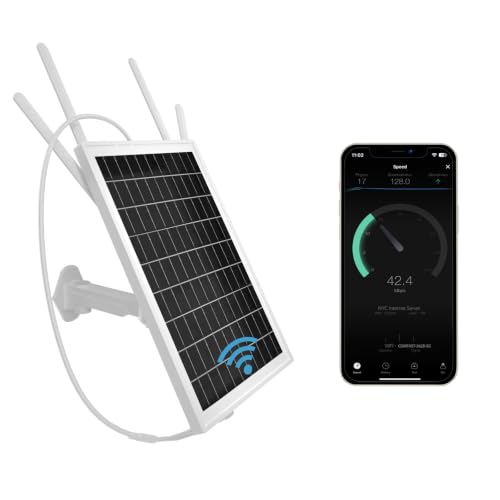
This model pairs a 15W panel and 26Ah battery with a 300Mbps WiFi specification and an IP66 housing. The maker says its four antennas are intended to extend an existing network across outdoor areas such as farms and gardens. IP66 denotes dust-tight protection and resistance to powerful water jets; it does not mean the device is suitable for immersion. The 300Mbps figure is lower than the 1200Mbps claim on the dual-band alternative, so it is a better match when the IP66 rating matters more than a higher headline speed.
Bottom line: Pick this when IP66 protection matters more than the higher speed claim.
15W Solar WiFi Extender, 26Ah

This extender shares the 15W panel, 26Ah battery, four antennas and IP66 rating of the other 15W, 26Ah option, but its maker does not give a speed figure. The maker says it is designed to extend an existing WiFi network over outdoor areas and includes network-security features. An extender still needs a usable signal from the router at its mounting point, so placing it beyond the router’s coverage can leave it without a signal to relay. Its IP66 rating favors exposed placement over an unrated option, though it is not an immersion rating.
Bottom line: Choose this for four antennas and IP66 protection without prioritizing a speed figure.
How to choose a solar powered WiFi extender
Start with the WiFi signal at the intended mounting point: an extender relays the signal it receives, so a location with no usable router connection is not a good repeater position. A common placement rule is to put the extender roughly halfway between the router and the dead zone, then move it toward the router if the connection is unstable. Compare panel wattage and battery capacity separately; watts describe panel output, while amp-hours describe stored charge, and neither alone predicts runtime without power draw and sunlight conditions. For a large property, treat advertised distance as a best-case claim, not a guaranteed radius through trees, walls or metal outbuildings. Prioritize band support if the router and remote devices need a particular WiFi band.
How IP65 and IP66 ratings differ outdoors
IP65 and IP66 both indicate dust-tight enclosures, but IP66 is tested against more powerful water jets than IP65 under the IEC 60529 ingress-protection system. Neither rating means a product can be submerged; immersion protection is associated with separate IP67 or IP68 ratings. Mount an outdoor unit with its panel facing an area that receives direct sun for as much of the day as practical, since shade reduces solar charging. Keep cable entries and mounting points aligned with the maker’s installation requirements, because enclosure ratings apply to the assembled device rather than improvised openings. If the unit will face prolonged rain or dust, favor an ingress rating and avoid treating a higher number as permission to submerge it.
Solar panel and battery capacity trade-offs
A watt is a rate of power and an amp-hour is a measure of battery charge, so a 30W panel and a 30Ah battery describe different parts of a solar setup. The daily energy a panel can harvest changes with sunlight hours, shade, season and panel angle; battery runtime changes with the extender’s power draw and charging losses. These models provide panel and battery figures, but the maker does not establish a comparable runtime across them. Use the table to separate those known capacities from performance claims before deciding.
Use this comparison to match power capacity with the network and weather specification you need.
| Need | Compare first | Decision cue |
|---|---|---|
| More solar input | Panel wattage | 30W is more panel output than 15W |
| More stored charge | Battery amp-hours | 30Ah exceeds 27Ah and 26Ah |
| Outdoor water resistance | IP rating | IP66 resists stronger water jets than IP65 |
Where to mount an outdoor WiFi repeater
Place the extender where it can receive a stable router signal and where its solar panel has a clear view of the sky. The halfway point between router and target area is a useful starting point, not a fixed rule: walls, trees, barns and metal siding can reduce range, so test a few positions before permanent mounting. WiFi at 2.4GHz generally reaches farther and passes through obstacles better than 5GHz, while 5GHz can offer more bandwidth at shorter range; actual results depend on interference and the client device. Leave the panel unshaded and orient it toward the sun-facing side of the site, then confirm that the remote camera or device can connect from its final location.
Frequently Asked Questions
Does a solar WiFi extender create internet service?
No, a solar WiFi extender repeats an existing WiFi network rather than providing internet service itself. It needs a usable router signal at its own location before it can relay that signal farther outdoors.
Is IP66 safe for a device underwater?
No, IP66 covers dust-tight protection and powerful water jets, not immersion. A device that may be submerged needs an immersion rating such as IP67 or IP68, and its installation instructions still matter.
Is 5GHz or 2.4GHz better for outdoor WiFi?
2.4GHz typically reaches farther and penetrates obstacles better, while 5GHz usually offers more bandwidth over shorter distances. For a remote camera behind walls or trees, prioritize a stable connection over a higher advertised speed.
How should I position a solar panel for charging?
Keep the panel out of shade and point it toward the sun-facing side of the installation; in the United States, that is generally south. Trees, roof overhangs and seasonal sun angles can reduce charging, so check the site at the times it receives direct sun.
Will an extender work at the edge of my property?
It works only if it can receive a usable signal from the router where it is mounted. Start near the midpoint between router and target, then move the unit toward the router if a wall, barn or other obstruction weakens the connection.