
Best 30 Foot Dog Leash: 5 Long Lines Compared

For most people, Hi Kiss 30-ft Nylon Lead is the best 30-foot dog leash because it combines a 3/4-inch nylon lead with reinforced stitching and a swiveling clip. Choose a coated option instead if easy cleanup after wet or muddy outings is your priority.
A long line is a leash that gives a dog room to move while keeping a handler connected; use it in open spaces where the line can stay clear of people, trees, and other dogs.
We earn a commission if you buy through links on this page. As an Amazon Associate I earn from qualifying purchases. Products are compared on manufacturer specifications, not hands-on testing.
- Best overall: Hi Kiss 30-ft Nylon Lead – Its 3/4-inch nylon webbing has reinforced stitching and a swiveling clip.
- Best for wet outings: Waterproof 30-ft Coated Lead – The coated lead is designed to wipe clean after swimming or muddy walks.
- Best for gradual slowing: Total Pet 30-ft Nylon Long Line – A control handle lets the handler slow the lead gradually, according to the maker.
- Best for a narrower lead: Waterproof 30-ft PVC-Coated Lead – Its 0.4-inch PVC-coated nylon webbing is the narrowest option here.
| Product | Best for | Width | Material | Shop |
|---|---|---|---|---|
| Hi Kiss 30-ft Nylon Lead | Everyday recall | 0.75 in | Nylon | Check Price on Amazon |
| Waterproof 30-ft Coated Lead | Wet conditions | 0.6 in | Coated nylon | Check Price on Amazon |
| Total Pet 30-ft Nylon Long Line | Controlled slowing | 1 in | Nylon | Check Price on Amazon |
| 30-ft Nylon Training Lead | Basic recall practice | 0.75 in | Nylon | Check Price on Amazon |
| Waterproof 30-ft PVC-Coated Lead | Narrow wet-weather lead | 0.4 in | PVC-coated nylon | Check Price on Amazon |
30-foot dog leashes
Compare each long line by width, material, and the handling feature that matters for your training routine.
Hi Kiss 30-ft Nylon Lead
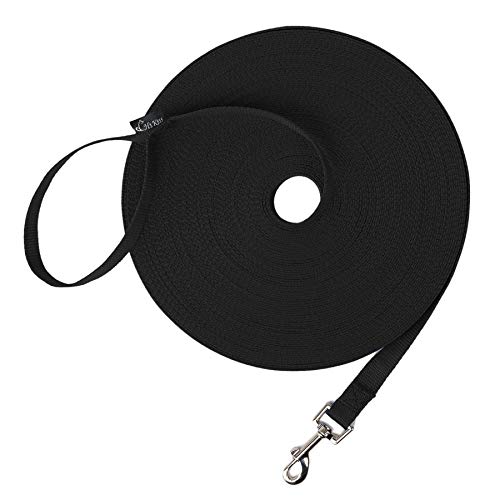
The Hi Kiss pairs a 3/4-inch nylon lead with reinforced stitching and a swiveling nickel-plated clip. At 30 feet, it gives a dog room to practice recall while the handler maintains a connection. The maker positions it for medium and large dogs and outdoor activities such as hiking, camping, and swimming. Its wider webbing may feel bulkier than the 0.4-inch option, so handlers who want a narrow line may prefer another pick. Keep the slack managed in open areas to reduce tangles.
Bottom line: Choose this if you want a 3/4-inch nylon line with reinforced stitching.
Waterproof 30-ft Coated Lead

The waterproof coated lead is the pick for outings where mud or water makes cleanup a priority: its 0.6-inch strap is designed to wipe clean. The maker describes the lead as flexible and suitable for hiking, beach trips, swimming, and recall practice. Its middle-of-the-range width can suit handlers who want something narrower than 3/4-inch webbing without choosing the thinnest option. The maker claims a 700-pound-force pull resistance, but that claim is not a substitute for checking the clip and line before use or choosing an appropriate leash for the dog.
Bottom line: Choose this if a wipe-clean lead matters for wet or muddy outings.
Total Pet 30-ft Nylon Long Line

The Total Pet line stands out with its 1-inch width and control handle, which the maker says allows gradual slowing. The nylon long line is intended for recall and distance commands, and it can be shortened by clipping at a distance marker while leaving excess lead behind. That adjustable handling can help when a full 30 feet is too much for a particular exercise. Its 1-inch width is the broadest among these picks, so handlers seeking a lighter-feeling narrow strap may prefer a different option. Keep excess line gathered rather than trailing underfoot.
Bottom line: Choose this if a control handle and shorter working length are useful.
30-ft Nylon Training Lead

This 30-foot nylon lead focuses on a straightforward training setup: 3/4-inch webbing and a swivel-style bolt snap. The maker describes the clip as a 360-degree swivel intended to resist twisting, and the lead is offered for recall and obedience practice with dogs of different sizes. Its simple configuration suits handlers who want a familiar-width long line without a specialized control handle or waterproof coating. Compared with coated choices, the nylon material may take more effort to clean after muddy or wet use. Check that the clip is fully fastened before training.
Bottom line: Choose this if you want a basic nylon line with a swivel clip.
Waterproof 30-ft PVC-Coated Lead

The orange lead is the narrowest option here at 0.4 inch and uses PVC-coated nylon webbing. The maker says the material remains lightweight and strong when wet and is easy to clean; it is intended for outdoor activities such as beach play, hiking, and camping. A narrower strap may be easier to handle for someone who prefers less webbing in hand, but it offers less width than the 3/4-inch and 1-inch options in this group. The maker claims 600 pounds of pull-force resistance; do not treat that figure as a guarantee for every dog or situation.
Bottom line: Choose this if you prefer a narrow, coated lead for outdoor use.
How to choose a 30-foot dog leash
Choose a long line by matching its material and width to where you train and how you handle slack. Nylon webbing is a common choice for recall practice, while coated webbing is useful when wiping off mud or water is important. Widths here range from 0.4 to 1 inch, so compare the strap in hand if you know you prefer narrow or broad webbing. A 30-foot line is best used in open space: with less than 30 feet of clear room, gather slack or work at a shorter length rather than letting the line run across a path. A swivel clip can help limit twisting, but it does not prevent a long line from snagging.
Use a long line as a training connection, not as an invitation to let a dog sprint to the end of the lead. Keep the line out of your hand wrapping; sudden tension can injure hands or jerk a dog. A harness attachment can reduce pressure on the neck compared with attaching a line to a collar, especially during recall work.
Nylon and coated long lines compared
Nylon lines offer familiar webbing, while coated lines are easier to wipe clean after wet or dirty outings. The right choice depends on the conditions and the strap feel you prefer. A 0.4-inch lead is much narrower than a 1-inch lead, but width alone does not establish a safe load limit; clip strength, stitching, dog behavior, and wear also matter. Maker pull-force claims should not be treated as a guarantee for a particular dog or for a damaged line. Inspect the webbing and clip for cuts, fraying, corrosion, or looseness before each session, and retire a lead with damaged stitching or hardware.
The comparison below uses the material and width to clarify the tradeoffs; it does not rank load safety.
| Type | Useful when | Tradeoff |
|---|---|---|
| Nylon webbing | You want a traditional training line | Can take more effort to clean after mud or water |
| Coated webbing | You expect wet or dirty use | Coating and width vary between leads |
Using a 30-foot line safely
A 30-foot leash needs space and active slack management. Choose an open training area with clear sightlines, away from roads, bike paths, crowds, and places where the line can wrap around trees or other dogs. Do not wrap the leash around your hand or body; hold it in manageable loops and feed out only the length you can control. Avoid allowing a dog to build speed and hit the end of the line, since a sudden stop can hurt the dog or handler. For dogs that pull hard or lunge, train at a shorter working length and consider a well-fitted harness attachment rather than relying on a long line to stop momentum.
Check the clip, stitching, and webbing before each outing. Wet, sandy, or muddy leads should be cleaned and allowed to dry before storage so grit and moisture do not stay trapped against the material.
Frequently Asked Questions
Is a 30-foot leash good for recall training?
Yes, a 30-foot line gives room to practice recall while keeping a connection to the dog. Use it in an open area, and shorten the working length if you cannot keep the slack clear and controlled.
Should a long line attach to a collar or harness?
A well-fitted harness is generally preferable for long-line work because it distributes pulling force across the body rather than concentrating it at the neck. Avoid letting a dog run to the end of a 30-foot line, regardless of attachment point.
How do I stop a long leash from tangling?
Use an open area and manage slack in loose, controlled loops rather than letting the full line trail around obstacles. A swiveling clip can help reduce lead twisting, but it cannot prevent snags around trees, people, or other dogs.
Can a dog run freely on a 30-foot leash?
No leash makes an uncontrolled sprint safe; a dog hitting the end of a 30-foot line can cause a sudden jolt to the dog or handler. Let out distance gradually and keep enough slack control to avoid abrupt stops.
How should I clean a dog training long line?
Coated webbing is designed to wipe clean, while nylon may need more effort after muddy or wet use. Remove grit and let the lead dry before storing it, then inspect for fraying, damaged stitching, and clip problems.