
Tool to Remove Bushings: 3 Press Kits Compared

For general automotive bushing removal, OMT Pull and Press Sleeve Kit is the most adaptable choice because its 22 sleeves cover bore diameters from 1.34 to 3.15 inches and it includes five spindle sizes. Choose another kit if you need the particular sleeve range in Bicos 28-Piece Sleeve Kit or the broader assortment and stop-plate adapters in 40-Piece Pull and Press Sleeve Kit.
Pull-and-press sleeve kits use a threaded spindle to draw a bushing into a receiving sleeve or press it into place; accurate alignment and a sleeve that clears the part are essential.
We earn a commission if you buy through links on this page. As an Amazon Associate I earn from qualifying purchases. Products are compared on manufacturer specifications, not hands-on testing.
- Best overall: OMT Pull and Press Sleeve Kit – Five spindle sizes and 22 sleeves with bore diameters from 1.34 to 3.15 inches offer a broad size range.
- Best for 34–72 mm bores: Bicos 28-Piece Sleeve Kit – Its sleeves span inside diameters of 34 to 72 mm for matching parts within that range.
- Best for extra adapters: 40-Piece Pull and Press Sleeve Kit – The 28 sleeves, six spindle pieces and five stop-plate discs provide multiple setup components.
| Product | Best for | Sleeve bore range | Pulling spindle sizes | Shop |
|---|---|---|---|---|
| OMT Pull and Press Sleeve Kit | Broad sleeve range | 1.34–3.15 in | M10, M12, M14, M16, M18 | Check Price on Amazon |
| Bicos 28-Piece Sleeve Kit | 34–72 mm bores | 1.34–2.83 in | — | Check Price on Amazon |
| 40-Piece Pull and Press Sleeve Kit | Adapter variety | 0.87–3.03 in | M10, M12, M14, M16 | Check Price on Amazon |
Tools to Remove Bushings
Match the receiving sleeve to the bushing and compare each kit’s spindle and adapter setup before choosing.
OMT Pull and Press Sleeve Kit

The five spindle sizes distinguish this kit from the other general-purpose options, giving it more thread-size choices for compatible drivers and wrenches. The set includes 22 notched sleeves; the notches catch a bushing edge while leaving the work area visible. Its bore range is 34–80 mm, with outer diameters of 44–90 mm. That makes it a fit for buyers whose bushing dimensions fall within those measurements, rather than a universal match for every vehicle. Confirm that the chosen sleeve clears the housing and supports the bushing evenly before applying force.
Bottom line: Choose this kit when your bushing dimensions fit its sleeve range and you want five spindle sizes.
Bicos 28-Piece Sleeve Kit
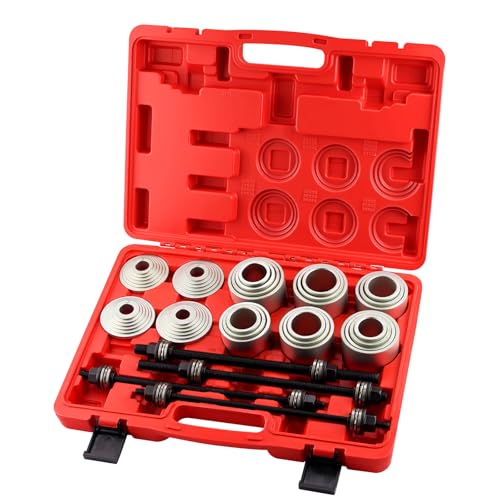
The Bicos kit lists paired sleeve sizes across inside diameters of 34–72 mm and outside diameters of 44–82 mm, a defined range for buyers who can measure the bushing before selecting a sleeve. It is intended for removal and installation work on bushings, bearings, and seals in automobiles and light commercial vehicles. Compared with the broader-bore options, its inside-diameter range ends at 72 mm, so buyers with larger parts should check the actual dimensions carefully. The specifications do not identify spindle sizes, so verify the drive setup you need before choosing this kit.
Bottom line: Choose this kit for automotive work when the bushing bore measures 34–72 mm.
40-Piece Pull and Press Sleeve Kit

The assortment includes five stop-plate discs and six pulling spindles—two each in M10 and M12, plus M14 and M16—along with 28 sleeves. The sleeve pairs run from 22/32 mm through 77/87 mm, giving this kit a smaller minimum bore than the other two kits. Its sleeves are alloy steel, and the product specifies a 3,500 N limit. That figure is a force limit, not a guarantee that every bushing or housing can tolerate the load. The maker cautions against using an impact wrench; buyers should use a compatible manual drive and keep the press aligned.
Bottom line: Choose this kit when you need its smaller bore sizes and stop-plate adapters.
How to Choose a Bushing Removal Tool
Choose a press-and-pull kit by measuring the bushing bore, outside diameter, and available space around the housing. The receiving sleeve must be large enough to accept the bushing as it exits, while the pushing adapter must contact the bushing face without bearing on the surrounding housing. A threaded spindle converts turning force into axial pressure, so crooked alignment can bind the threads or damage the part. With less than 1/8 inch of clearance around a bushing, measure the tool’s outside diameter and the access opening before starting; sleeve ranges alone do not establish that a tool will fit into a tight location. Use a hand wrench unless the kit maker permits powered tools.
Suspension bushings may be bonded rubber, so pressing force should act on the intended sleeve or outer shell rather than on unsupported rubber. Stop if the sleeve tilts or the spindle begins to bind.
How to Match Sleeve Sizes
Match both sleeve dimensions rather than relying on a single nominal bushing size. A sleeve’s bore is the opening through which a part passes, while its outer diameter determines whether the sleeve fits the working area; check which measurement the kit labels as inner or outer. A press setup also needs a receiver deep and wide enough for the displaced bushing, plus a driver that contacts the bushing squarely. Measure with calipers when possible, since rust, coatings, and a flanged bushing can make a tape measurement misleading.
For a measured bore above 72 mm, the Bicos kit’s range does not cover it; check the applicable larger range instead. Never stack mismatched sleeves to compensate for a size gap, because uneven contact can cause the bushing or tool to shift under load.
Press Kit Types and Their Limits
Universal sleeve kits use a threaded rod, interchangeable sleeves, and adapters to push and receive parts; they suit work where the bushing dimensions match the included pieces. Vehicle-specific hydraulic tools are a different type: their adapters and force source are designed around particular suspension components, so fitment is narrower but the setup may suit that application better. A separate pin-and-bushing adapter may also require its own starter kit, rather than working as a complete tool by itself.
Use this distinction before buying: choose a general sleeve set for varied jobs only when its measurements fit, and a dedicated tool when the component and vehicle are explicitly covered. The largest sleeve range does not establish fit for every bushing, housing, or access angle.
Safe Bushing Removal Setup
Keep the press axis square to the bushing and support the component close to the press opening. A threaded puller can store substantial force; eye protection and stable support help reduce injury risk if a sleeve slips or a part releases suddenly. Do not use an impact wrench with a kit whose maker warns against it, and do not exceed the tool’s force limit. Remove rust and debris from the contact surfaces so the adapters sit flat, then apply force gradually and reassess alignment if resistance rises abruptly.
Before pressing, verify that brake lines, wiring, and nearby suspension parts are clear of the tool’s travel. A press kit cannot make an unsafe support point suitable, and a damaged or distorted housing should be assessed before force is applied.
Frequently Asked Questions
How do I measure a bushing for a press kit?
Measure the bore and outside diameter with calipers, and note any flange width or shoulder that affects the receiver. The sleeve must clear the housing opening and accept the bushing without rocking.
Can a bushing press kit work with any car?
No; fit depends on the sleeve dimensions, access space, and the bushing design. Check the part’s measurements against both the driver and receiving sleeve before starting.
Should I use an impact wrench on a bushing puller?
Only if the tool maker allows it; some threaded sleeve kits expressly prohibit impact-wrench use. A hand wrench gives more control, and abrupt resistance is a reason to stop and check alignment.
Why does a press sleeve need to be larger?
The receiving sleeve needs enough inner clearance to accept the bushing as it is pushed out. It also needs an outer diameter that fits the surrounding workspace without pressing on the housing.
How can I keep a bushing press from slipping?
Keep the spindle centered and both adapters square to the part before applying force. Support the component close to the press opening, and stop if the sleeve tilts or the spindle binds.