
Barge All Purpose Cement: Sizes and Uses Compared

Barge All Purpose Cement 32 oz is the named Barge All Purpose Cement option here, and its 32-ounce can suits repeat leather and footwear repairs where a flexible bond matters. Choose a smaller can for occasional craft fixes, or compare the alternate clear, blue, and toluene-free options by their formula traits.
We earn a commission if you buy through links on this page. As an Amazon Associate I earn from qualifying purchases. Products are compared on manufacturer specifications, not hands-on testing.
- Best overall: Barge All Purpose Cement 32 oz – The 32-ounce original formula is aimed at repeated leather, rubber, and footwear repairs.
- Best for small projects: Barge Contact Cement 2 oz with Spreaders – The 2-ounce clear adhesive includes five paste spreaders.
- Best for toluene-free choice: Barge All Purpose Cement Blue 2 oz – The blue 2-ounce formula is identified as toluene-free.
| Product | Best for | Size | Color or formula | Water resistance | Shop |
|---|---|---|---|---|---|
| Barge All Purpose Cement 32 oz | Footwear repairs | 32 fl oz | Red, original | Waterproof | Check Price on Amazon |
| Barge Contact Cement 2 oz with Spreaders | Small craft fixes | 2 oz | Clear, toluene-free | Water resistant | Check Price on Amazon |
| Barge All Purpose Cement Quart | Multiple materials | Quart | Original version | — | Check Price on Amazon |
| Barge All Purpose Cement Blue 2 oz | Toluene-free repairs | 2 oz | Blue, toluene-free | Waterproof | Check Price on Amazon |
| Barge All-Purpose Cement 32 oz | Fast repairs | 32 oz | Clear | Waterproof | Check Price on Amazon |
Barge All Purpose Cement Options
Compare the can size and formula traits to match the adhesive to the repair and how often you expect to use it.
Barge All Purpose Cement 32 oz

Barge All Purpose Cement 32 oz is the named 32-ounce original Barge All Purpose Cement, with a can sized for repeated shop or barn repairs. The maker says the flexible, waterproof formula spreads without smearing and bonds leather, rubber, crafts, tack, and footwear with one coat. That range makes it suited to ongoing shoe and gear work rather than a single small craft fix. The larger can is less convenient if you only need adhesive for an occasional repair, and the specifications do not specify a working time or surface preparation steps.
Bottom line: Choose it for recurring leather, rubber, or footwear repairs.
Barge Contact Cement 2 oz with Spreaders

Barge Contact Cement 2 oz with Spreaders pairs a compact 2-ounce container of clear Barge contact cement with five paste spreaders, unlike the larger cans. The maker describes a quick-drying, water-resistant, toluene-free formula for shoe repairs and crafts, and names rubber, leather, vinyl, and wood as bondable materials. This format suits a small fix or project where spreaders are useful.
Bottom line: Pick it for a small repair where included spreaders help.
Barge All Purpose Cement Quart

Barge All Purpose Cement Quart stands out for its quart-can size and broad material list: leather, rubber, vinyl, wood, metal, plastic, plaster, paper, and concrete. The maker positions it as professional-strength adhesive for patching rubber boots and resoling leather shoes, as well as other repairs. It makes sense when a project spans materials beyond footwear.
Bottom line: Choose it when a repair job involves several material types.
Barge All Purpose Cement Blue 2 oz
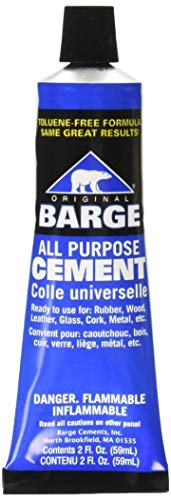
Barge All Purpose Cement Blue 2 oz is a blue, toluene-free 2-ounce Barge cement, distinguishing it from the larger red original can. The maker describes a flexible, long-lasting waterproof bond and says the adhesive spreads easily without smearing. Its small size suits occasional gear or footwear fixes when the toluene-free formula is the deciding trait.
Bottom line: Pick it for a small repair when toluene-free is the priority.
Barge All-Purpose Cement 32 oz

Barge All-Purpose Cement 32 oz is another 32-ounce Barge cement, but its clearest distinction is the maker’s timing claim: 10–15 minutes to dry and up to 4 hours of open time. The formula is described as waterproof, easy to spread, and resistant to freezing. Those time windows can help plan a repair that requires preparation before joining surfaces.
Bottom line: Choose it when the dry and open times guide your work plan.
How to choose a contact cement for repairs
Choose by surface compatibility, working quantity, and the formula trait that matters to the job. Contact cement is generally applied to both mating surfaces, allowed to flash off, then joined under firm pressure; the bond forms on contact, so careful alignment matters. For shoe soles, clean and dry both surfaces and roughen smooth rubber or leather lightly so the adhesive has texture to grip. Do not assume every formula works on every plastic: low-surface-energy plastics such as polyethylene and polypropylene are difficult to bond with ordinary contact cement. A 2-ounce can is a sensible scale for one small fix; a quart or 32-ounce can suits repeated repairs better. For products without a named material match, confirm the surface first.
Water resistance and outdoor gear repairs
Water resistance is not the same as a guarantee for prolonged soaking, heat, or flexing under load. Barge All Purpose Cement 32 oz and Barge All Purpose Cement Blue 2 oz are described as waterproof, while Barge Contact Cement 2 oz with Spreaders is described as water resistant; those terms are not interchangeable. Outdoor boots also expose a bond to abrasion and repeated bending, so clean the joint, remove loose old adhesive, and apply even pressure while the surfaces join. A decision rule: choose a waterproof formula when the repair will regularly encounter rain or wet ground, but use a material-specific adhesive if the bond must withstand immersion or a manufacturer’s prescribed repair system. Keep solvent-based adhesives away from flame and use ventilation, since contact cements commonly release flammable vapors during application.
Can size and repair scale
Container size changes how practical the adhesive is, not automatically how strong the bond will be. A 2-ounce can is easier to reserve for a small shoe patch or craft job; a 32-ounce can or quart is more appropriate for repeated repairs or a larger shop workload. Barge Contact Cement 2 oz with Spreaders also includes five spreaders, which can help control adhesive on a small work area. Avoid buying by volume alone: the surfaces and the repair environment decide whether the formula is suitable. For a single sole repair under a few square inches, a small can minimizes leftover material; choose a larger container only when there are multiple jobs or frequent use. Store contact cement tightly closed, away from heat and ignition sources.
Planning dry time and joining surfaces
Dry time and open time describe different parts of a contact-cement job. Dry time is how long the applied coat takes before joining; open time is the window in which the coated surfaces can still be joined effectively. Barge All-Purpose Cement 32 oz gives a 10–15 minute dry-time claim and up to 4 hours of open time, while Barge Contact Cement 2 oz with Spreaders is described only as quick drying. A longer open window can help with careful alignment, but it does not remove the need to prepare surfaces and apply even pressure. Read the cement’s package directions for coat thickness and joining timing, because applying too wet or waiting beyond the usable window can weaken the bond.
Frequently Asked Questions
How long should contact cement dry before joining?
Dry time depends on the formula and coat conditions; Barge All-Purpose Cement 32 oz gives a 10–15 minute dry-time claim. Join only when the cement reaches the tack stage specified on its container, since joining too wet can reduce bond quality.
Can contact cement repair a shoe sole?
Contact cement is commonly used for flexible shoe and boot repairs, and several options here name footwear or resoling as uses. Clean off loose material and lightly roughen smooth surfaces; avoid relying on a cement unless its formula names the sole materials.
Is water resistant the same as waterproof cement?
No: water resistant does not promise the same protection as waterproof. Select a waterproof formula for regular rain exposure, and do not assume either term means the bond is suitable for soaking or immersion.
How much contact cement is needed for one repair?
A 2-ounce container is a practical scale for one small patch or craft repair, while 32 ounces or a quart is better suited to repeated jobs. The actual amount depends on the area and whether the cement must coat both mating surfaces.
Is contact cement safe to use indoors?
Many contact cements use solvents that release flammable vapors, so use strong ventilation and keep the work away from flames, sparks, and pilot lights. Follow the product’s safety directions and keep the container closed when not applying adhesive.