
Indoor Air Quality Testing Kits: 3 Monitors Compared

BREATHE Airmonitor Plus Gen 2 suits most people who want ongoing indoor air readings because its NDIR sensor measures CO2 directly and its app stores 90 days of history. Choose 16-in-1 Monitor or 16-in-1 Monitor, Flat Black instead if you prefer a portable monitor with a color display and one-button controls.
We earn a commission if you buy through links on this page. As an Amazon Associate I earn from qualifying purchases. Products are compared on manufacturer specifications, not hands-on testing.
- Best overall: BREATHE Airmonitor Plus Gen 2 – NDIR CO2 sensing, app alerts, 90-day history and CSV export combine live readings with saved trends.
- Best for simple controls: 16-in-1 Monitor – A single button handles power and temperature units, with a double-tap to dim the lights.
- Best for quiet use: 16-in-1 Monitor, Flat Black – A double-tap mutes the audio tone, and the monitor supports fast charging.
| Product | Best for | Readings tracked | Connectivity and history | Controls | Shop |
|---|---|---|---|---|---|
| BREATHE Airmonitor Plus Gen 2 | App-based tracking | 8 readings | 2.4 GHz Wi-Fi; 90-day history | App alerts and CSV export | Check Price on Amazon |
| 16-in-1 Monitor | Simple controls | PM1.0, PM2.5, PM10, CO2, TVOC, HCHO | — | One-button controls; dimmable lights | Check Price on Amazon |
| 16-in-1 Monitor, Flat Black | Quiet operation | PM1.0, PM2.5, PM10, CO2, TVOC, HCHO | No app or history features specified | One-button controls; audio tone can be muted | Check Price on Amazon |
Indoor Air Quality Testing Kits
Compare the readings and features each monitor offers, then choose based on whether you want saved trends or a simple portable display.
BREATHE Airmonitor Plus Gen 2
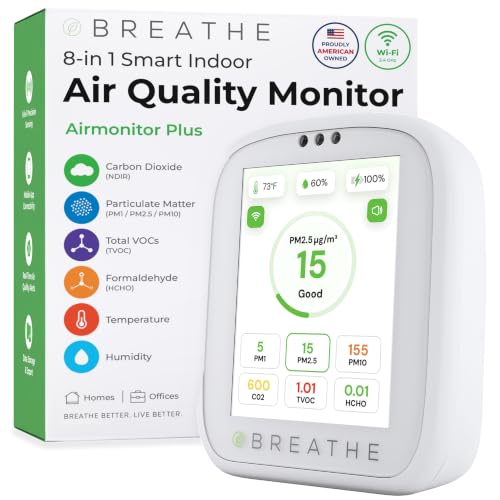
Unlike the portable display models, this monitor connects to an app for remote readings and saved trends. It tracks CO2, PM1, PM2.5, PM10, TVOC, HCHO, temperature and humidity; the maker says its NDIR sensor measures CO2 directly. The app supports custom CO2 and PM2.5 alerts, graphs, 90 days of stored history and CSV export. That makes it a fit for people who want to review changes over time. Its Wi-Fi connection requires 2.4 GHz, so it may not suit someone who wants readings only on a device screen.
Bottom line: Pick this if you want app access and saved air-quality trends.
16-in-1 Monitor

This portable monitor emphasizes straightforward physical controls rather than app-based tracking. It displays PM1.0, PM2.5, PM10, CO2, TVOC, HCHO, temperature and humidity, with tiered color lights for readings. The maker says double-tapping dims the lights without pausing 24-hour data logging; the button also controls power and switches Celsius and Fahrenheit. Consider it for a bedroom or office where screen brightness matters. The maker says it has no alert or alarm function, so it is not a choice for someone who needs audible warnings.
Bottom line: Choose this for dimmable on-device readings and simple controls.
16-in-1 Monitor, Flat Black

Quiet operation is the distinguishing feature here: a double-tap mutes the audio tone, while the single button handles power and Celsius/Fahrenheit switching. The monitor measures PM1.0, PM2.5, PM10, CO2, TVOC, HCHO, temperature and humidity, and its maker says it supports fast charging. It suits someone who wants several readings in one portable unit without sound feedback at night. The controls center on the device itself, so choose the app-connected alternative if remote readings, alerts or downloadable history are priorities.
Bottom line: Pick this if muting the audio tone matters more than app tracking.
How to choose an indoor air quality monitor
Choose by the pollutants you need to track and whether you want readings saved beyond the current display. PM sensors report particle concentrations, while gas sensors may estimate compounds such as TVOC or formaldehyde; CO2 is useful as a ventilation indicator, not a complete measure of air quality. NDIR is a direct infrared sensing method for CO2. For a quick choice, prioritize app history if you need to compare readings across days; pick a screen-first monitor if you mainly want to check a room in person. Compare the actual measured fields, since a larger “in-1” count does not by itself establish sensor accuracy or measurement method.
| Need | Feature to prioritize |
|---|---|
| Review changes over days | Stored history and export |
| Check a room at a glance | On-device display |
| Track ventilation conditions | CO2 measurement |
What indoor readings can and cannot tell you
CO2 can help indicate whether a room is accumulating exhaled air, but it does not identify every indoor pollutant or prove a space is safe. Outdoor CO2 is commonly around 400–450 ppm, and indoor readings rise with occupancy and limited outdoor-air exchange; compare rooms under similar occupancy rather than treating one threshold as a universal health limit. PM readings concern airborne particles, while TVOC and HCHO readings concern different gas categories. Consumer monitors are screening tools, not substitutes for a qualified investigation when a specific hazard is suspected. Use unusual or persistent readings as a prompt to investigate sources and ventilation, not as a diagnosis.
Where to place an air quality monitor
Place a monitor in the occupied part of a room, roughly breathing height, and keep it away from direct drafts, windows, vents, cooking, and humidifiers. A sensor beside a supply vent or open window can report incoming air rather than the room’s mixed conditions; a position several feet from those sources is a practical starting point. Let readings settle after moving the unit, and compare rooms at similar times and occupancy. For a suspected source, take readings both near the area and in a representative occupied space, while remembering that a monitor’s sensing range and response can differ by pollutant. Keep the unit on a stable surface with its air openings unobstructed.
How to interpret changing readings
Look for repeated patterns rather than reacting to a single spike: cooking can temporarily raise particles, while people in a closed room can raise CO2. Ventilation can lower CO2 and dilute some indoor pollutants, but it may bring in outdoor particles when outside air is polluted. A simple comparison is to note the reading before and after airing out a room, using the same monitor placement and similar occupancy. Check the monitor’s units and displayed pollutant before comparing numbers; ppm, micrograms per cubic meter and an index are not interchangeable. If readings stay high or suggest a specific contaminant, identify likely sources and seek appropriate professional measurement rather than relying on a general-purpose monitor alone.
Frequently Asked Questions
Does a higher CO2 reading mean the air is unsafe?
Not by itself: CO2 is mainly a ventilation clue in ordinary occupied rooms, not a complete safety measure. Outdoor levels are commonly about 400–450 ppm, and occupancy and air exchange affect indoor readings.
Can an air quality monitor detect mold?
Mold assessment generally requires looking for moisture and visible growth, with targeted sampling when a specific question needs answering.
How long should I wait for a room reading?
Allow several minutes for readings to settle after moving a monitor, then compare conditions over a longer period if you need a pattern. Placement, airflow and a changing source such as cooking can alter short-term measurements.
Where should I put a CO2 monitor at home?
Set it in the occupied area around breathing height, several feet from windows, doors and air vents. Avoid placing it directly beside people’s faces, since exhaled breath can skew a nearby reading.
Do indoor air monitors measure every pollutant?
No; each monitor covers only its sensor types, and a general monitor cannot detect every gas, particle or biological contaminant. Check which specific readings it provides before using it to investigate a particular concern.