
Best Bear Proof Coolers: 5 Models Compared by Fit

Lifetime 65-Quart High Performance Cooler is the best fit for most campers who want a 65-quart cooler with IGBC certification and a maker-stated ability to withstand a bear for up to an hour when locked. Choose Lifetime 90820 55-Quart Cooler for a smaller 55-quart option, or Wyld Gear 65-Quart Dual Compartment Cooler if wheels and separate food and drink compartments matter more than a lighter carry weight.
Bear-resistant coolers are hard-sided ice chests designed to resist access by bears when properly secured; no cooler should be treated as bear-proof in every situation.
We earn a commission if you buy through links on this page. As an Amazon Associate I earn from qualifying purchases. Products are compared on manufacturer specifications, not hands-on testing.
- Best overall: Lifetime 65-Quart High Performance Cooler – It combines a 65-quart capacity with IGBC certification and a maker-stated one-hour resistance when locked.
- Best for smaller loads: Lifetime 90820 55-Quart Cooler – Its 55-quart capacity is smaller than the other options, and the maker states up to 7-day ice retention.
- Best for rolling storage: Wyld Gear 65-Quart Dual Compartment Cooler – Wheels, a folding tow handle, and separate 40- and 25-quart compartments suit organized transport.
| Product | Best for | Capacity | Bear-resistance claim | Maker-stated ice retention | Shop |
|---|---|---|---|---|---|
| Lifetime 65-Quart High Performance Cooler | IGBC-certified storage | 65 qt | IGBC certified | Up to 8 days | Check Price on Amazon |
| YETI Tundra 65 | Insulated field storage | 65 qt | Certified bear-resistant | — | Check Price on Amazon |
| Lifetime 65-Quart Hard Cooler | IGBC-certified capacity | 65 qt | IGBC certified | Up to 8 days | Check Price on Amazon |
| Lifetime 90820 55-Quart Cooler | Smaller cooler capacity | 55 qt | Certified to withstand a bear for up to an | Up to 7 days | Check Price on Amazon |
| Wyld Gear 65-Quart Dual Compartment Cooler | Wheeled divided storage | 65 qt | Described as bear proof | — | Check Price on Amazon |
Bear Proof Coolers Compared
Compare capacity, bear-resistance claims, and distinctive features before matching a cooler to your trip.
Lifetime 65-Quart High Performance Cooler
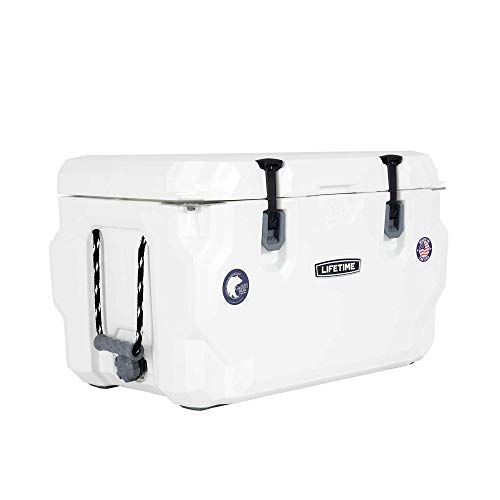
Lifetime 65-Quart High Performance Cooler pairs a 65-quart capacity with an IGBC certification and a maker-stated ability to withstand a bear for up to an hour when locked. Its polyethylene, urethane, and polypropylene construction has rope handles, two latches, serviceable feet, and a capped drain compatible with a garden hose. The maker states ice retention of up to 8 days. This configuration suits campers who want a roomy, certified hard cooler with a hose-compatible drain. Locks are not included, so buyers who need to secure the lock holes must supply compatible locks.
Bottom line: Choose this for a 65-quart cooler with IGBC certification and lock holes.
YETI Tundra 65

YETI Tundra 65 stands out for its thick-wall construction: the maker specifies up to 3 inches of PermaFrost insulation and says the cooler is certified bear-resistant. The 65-quart Tundra has rotomolded construction and heavy-duty rubber T-Rex lid latches, making it a fit for buyers prioritizing insulation and a rugged shell over a divided layout or wheels. The maker does not give an ice-retention duration, so avoid comparing it to models with a day count as though those figures were equivalent. Choose it for the insulation and latch design.
Bottom line: Choose this for thick insulation and a rotomolded 65-quart shell.
Lifetime 65-Quart Hard Cooler

Lifetime 65-Quart Hard Cooler offers a 65-quart IGBC-certified format and the maker states up to 8-day ice retention, like Lifetime 65-Quart High Performance Cooler. Its color is Light Sage, and the feature set includes rope handles with molded grips, two bottle openers, serviceable feet, a capped drain compatible with a garden hose, and holes for locks. The maker says it can withstand a bear for up to an hour when locked; locks are not included. This is a straightforward fit when the buyer wants those core capacity and storage features, but it does not offer the separate compartments or wheels described for Wyld Gear 65-Quart Dual Compartment Cooler.
Bottom line: Choose this for a 65-quart certified cooler with hose-compatible drainage.
Lifetime 90820 55-Quart Cooler

Lifetime 90820 55-Quart Cooler is the smaller-capacity choice at 55 quarts, with a maker-stated ability to withstand a bear for up to an hour and up to 7-day ice retention. Its drain is compatible with a garden hose, and the stainless steel bottle opener has padlock compatibility; two rubber latches are designed for one-handed opening. The reduced capacity suits trips with less food and drink to carry. Buyers needing a 65-quart interior should choose a larger model instead, since the extra volume is the main tradeoff here.
Bottom line: Choose this for a smaller 55-quart cooler with bear resistance.
Wyld Gear 65-Quart Dual Compartment Cooler

Wyld Gear 65-Quart Dual Compartment Cooler divides its 65-quart interior into 40- and 25-quart compartments and adds never-flat wheels with a folding tow-and-stow handle. The maker describes it as a bear-proof cooler and specifies more than 2 inches of rotomolded insulation; it also has a Dura-Latch system, two-stage drain, and embossed lid measuring lines. This design suits trips where separated storage and rolling transport are priorities. At 49 pounds, it is heavier than the 25.5-pound Lifetime 65-quart models, so it is less suitable when frequent lifting matters.
Bottom line: Choose this for wheeled transport and separately organized food and drinks.
How to Choose a Bear-Resistant Cooler
Start with capacity, then check the cooler’s certification and the way it will be secured. A practical packing rule for many hard coolers is roughly 2 parts ice to 1 part contents by volume; warm weather, frequent opening, and pre-chilled or room-temperature food can change how much ice a trip needs. For a weekend with several people, a 65-quart model offers more room than a 55-quart model, but capacity alone does not guarantee a particular ice life. Compare the maker’s retention claims only as claims, not as directly comparable test results. If the trip requires certified bear-resistant storage, confirm the specific model against the land manager’s current approved-container requirements before leaving.
Hard-sided coolers are not substitutes for food-storage rules. Keep food, scented items, and trash secured as required at the campsite, and do not leave a cooler unattended in a place where bears can access it.
Cooler Size and Trip Fit
For a single cooler, choose capacity based on the amount of food, drinks, and ice you must carry together. A 55-quart model holds 10 fewer quarts than a 65-quart model; that difference can matter when the cooler must also accommodate ice around the contents. A useful planning approach is to reserve about two-thirds of internal volume for ice and one-third for food and drinks when using a 2:1 ice-to-contents ratio. A dual-compartment design can help separate items, but partitions do not create additional capacity. Measure vehicle cargo space and available storage space before packing: exterior dimensions, not quart capacity, determine whether a hard cooler fits.
For long trips, plan for ice replenishment rather than relying on a day-count claim alone. Shade, a pre-chilled cooler, and keeping the lid closed help reduce heat gain.
Bear Resistance, Locks, and Camp Safety
Bear-resistant means resistant under defined conditions, not impossible for a bear to open. IGBC certification is a useful marker for buyers seeking a tested bear-resistant container, but the cooler still needs to be used and secured as required by the local land manager. Requirements can differ by park, campground, and backcountry area, so check the applicable rules before a trip. A cooler with lock holes is not secure without compatible locks; likewise, a latch alone should not be assumed to meet a site’s storage requirements.
Store food and scented toiletries in the designated bear-resistant location, and keep cooking and sleeping areas separate where local guidance requires it. Never leave food in an unlocked cooler or assume a cooler’s claim makes unattended storage safe.
Ice Retention and Cooler Use
Ice retention depends on more than insulation thickness: outside temperature, direct sun, how often the lid opens, starting temperature, and the amount of ice all affect melt rate. Pre-chill the cooler and its contents, use block ice where it fits, and fill empty space rather than carrying a mostly empty cooler. A 2:1 ice-to-contents starting ratio is a common planning point for hard coolers, not a guarantee of a fixed number of cold days. Drain water only when needed; cold meltwater can help keep contents chilled, while wet packaging may be a concern for food that should stay dry.
Keep raw meat sealed against leaks and separate from ready-to-eat food. Use a food thermometer for perishables, since ice retention claims do not establish that food has stayed at a safe temperature.
Cooler Features Compared
Choose a feature layout based on how you move and organize supplies: wheels help over firm ground, while separate compartments make it easier to keep categories apart. A hose-compatible drain is useful near a suitable drain location, but it does not replace safe disposal of meltwater. Use this comparison to match a design to the trip rather than treating any one feature as proof of overall performance.
| Trip need | Feature to prioritize | Why it matters |
|---|---|---|
| Certified storage | IGBC certification | Gives a defined certification marker to verify against local rules |
| Less lifting | Wheels and tow handle | Reduces carrying over firm, accessible ground |
| Separate food and drinks | Dual compartments | Keeps two groups of items in separate sections |
| Smaller load | 55-quart capacity | Provides less capacity than a 65-quart model |
Frequently Asked Questions
Are bear-resistant coolers completely bear-proof?
No cooler should be treated as completely bear-proof. Resistance depends on the model, how it is secured, and the conditions or rules where it is used; check the campsite’s approved-storage requirements before relying on one.
How much ice should I put in a hard cooler?
A common starting point is about 2 parts ice to 1 part contents by volume. Hot weather, frequent lid opening, and warm items can require more ice or replenishment.
Does IGBC certification mean every campground accepts a cooler?
No; local rules determine which containers are accepted. Verify the exact model with the park or land manager before a trip, since approved storage requirements can vary by site.
How can I keep ice from melting quickly?
Pre-chill the cooler and its contents, keep it shaded, and limit lid openings. A 2:1 ice-to-contents ratio is a useful starting point, but outside heat and access frequency change results.
Should food stay in meltwater inside a cooler?
Keep leak-prone raw meat sealed and separated from ready-to-eat food, and drain water if packaging could become wet. Use a food thermometer for perishables because ice presence alone does not confirm safe food temperature.