
4 Prong Twist Lock to 3 Prong Adapter Types Compared

For a 4-prong twist-lock generator outlet feeding an RV, ELEGRP L14-30 to TT-30 RV Adapter is the match because it converts an L14-30 connection to a 30A, 125V TT-30 connection. Choose another adapter when your equipment needs a different NEMA receptacle or 240V output; matching only the prong count is not enough.
We earn a commission if you buy through links on this page. As an Amazon Associate I earn from qualifying purchases. Products are compared on manufacturer specifications, not hands-on testing.
- Best overall: ELEGRP L14-30 to TT-30 RV Adapter – Converts an L14-30 generator connection to a 30A, 125V TT-30 RV connection.
- Best for L6-30 equipment: HUBRV L14-30 to L6-30 Adapter – Ends in an L6-30R receptacle for compatible 30A, 125/250V equipment.
- Best for 6-50 welders: LAVANDINO L14-30 to 6-50 Welder Adapter – Provides a 6-50R receptacle for a welder with that plug, from an L14-30 outlet.
| Product | Best for | NEMA ends | Rated voltage | Cord length | Shop |
|---|---|---|---|---|---|
| ELEGRP L14-30 to TT-30 RV Adapter | RV generator use | L14-30P to TT-30R | 125/250V to 125V | 12 in. | Check Price on Amazon |
| HUBRV L14-30 to L6-30 Adapter | L6-30 equipment | L14-30P to L6-30R | 125/250V | 12 in. | Check Price on Amazon |
| LAVANDINO L14-30 to 6-50 Welder Adapter | 6-50 welder plugs | L14-30P to 6-50R | 220V | 12 in. | Check Price on Amazon |
| Suplevel L14-30 to 6-50 Welder Adapter | Longer 6-50 reach | L14-30P to 6-50R | 125/250V | 18 in. | Check Price on Amazon |
4 Prong Twist Lock to 3 Prong Adapters
Match the source plug, destination receptacle, and equipment voltage before selecting an adapter.
ELEGRP L14-30 to TT-30 RV Adapter

For an RV with a TT-30 plug, this adapter changes an L14-30 generator receptacle connection to a 30A, 125V TT-30 connection. The cord uses 10-gauge stranded copper wire and an STW jacket described as resistant to abrasion, oil, and moisture. At 1 foot, it suits a short generator-to-RV hookup when the generator has the matching L14-30 receptacle. Its limitation is purpose: this TT-30 output is 125V, so it is not the right end for equipment requiring a 240V twist-lock connection.
Bottom line: Choose this for a TT-30 RV connection that needs 125V power from an L14-30 outlet.
HUBRV L14-30 to L6-30 Adapter

Unlike the RV-focused option, this adapter ends in a three-prong L6-30R twist-lock receptacle. It connects an L14-30P plug to compatible L6-30 equipment and uses 10 AWG copper wire in a 1-foot STW cord; the maker gives a 30A rating and up to 3,750W. Choose it only when the device plug and required voltage match the L6-30 output. The L6-30 end is not a TT-30 RV receptacle, and a 30A adapter does not make a higher-current device suitable for a 30A source.
Bottom line: Pick this for compatible equipment with an L6-30 plug and a 30A supply.
LAVANDINO L14-30 to 6-50 Welder Adapter
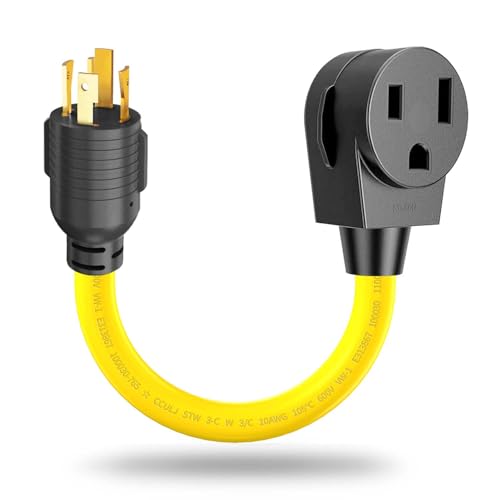
This adapter is the option for a welding machine with a 6-50 plug rather than an L6-30 plug. Its L14-30P male end connects to a generator outlet, and the 6-50R female end accepts the welder plug; the 1-foot cord contains 10 AWG, three-conductor copper wire and is rated for a maximum 30A load. The 6-50 receptacle’s 50A designation does not increase the 30A source capacity. Confirm the welder’s voltage and current requirements before using this adapter.
Bottom line: Choose this when the welder has a 6-50 plug and operates within the source limits.
Suplevel L14-30 to 6-50 Welder Adapter

For a 6-50 welder connection needing a little more reach, this cord measures 1.5 feet, compared with the 1-foot alternative. It has an L14-30P input and 6-50R output, with 10 AWG, three-conductor copper wire in an STW jacket. The maker specifies up to 30A, 125/250V, and 7,500W maximum. Although the receptacle is rated for 50A, the adapter supports up to 30A; it cannot supply a load that requires more than the source and cord ratings allow.
Bottom line: Select this for a compatible 6-50 load when its 18-inch length is useful.
How to choose a 4-prong to 3-prong adapter
Choose by the NEMA configuration and voltage, not by counting prongs alone. An L14-30 connection is a 30A, 125/250V locking configuration; a TT-30 is a 30A, 125V RV connection, while L6-30 and 6-50 receptacles serve different equipment patterns and voltage needs. The 6-50 receptacle rating does not make a 30A L14-30 source capable of delivering 50A. Match the exact male end to the generator outlet and the exact female end to the appliance plug, then check the appliance nameplate for voltage and current. If either plug pattern or voltage does not match, do not force a connection or assume an adapter changes the source voltage or capacity.
Use the adapter’s rated current as the limit: a 30A adapter should not be used for equipment drawing more than 30A.
What the NEMA ends mean
The NEMA letters and numbers identify the connector pattern and electrical configuration, so they are more useful than a generic “3-prong” label. L14-30 is a locking 30A pattern for 125/250V; TT-30 is a 30A, 125V RV pattern, and L6-30 is a 30A locking pattern for 250V equipment. A 6-50R is a different receptacle pattern commonly associated with 50A welding connections. Those distinctions explain why two adapters can both change four prongs to three yet serve incompatible loads.
The connector’s rating is not a promise that the generator can supply that much power in every setup. Confirm the generator output and appliance voltage, and keep total load within the lowest-rated part of the circuit.
Match the adapter to the equipment
For a TT-30 RV plug, select an L14-30-to-TT-30 cord only when the generator has the matching L14-30 outlet. Equipment with an L6-30 plug needs an L6-30R adapter; a welder with a 6-50 plug needs a 6-50R adapter instead. A matching shape is not enough if the appliance voltage differs, so read the device nameplate before connection.
This quick guide separates the common destinations by their receptacle pattern and use.
| Destination plug | Adapter output | Typical fit |
|---|---|---|
| TT-30 | TT-30R | 30A, 125V RV |
| L6-30 | L6-30R | Compatible 30A equipment |
| 6-50 | 6-50R | Compatible welder plug |
Do not use a 6-50 output’s higher receptacle rating to infer that a 30A generator circuit can power a 50A load.
Safe generator adapter use
Keep a generator adapter within the ratings of the generator outlet, adapter cord, and connected equipment; the lowest rating governs. Use the adapter only for a direct, compatible connection, and do not connect a generator to household wiring through an outlet, which can backfeed utility lines. A home connection requires properly installed transfer equipment designed for generator use. Outdoor generator operation also requires placement outside and away from doors, windows, and vents because exhaust contains carbon monoxide.
Before powering a load, inspect plugs and cord jackets for damage, keep connections dry, and avoid extending a cord beyond its intended current capacity. For an RV, confirm the inlet accepts TT-30 and that the RV’s connected load stays within the 30A, 125V feed.
Frequently Asked Questions
Can an L14-30 adapter power a 120V RV?
Yes, an L14-30-to-TT-30 adapter is intended for a compatible 30A, 125V RV connection. Confirm that the generator has an L14-30 receptacle and the RV inlet accepts TT-30.
Does a 6-50 adapter provide 50 amps?
No, a 6-50 receptacle does not raise the source capacity. These adapters are rated up to 30A, so the connected load must stay within the generator outlet and adapter limits.
Can a 3-prong adapter run 240V equipment?
Some can, but the receptacle pattern and voltage must match the equipment. An L6-30 connection is a 250V pattern, whereas TT-30 supplies 125V; check the device nameplate.
Can I connect a generator adapter to a home outlet?
Never use a cord to feed household wiring through an outlet, because that can backfeed utility lines. A generator connection to home circuits requires properly installed transfer equipment.
How do I know which generator plug I have?
Read the outlet’s NEMA marking or the generator manual, then match its pattern to the adapter’s male end. L14-30 is a locking 30A, 125/250V pattern; do not identify compatibility by prong count alone.