
Veise Door Locks Compared by Entry Type and Fit

The Veise keyed deadbolt Veise Keyed Deadbolt suits buyers who want a conventional key-and-thumb-button lock with a fit for 1-3/8- to 1-3/4-inch doors. Choose a smart model instead if you need fingerprint, app, PIN, or remote access; the lever lock and deadbolt-and-handle set also differ in hardware style.
We earn a commission if you buy through links on this page. As an Amazon Associate I earn from qualifying purchases. Products are compared on manufacturer specifications, not hands-on testing.
- Best overall: Veise Keyed Deadbolt – A straightforward keyed deadbolt with a door-thickness range and two adjustable backsets.
- Best for app access: Veise VE017 Fingerprint Deadbolt – The VE017 combines fingerprint and app entry with user-permission management.
- Best for Wi-Fi access: Veise VE029 Wi-Fi Lever Lock – The VE029 has built-in Wi-Fi and supports remote access without a hub.
- Best for a handle set: Veise VE017-D Deadbolt and Lever Set – The VE017-D pairs a fingerprint smart deadbolt with a lever handle.
| Product | Best for | Lock style | Entry methods | Shop |
|---|---|---|---|---|
| Veise Keyed Deadbolt | Keyed entry | Deadbolt | Key, inside thumb button | Check Price on Amazon |
| Veise VE017 Fingerprint Deadbolt | App-managed access | Smart deadbolt | Fingerprint, app, fob, PIN, key | Check Price on Amazon |
| Veise VE029 Wi-Fi Lever Lock | Remote Wi-Fi entry | Smart lever lock | Fingerprint, app, PIN, key, voice, card | Check Price on Amazon |
| Veise VE017-D Deadbolt and Lever Set | Bundled handle set | Smart deadbolt and lever | Fingerprint, app, fob, PIN, key | Check Price on Amazon |
Veise door locks by entry type
Compare the keyed deadbolt, smart deadbolts, and smart lever lock by the access methods and hardware each provides.
Veise Keyed Deadbolt

Unlike the smart models, this Veise lock uses a conventional key outside and a thumb button inside. It includes two keys and fits doors 1-3/8 to 1-3/4 inches thick, with an adjustable 2-3/8- or 2-3/4-inch backset. The maker says installation takes 10 minutes. This is the simplest match for someone who wants a keyed deadbolt rather than app or fingerprint access. Its limitation is the entry method: buyers who need remote permissions, PIN codes, or keyless entry should compare the smart models instead.
Bottom line: Choose this if you want a keyed deadbolt and your door matches its thickness and backset range.
Veise VE017 Fingerprint Deadbolt

The VE017 centers on app-based user control, unlike the conventional keyed deadbolt. Its features include fingerprint, app, authorized access, and fob entry; the product name also identifies a touchscreen keypad, USB-C port, and auto-lock function. The maker says the KK Home app can grant, change, pause, or remove user permissions and show entry activity. This model suits owners or rental operators who want to manage access remotely. It is a deadbolt rather than a lever-handle set, so buyers replacing both pieces of door hardware should consider the VE017-D.
Bottom line: Pick this if app-managed permissions and fingerprint entry matter more than a bundled handle.
Veise VE029 Wi-Fi Lever Lock
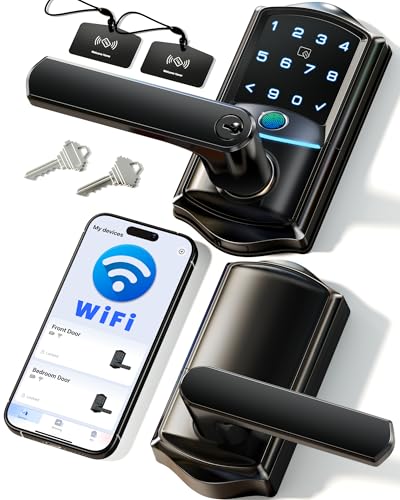
The VE029 is the only lever-style lock here and the only one with built-in Wi-Fi, so it is the fit for remote control without a separate hub. The maker lists fingerprint, app, IC card, PIN, backup key, voice control, user authorization, and code sharing among its access options. It also advertises real-time alerts, access logs, and IP65 protection. This model suits buyers who want a connected lever lock. Its limitation is the hardware format: choose a deadbolt model instead if your replacement needs a deadbolt rather than a lever lock.
Bottom line: Choose this if you want a Wi-Fi-connected lever lock and your door uses that hardware style.
Veise VE017-D Deadbolt and Lever Set

The VE017-D combines a smart deadbolt with a lever handle, unlike the standalone VE017 deadbolt and the VE029 lever lock. Its access options include fingerprint, app, authorized access, fob card, PIN, code sharing, and mechanical key; voice-assistant compatibility requires a G1 Gateway according to the maker. The maker also describes remote user-permission controls and entry logs. This set suits buyers replacing a deadbolt and lever together. Its limitation is the gateway requirement for voice-assistant use, which matters if that control method is essential.
Bottom line: Pick this if you need a smart deadbolt and lever handle as a set.
How to choose a Veise door lock
Start with the entry method and the hardware style your door needs. A keyed deadbolt uses a key and inside thumb button; smart options add methods such as fingerprint, keypad, app, card, or voice access, depending on the model. A lever lock is not interchangeable with a deadbolt simply because both secure a door: match the lock body and existing preparation in the door. For the keyed model, measure door thickness and backset before choosing; its fit range is explicit. For connected models, decide whether remote permissions or alerts matter enough to make app access useful. Choose the VE029 when built-in Wi-Fi is a priority; its product name specifies 2.4GHz Wi-Fi and no hub needed.
Measure door thickness and backset
Measure door thickness at the edge and backset from the edge of the door to the center of the knob or deadbolt bore. The keyed deadbolt fits 1-3/8- to 1-3/4-inch doors and adjusts between 2-3/8- and 2-3/4-inch backsets. Those measurements are separate: matching thickness does not guarantee the backset matches. Many residential doors use one of those two backsets, but measure the actual door rather than relying on a typical size. Before ordering any model, confirm its fit with your existing door preparation; the maker gives a fit range for the keyed lock, but not corresponding measurements for each smart lock. Check whether your door is drilled for a deadbolt, a lever, or both.
Compare keyed and smart lock types
Keyed locks rely on a physical key, while smart locks can offer multiple entry methods and remote controls. The ANSI/BHMA grading system uses Grade 1, Grade 2, and Grade 3, with Grade 1 the highest performance grade; the keyed Veise model is identified as ANSI Grade 3. A grade does not tell you whether a lock has app control or which door preparation it fits, so compare those separately. Smart features also differ: the VE017 emphasizes app permission management, the VE029 specifies built-in Wi-Fi, and the VE017-D pairs a deadbolt with a lever. Match the lock type to your door first, then narrow by access features.
| Need | Lock type to compare | Useful distinction |
|---|---|---|
| Physical key and inside thumb button | Keyed deadbolt | Known thickness and backset range |
| Fingerprint and app permissions | Smart deadbolt | Standalone deadbolt hardware |
| Wi-Fi remote access | Smart lever lock | Built-in 2.4GHz Wi-Fi |
| Deadbolt plus lever replacement | Smart lock set | Includes a lever handle |
Weather ratings and smart-lock access
IP ratings describe protection from dust and water, not resistance to forced entry. The VE029 identifies an IP65 rating and the VE017-D an IP55 rating; in the IP code, the first digit concerns solids and the second concerns water ingress. A higher digit in one position does not establish every kind of weather durability, so follow the model’s installation guidance for exposed doors. Smart lock access methods can also depend on add-ons: the VE017-D identifies a G1 Gateway as required for Alexa or Google voice-assistant compatibility. If voice control is a must-have, account for that gateway requirement before choosing; otherwise, compare the entry methods you will actually use.
Frequently Asked Questions
How do I measure a door lock backset?
Measure from the door edge to the center of the hole for the knob or deadbolt. Common residential backsets are 2-3/8 and 2-3/4 inches, and the keyed Veise deadbolt adjusts to either.
What door thickness does the Veise keyed deadbolt fit?
The keyed Veise deadbolt fits doors 1-3/8 to 1-3/4 inches thick. Measure the door itself before choosing, because matching backset alone does not confirm thickness fit.
What does ANSI Grade 3 mean for a deadbolt?
ANSI/BHMA Grade 3 is the lowest of the three common grades, with Grade 1 the highest. The Veise keyed deadbolt is identified as Grade 3; compare grade separately from entry method and fit.
Can a smart lock work without home Wi-Fi?
Some smart-lock functions may use local entry methods such as a key, fingerprint, or keypad, while remote app control requires a connection. The VE029 specifies built-in 2.4GHz Wi-Fi; confirm the connection requirements for the functions you intend to use.
What does an IP65 rating mean on a door lock?
IP65 indicates dust-tight protection and protection against water jets under the rating test. It does not by itself establish a lock’s resistance to forced entry or guarantee suitability for every exposed installation.