
Kitchen Chopping Board Holder: 3 Racks Compared

For a countertop kitchen chopping board holder, SUNFICON 4-Slot Steel Rack stands out for its four 1.18-inch-wide slots, while Luxylei Wood-Base Two-Slot Rack and Walnut-Base 3-Slot Rack offer different base materials and rack capacities. Choose a different style if you want a bamboo board set with a storage stand rather than a separate rack.
A chopping board holder stores boards upright; the right choice depends on how many items you want to separate and the space available.
We earn a commission if you buy through links on this page. As an Amazon Associate I earn from qualifying purchases. Products are compared on manufacturer specifications, not hands-on testing.
- Best overall: SUNFICON 4-Slot Steel Rack – Four 1.18-inch-wide slots provide the most clearly specified storage positions.
- Best for wood-and-metal design: Luxylei Wood-Base Two-Slot Rack – The rack combines a wood base with metal supports and has two storage slots.
- Best for three slots: Walnut-Base 3-Slot Rack – Its three-slot design separates boards, lids, and trays in a walnut-base rack.
| Product | Best for | Slots | Material | Dimensions | Shop |
|---|---|---|---|---|---|
| SUNFICON 4-Slot Steel Rack | Multiple boards | 4; 1.18 in. wide each | Steel | 4.92 x 5.7 x 8.47 in. | Check Price on Amazon |
| Luxylei Wood-Base Two-Slot Rack | Wood base | 2 | Wood and metal | 6.5 x 3.9 x 6.2 in. | Check Price on Amazon |
| Walnut-Base 3-Slot Rack | Three separated slots | 3 | Walnut wood and metal | 6 x 3.5 x 5 in. | Check Price on Amazon |
Kitchen Chopping Board Holders
Compare the racks by slot count, materials, and footprint before choosing where to store them.
SUNFICON 4-Slot Steel Rack
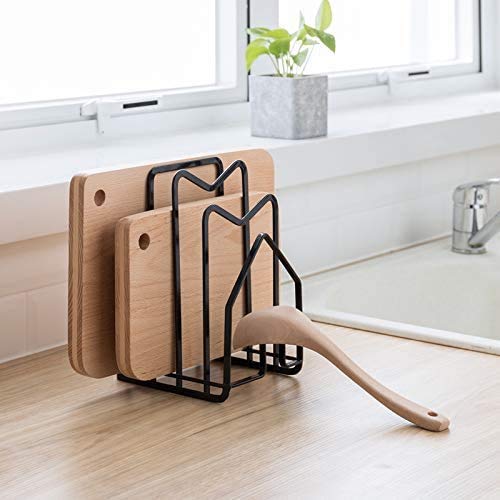
SUNFICON 4-Slot Steel Rack has four slots, each 1.18 inches wide, making it the clearest fit for separating several boards or lids. The steel rack measures 4.92 by 5.7 by 8.47 inches and has a house-shaped design with a V-shaped groove at the top for a pot lid. Its compact footprint suits a counter or cabinet shelf where vertical storage is useful. The narrow slots may not suit unusually thick boards or cookware, so check the fit of your thickest item before choosing this rack.
Bottom line: Choose it if you want four narrow slots in a compact steel rack.
Luxylei Wood-Base Two-Slot Rack

Luxylei Wood-Base Two-Slot Rack pairs a wood base with metal supports, unlike the all-steel style of SUNFICON 4-Slot Steel Rack or the walnut-base design of Walnut-Base 3-Slot Rack. Its two storage slots are intended for cutting boards, lids, pans, trays, plates, and kitchen utensils. The size is about 6.5 by 3.9 by 6.2 inches, converted from the 16.6 by 10 by 15.8 centimeters. Two slots make this a simpler arrangement for a small group of items, but it offers fewer separated spaces than the three- and four-slot options.
Bottom line: Choose it if a wood-and-metal rack with two slots suits your storage needs.
Walnut-Base 3-Slot Rack

Walnut-Base 3-Slot Rack offers three slots on a walnut-base, giving it a middle capacity between the two-slot and four-slot racks. Its 6-by-3.5-inch footprint and 5-inch height make it a low-profile option for a shelf or counter with limited vertical room. The design is intended to hold boards, pot lids, baking sheets, pans, and plates upright. This rack has fewer slots than SUNFICON 4-Slot Steel Rack, so it is a better match when three separated spaces are enough rather than when each item needs its own position.
Bottom line: Choose it if you want three slots and a walnut-base in a low-profile rack.
How to choose a chopping board holder
Choose a rack by matching the number of separated slots to the items you plan to store and the room available. A rack with four slots can separate more pieces than one with two, but slot width matters as much as slot count: a 1.18-inch opening may not fit every thick board or pan. Measure the widest and thickest items you intend to store, then compare those measurements with the rack’s openings and footprint. For a counter with little depth, prioritize the base dimensions; for a low shelf, check the rack height. Upright storage keeps boards from lying in a stack, but leave space around damp boards so they can dry.
Countertop and cabinet fit
Measure the intended surface before choosing a chopping board holder, including clearance above a shelf and room to lift items out. A difference of even an inch can matter when a rack sits beside a wall or appliance. Compare footprint in the same units and remember that a rack’s length and width describe its base, not necessarily the space needed to remove a large board. Leave a little extra clearance around the rack for handling. For a cabinet, confirm shelf height and depth; for a counter, check that the rack does not obstruct nearby prep space or a frequently used work area.
Keeping boards organized and dry
Store clean boards upright only after removing excess water, and allow air to circulate between items. Trapped moisture can leave wood boards damp for longer, so avoid packing a rack tightly or placing a wet board against another surface. Wooden boards generally need hand washing and prompt drying; prolonged soaking and dishwasher heat can contribute to warping or cracking. Rack materials also need simple care: wipe surfaces dry when spills occur and follow the relevant care guidance for the board itself. A holder organizes storage, but it does not clean or sanitize a board.
Common holder sizing mistakes
The most common fit mistake is measuring only a board’s length and width while ignoring thickness. A wide slot count does not guarantee a fit if each opening is too narrow for a thick board, lid handle, or pan rim. Measure the thickest item and the widest handle or edge that must pass into the rack. Another mistake is choosing by overall rack size alone: a short rack may not support tall boards as steadily as a taller design. Keep heavy cookware from overloading a holder unless it is designed for that use, and place the rack on a stable, level surface to reduce tipping risk.
Frequently Asked Questions
How many chopping boards fit in a holder?
The number of separated items depends on the holder’s slot count: these racks provide two, three, or four slots. A slot can sometimes hold more than one thin item, but measure thickness and avoid forcing items into an opening.
Should chopping boards be stored upright?
Upright storage helps keep boards from stacking against each other and can leave room for airflow. Dry a board after washing and leave space around it rather than storing it wet in a crowded rack.
How do I measure a board holder for a cabinet?
Measure cabinet shelf depth, width, and vertical clearance, then compare all three with the rack’s footprint and height. Leave clearance above the rack so boards can be lifted out without scraping the shelf above.
Can a chopping board rack hold pot lids?
Some racks are intended to hold lids as well as boards, but lid handles and rims affect fit. Measure the lid’s thickness and handle clearance against the rack openings before storing it there.
How should I clean a wooden chopping board?
Wash wooden boards by hand and dry them promptly; avoid prolonged soaking and dishwasher heat, which can contribute to warping or cracking. Keep boards dry between uses, since a holder does not sanitize them.