
Best AC Stop Leak: 3 Options by System Fit

Leak Saver Ultimate 3-in-1 suits most buyers who want a multi-function HVAC treatment, combining sealant, moisture remover and UV dye for systems up to 5 tons. Choose Leak Saver Direct Inject 3-Pack for sealant without the added functions, or Red Angel Automotive A/C Stop Leak for automotive AC; the formulas are not interchangeable by purpose.
We earn a commission if you buy through links on this page. As an Amazon Associate I earn from qualifying purchases. Products are compared on manufacturer specifications, not hands-on testing.
- Best overall: Leak Saver Ultimate 3-in-1 – Combines sealant, moisture remover and UV dye in a system treatment for HVAC systems up to 5 tons.
- Best for HVAC multipacks: Leak Saver Direct Inject 3-Pack – Includes three injectors and is sized for standard systems up to 5 tons.
- Best for automotive AC: Red Angel Automotive A/C Stop Leak – Made for R-12 or R-134a automotive systems and comes in a 2-ounce package.
| Product | Best for | System fit | Treatment | Package size | Shop |
|---|---|---|---|---|---|
| Leak Saver Ultimate 3-in-1 | Multi-function HVAC | HVAC up to 5 tons | Sealant, moisture remover, UV dye | 1 pack | Check Price on Amazon |
| Leak Saver Direct Inject 3-Pack | HVAC multipack | HVAC up to 5 tons | Sealant | 3 pack | Check Price on Amazon |
| Red Angel Automotive A/C Stop Leak | Automotive AC | Automotive R-12 or R-134a | Sealant and conditioner | 2 ounces | Check Price on Amazon |
AC Stop Leak Options by System Fit
Match the formula to the equipment first, then compare whether you want sealant alone or added treatment functions.
Leak Saver Ultimate 3-in-1
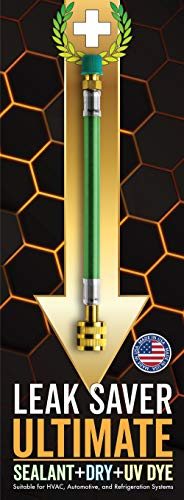
For buyers who want more than a sealant, Leak Saver Ultimate 3-in-1 combines sealant, moisture remover and UV dye in one treatment for systems up to 5 tons. The maker says the sealant can permanently seal refrigerant leaks when the complete charge has not been lost within 7 days; its UV dye is intended to help locate larger leaks. That makes this the most versatile HVAC option here. It is not the automotive-specific choice, and the product’s broad system compatibility should not replace checking refrigerant and equipment compatibility before use.
Bottom line: Choose this if you want sealant plus moisture treatment and UV dye for an HVAC system up to 5 tons.
Leak Saver Direct Inject 3-Pack

Leak Saver Direct Inject 3-Pack is the only three-pack here, aimed at standard HVAC systems up to 5 tons. The maker says it is compatible with systems and refrigerants except ammonia, and that its sealant can permanently close small refrigerant leaks when the complete charge has not been lost within 7 days. It is a straightforward pick if you do not need UV dye or moisture remover. The multipack is more than a single treatment, so buyers needing only one application may prefer a one-pack product.
Bottom line: Pick this for a standard HVAC system when a three-pack of sealant is the priority.
Red Angel Automotive A/C Stop Leak

Red Angel Automotive A/C Stop Leak is the automotive-specific formula, with a 2-ounce package for R-12 or R-134a systems. The maker says it uses no solid or particulate matter, is safe for recovery units, and forms a permanent chemical weld; those claims distinguish it from the two HVAC-focused options. It is suited to vehicle AC components including condensers, evaporators, hoses, gaskets and O-rings. Its refrigerant compatibility is limited to R-12 and R-134a, so do not assume it suits a vehicle using another refrigerant.
Bottom line: Choose this for automotive AC only when the system uses R-12 or R-134a.
How to Choose AC Stop Leak
Choose by equipment type and leak condition before comparing extra functions. Leak Saver Ultimate 3-in-1 and Leak Saver Direct Inject 3-Pack target HVAC systems up to 5 tons, while Red Angel Automotive A/C Stop Leak is for automotive R-12 or R-134a systems. A sealant cannot repair a system that has already lost its full refrigerant charge under the claims given for the HVAC formulas. UV dye can help identify larger leaks, but it does not make a sealant appropriate for every system. Use this decision rule: for a car, match the refrigerant to the formula; for residential or commercial HVAC under 5 tons, consider the two Leak Saver options. Have a qualified technician handle refrigerant service when system type or compatibility is uncertain.
| Need | Choose |
|---|---|
| HVAC sealant with extra treatment functions | Leak Saver Ultimate 3-in-1 |
| HVAC sealant in a three-pack | Leak Saver Direct Inject 3-Pack |
| Automotive R-12 or R-134a sealant | Red Angel Automotive A/C Stop Leak |
HVAC and Automotive Formulas Are Different
HVAC stop leak products and automotive formulas should be matched to their system applications, not treated as interchangeable. The two HVAC products here are sized for systems up to 5 tons, a capacity measure for cooling equipment; the Red Angel formula specifies automotive AC and R-12 or R-134a. Refrigerants operate in pressurized circuits, and opening a line can release refrigerant. In the United States, intentional venting of regulated refrigerants is prohibited, so avoid releasing refrigerant into the air. If the equipment label, refrigerant, or system type does not match the product’s fit, stop and confirm compatibility before use.
What a Stop Leak Formula Can and Cannot Do
Stop leak products are intended to address leaks, not replace diagnosis of every cooling problem. A leak may occur at a hose, connection, gasket, O-ring, condenser or evaporator; the automotive product names these kinds of components, while the HVAC products describe refrigerant leak sealing more generally. A weak cooling system can also have causes other than a leak, so adding sealant without confirming the fault can waste a treatment. For a system with no remaining charge, do not rely on the HVAC products’ sealing claim: their maker sets a condition that the complete charge has not been lost within 7 days. Seek leak diagnosis instead.
Safe Handling and Compatibility Checks
Refrigerant circuits are pressurized, so do not disconnect hoses or open fittings as a shortcut to applying a treatment. Avoid intentional refrigerant release, and use a qualified HVAC or automotive technician if you are not equipped to identify the refrigerant and service connection. Before choosing, verify that the formula matches the equipment type and refrigerant; the automotive option specifically names R-12 and R-134a, and the HVAC multipack excludes ammonia. Stop leak claims do not establish that every manufacturer permits sealant in its equipment. Check the equipment maker’s requirements before treatment, especially for equipment under warranty or systems that may later need recovery service.
Frequently Asked Questions
Can automotive AC stop leak go in a home HVAC system?
No; choose a formula for the equipment type. The automotive option here is made for R-12 or R-134a vehicle systems, while the two Leak Saver products target HVAC systems up to 5 tons.
Will AC stop leak work after all refrigerant is gone?
The Leak Saver products’ claim applies when the complete refrigerant charge has not been lost within 7 days. If the system has lost its full charge, arrange leak diagnosis rather than relying on that claim.
What does UV dye do in AC stop leak?
UV dye helps reveal larger leaks during inspection under suitable lighting. The 3-in-1 HVAC option combines dye with sealant and moisture remover, but dye does not itself repair a leak.
Can I release refrigerant before adding stop leak?
No; do not intentionally vent refrigerant into the air. Refrigerant circuits are pressurized, so have a qualified technician handle service if the correct connection or procedure is unclear.
Does AC stop leak fix a compressor problem?
A stop leak formula is intended for leaks, not every cause of poor cooling. If the system is not cooling and no leak has been identified, diagnose the fault before adding a leak treatment.